Atlassino Academy · Blackjack · Lesson 15 of 21
Spanish 21: a shorter deck and its own chart
A shoe of 48-card decks, a set of moves and payments the plain game has not got, and a chart that disagrees with the one in your pocket.
The sign says Spanish 21. The game looks like blackjack and the chart in your pocket is for blackjack. How much of it still applies?
The short answer
Less than it looks. Every deck in the shoe is four cards short, the table hands you moves and payments the plain game has not got, and the chart worked out for this game names a different move from the plain chart in 34 of its 330 cells. In 52 more the move is the same until your hand grows a fourth card. None of it makes the game free of cost: what the house keeps still turns on one line posted at the table.
The deck: four cards out of every 52
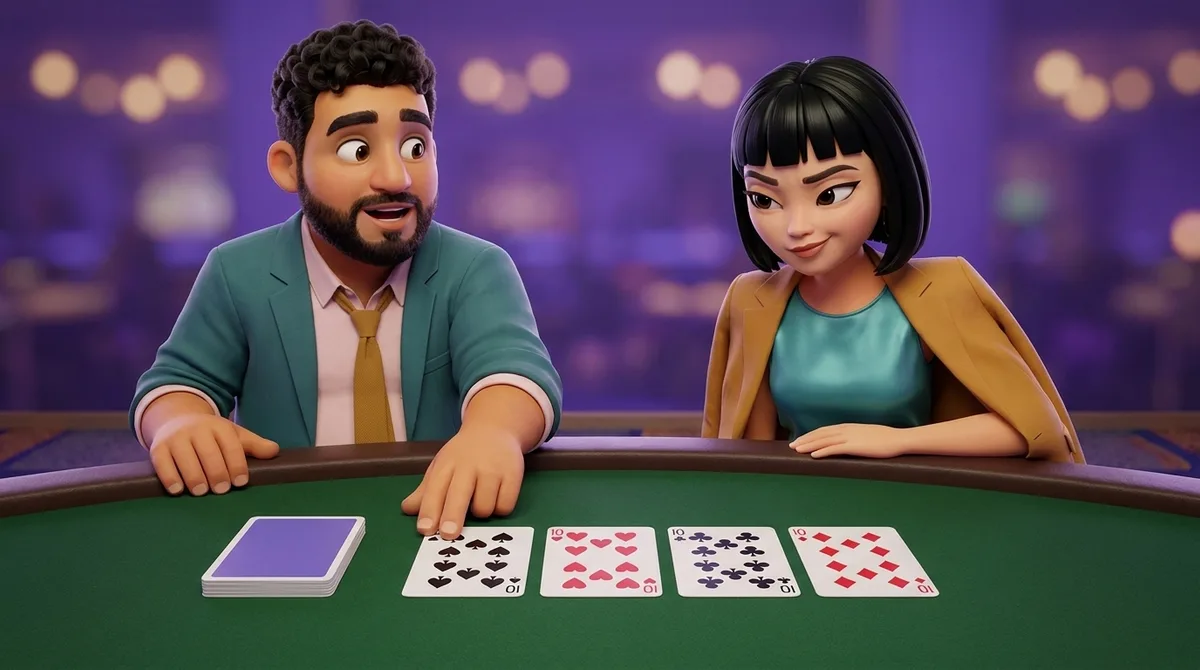
Spanish 21 is dealt from six or eight Spanish decks, and a Spanish deck holds 48 cards rather than 52. The four cards missing from each deck are the four tens — the jacks, queens and kings all stay, and they are all still worth ten points each. Everything about the shape of the game is the shape you already know: your total against the dealer’s without going over 21, the dealer acting last by a rule printed at the table, and a bet lost on a hand that goes over.
- A
- 2
- 3
- 4
- 5
- 6
- 7
- 8
- 9
- 10 taken out
- J
- Q
- K
One suit of a Spanish deck: the 10 is taken out, the jack, queen and king stay. Every card that would have finished your 20 or broken the dealer’s hand is now a shade less likely to arrive.
A game dealt this way and changed in no other respect would cost more than the plain game, and nobody would sit at it. What makes people sit at it is the other half of the exchange, and that half is written into the published rules of the game rather than posted at the table.
What the table hands back
These terms are printed in the published rules of the game, not chosen by the table, so they travel with the name over it.
| The term | What it means when you are sitting there |
|---|---|
| A player 21 is settled in your favour | A total of 21 in your hand is settled your way whatever the dealer is holding, and a blackjack of yours against a blackjack of the dealer’s goes the same way. At a plain table both of those are a push, and a blackjack there is paid three to two. |
| A second bet on any number of cards | The plain game lets a second bet go up on your first two cards. This one lets it go up on a hand of any size, which is why the chart for it has to say how many cards you are holding. |
| A way out after that bet | Having put the second bet up, you may still give the hand up: the doubled portion comes back and the original bet is lost. The rules give the move a name of its own. |
| Surrender before you act | Printed in the rules of the game, in the same terms as at the tables that offer it: the hand is given up before you act, for half the bet. |
| Splitting, and playing on afterwards | A second bet may go up after a split, a pair of aces may be split again, and split aces may usually be played on rather than taking one card each and stopping. |
- Hit and standAs at any table.
- A second bet on the handOn any number of cards, not only the first two.
- The way out after itGive the hand up afterwards; the second bet comes back, the first is lost.
- Split, and split aces againAnd carry on playing the split aces rather than taking one card each.
- SurrenderPrinted in the rules of this game.
Five things to do where the plain table offers four, and one of the five — the way out after the second bet — exists only because this game lets that bet go up so freely. A move you have never used is a move you will not think of at the table, which is what the practice table further down is for.
What a long 21 is paid
The other half of the exchange is a scale of payments for hands the plain game adds nothing for. Two scales, in fact, and both carry the same condition at the end.
| The hand | What the published rules say |
|---|---|
| A 21 that took five cards or more | Paid on a scale that starts at five cards and rises at six and again at seven or more — and not paid at all once a second bet has gone up on the hand. |
| A 6-7-8, or three 7s | A scale of its own with three steps — mixed suits, one suit, and spades — under the same condition about a second bet. |
| Either of them after a split | Usually not paid. The wording puts it as what most tables do rather than as a rule every table follows, which makes it a line to read at the table in front of you. |
The extra payment or the extra bet, not both on the same hand: that is why this game’s chart does not put a second bet up everywhere the plain chart does.

Mayaformer floor supervisor · manners, money and breaks
The scales are the part people remember from this game, and they are also the part that does the least work. A payment that arrives on a hand you were going to finish anyway is welcome; it is not a reason to take a card you would otherwise have stood on. The chart below already counts every one of these payments — that is what makes it the chart for this table and not the other one.
Its own chart, and where it differs
The chart worked out for this game, at a table where the dealer hits a soft 17, is on the card below: hard totals, soft hands and pairs. Read a cell as you read the plain chart — your hand down the side, the dealer’s card across. A number beside a letter counts your cards, because the second bet may go up on any number of cards. The marks *, † and ‡ flag hands where a 6-7-8 payment is still possible from your two cards.
Set beside the plain chart, the disagreement is not a cell or two. In 34 cells of 330 the two charts name different moves outright: a hand the plain chart stands on is taken a card on here, a pair the plain chart splits is not split here. In 52 more the move is the same for the first two or three cards and changes once the hand is longer — something the plain chart never has to say, because there the second bet can only go up on two.
- Different move outright34 cells where the chart you learned names a move this game’s chart does not.
- Same move, until the hand grows52 cells where the answer holds for two or three cards and changes after that.
- Cells in the chart330 in all, across hard totals, soft hands and pairs.
Playing by the full chart makes the cost of the play smaller than playing by feel, and that is as true here as at the plain table. What it does not do is make the game free of cost, or turn a hand that was always going to be lost into one that was not. Carrying the plain chart to this table is the one thing worse than carrying none at all: it will answer confidently, and in a good many cells it will answer for a different game.
What the hour costs, and which line decides
Everything above — the four cards taken out, the moves handed back, the scales of payments — comes to a single figure: the share of every bet the house keeps on average from a player who never departs from the chart. Here it is beside the plain game, and beside itself.
The longer the bar, the dearer the hour. The two Spanish 21 bars are the same game played by its own full chart; what separates them is what the dealer must do on a soft 17.
So the honest sentence about this game is a sentence about which table you are standing at. The small figure people repeat for Spanish 21 is printed under the line for a dealer who stands on a soft 17, and the list that line comes from carries a second line, for a table where the dealer hits a soft 17, on which the house keeps the larger share. The rules of the game leave that choice to the table, and the table posts it along with its bets and its payouts, in one wording or the other.
- What the name over the table tells youThe deck it is dealt from, and with it the moves and the scales of payments: those are in the published rules of the game.
- What the name does not tell youWhat the dealer must do on a soft 17, and the smallest and largest bet the table takes. Those are posted at the table, and the first of the two decides which of the two figures above is yours.
8 of the casinos in our register name this game among the games they deal, so it is a table you can walk up to rather than a curiosity. Read the dealer rule on the one in front of you before deciding it is the cheaper table in the room.

Mayaformer floor supervisor · manners, money and breaks
Decide how much money the evening gets and how long it runs before you sit down, and stop when either one is used up. A run of losing hands is not a debt the table owes you: putting more money down to get it back only makes the hour dearer. An unfamiliar name over the table is a reason to read, not a reason to raise the bet. If the money on the table starts to feel like money you need, call one of the lines below — that is what they are for.
If it stops being fun
If gambling stops being entertainment, help is available. 19+ in most of Canada; 18+ in Alberta, Manitoba and Quebec. More on responsible gaming.
The chart on one card
That is the lesson. The chart for this game is on one card: print it, or keep it on your phone.
| Hard | 2 | 3 | 4 | 5 | 6 | 7 | 8 | 9 | 10 | A |
|---|---|---|---|---|---|---|---|---|---|---|
| 5–8 | H | H | H | H | H | H | H | H | H | H |
| 9 | H | H | H | H | D | H | H | H | H | H |
| 10 | D5 | D5 | D | D | D | D4 | D3 | H | H | H |
| 11 | D4 | D5 | D5 | D5 | D5 | D4 | D4 | D4 | D3 | D3 |
| 12 | H | H | H | H | H | H | H | H | H | H |
| 13 | H | H | H | H | S4*, hit if the two cards are 6-7, 6-8 or 7-8 (a 6-7-8 bonus is still possible) | H | H | H | H | H |
| 14 | H | H | S4*, hit if the two cards are 6-7, 6-8 or 7-8 (a 6-7-8 bonus is still possible) | S5†, hit if those two cards are of one suit | S6‡, hit if those two cards are both spades | H | H | H | H | H |
| 15 | S4*, hit if the two cards are 6-7, 6-8 or 7-8 (a 6-7-8 bonus is still possible) | S5†, hit if those two cards are of one suit | S6 | S6 | S | H | H | H | H | H |
| 16 | S6 | S6 | S6 | S | S | H | H | H | H | Rh |
| 17 | S | S | S | S | S | S | S6 | S6 | S6 | Rh |
| 18+ | S | S | S | S | S | S | S | S | S | S |
| Soft | 2 | 3 | 4 | 5 | 6 | 7 | 8 | 9 | 10 | A |
|---|---|---|---|---|---|---|---|---|---|---|
| A,2 | H | H | H | H | H | H | H | H | H | H |
| A,3 | H | H | H | H | H | H | H | H | H | H |
| A,4 | H | H | H | H | D4 | H | H | H | H | H |
| A,5 | H | H | H | D3 | D4 | H | H | H | H | H |
| A,6 | H | H | D3 | D4 | D5 | H | H | H | H | H |
| A,7 | S4 | S4 | D4 | D5 | D6 | S6 | S4 | H | H | H |
| A,8 | S | S | S | S | S | S | S | S | S6 | S6 |
| A,9 | S | S | S | S | S | S | S | S | S | S |
| Pair | 2 | 3 | 4 | 5 | 6 | 7 | 8 | 9 | 10 | A |
|---|---|---|---|---|---|---|---|---|---|---|
| 2,2 | P | P | P | P | P | P | H | H | H | H |
| 3,3 | P | P | P | P | P | P | P | H | H | H |
| 4,4 | H | H | H | H | H | H | H | H | H | H |
| 5,5 | D | D | D | D | D | D | D | H | H | H |
| 6,6 | H | H | P | P | P | H | H | H | H | H |
| 7,7 | P | P | P | P | P | P | H | H | H | H |
| 8,8 | P | P | P | P | P | P | P | P | P | Rh |
| 9,9 | S | P | P | P | P | S | P | P | S | S |
| 10,10 | S | S | S | S | S | S | S | S | S | S |
| A,A | P | P | P | P | P | P | P | P | P | P |
- H hit
- S stand
- D double
- P split
- Rh surrender, otherwise hit
- D3 double with up to 2 cards; with 3 or more, hit
- D4 double with up to 3 cards; with 4 or more, hit
- D5 double with up to 4 cards; with 5 or more, hit
- S4 stand; hit with 4 or more cards
- S5 stand; hit with 5 or more cards
- S6 stand; hit with 6 or more cards
- D6 double with up to 5 cards; with 6 or more, hit
- * hit with 6-7, 6-8 or 7-8
- † the same, one suit only
- ‡ the same, spades only
19+ (18+ in AB, MB, QC) · Set a limit before you sit · Play responsibly · help, day or night: Gambling Support BC 1-888-795-6111, 24 hours
Practice table
Every hand below is a cell where the chart for this game and the chart for the plain game disagree, and both answers come from the engine that works the charts out rather than from anybody’s memory. Level 1 is the cells where the move itself changes; level 2 is the cells where the move holds until your hand grows; level 3 is what the table pays extra, and when it does not. The lesson is one run: every square on the strip below is one hand of the lesson, and all the squares are there from the start. Only your first answer on each hand counts, and when a level’s squares are full the next level begins by itself. Nothing is bet here.
Lesson done
Review my mistakes (0)
Progress stays in this browser; nothing is sent anywhere.
The practice table needs JavaScript. Here is one hand from it, with the answer.
Spanish 21 · six 48-card decks · dealer hits a soft 17
You hold a hard 9 against a 3. What does the chart worked out for this game say?
The answer: Take a card.
Both charts are worked out by the same engine: one under the rules of the plain six-deck game, one under the published rules of this one, dealt from 48-card decks. Here they disagree — the plain chart says “double, otherwise hit”, this game’s chart says “hit”. The three tables further up the page are the second of those two charts in full.
Every hand in the practice table is a cell where the two charts disagree, and both answers come from the engine that works the charts out — neither is typed in by hand.
Check yourself

Mayaformer floor supervisor · manners, money and breaks
Five quick ones. Pick an answer, then check it. No timer, no points: just whether it stuck.
Where to play, and further reading
19+ (18+ in AB, MB, QC) · Play responsibly · help, day or night: Gambling Support BC 1-888-795-6111, 24 hours
Further reading
- Rules of Play for Table Games: Blackjack · British Columbia Lottery Corporation (BCLC)The rules this track follows section by section: six decks, the dealer on soft 17, doubling, splitting and surrender.
- Game rules: Blackjack · Loto-Québec (Société des casinos du Québec)Québec’s rules: one to eight decks, a face-down dealer card, and the soft-17 rule left to the sign at the table.
- Playing Blackjack · Fallsview Casino Resort and Casino NiagaraOne Ontario operator’s own booklet, including both blackjack payouts and both dealer rules it may post.
- Blackjack: how to play · OLG PlaySmartOntario’s beginner page: the moves, the hand signals it describes, and what insurance is.
- Know the game: Blackjack · Casinos Regina & Moose Jaw (SaskGaming)A Saskatchewan operator on what the chart does and does not do, and where to pick one up in the building.
- Blackjack basics · Wizard of OddsWhat three common ways of playing blackjack without the chart cost, on that author’s own table.
How it’s worked out
Rules, numbers and hosts
Where this happens. Every table on this page is a real table in a room you can walk into, and every rule quoted from it comes from a rule book its publisher makes public. A blackjack game on a screen at home is asked for different things by a different book of rules, and it belongs to a track of its own.
Numbers. The three figures in the bars are shares of a bet, worked out when the page is built by the same engine as our blackjack strategy tool. The plain figure is for the table rules this page is set to, played by the full chart — hard totals, soft hands and pairs together. The two figures for this game are for six decks under its own published rules, once with the dealer hitting a soft 17 and once with the dealer standing on it; they are not this page’s rule set with a different deck dropped into it. All three assume the cards are shuffled after every hand and a player who never departs from the chart. The publisher whose wording this page quotes prints a figure of its own for each of the two dealer rules, and each of that pair sits within a few hundredths of a percentage point of the figure worked out here for the same table, because the published pair is quoted under a rule set that is not exactly the one this engine is given: treat the second decimal of either as approximate.
The count of cells. The two charts are compared cell by cell when the page is built. A cell counts as a different move when the two charts name different actions; it counts in the second, smaller group when the action is the same and only the number of cards you may hold has changed. The two are kept apart on purpose: the first group is where the plain chart is wrong, the second is where it is incomplete, and adding them together would overstate the first and hide the second.
The practice table. Its hands are taken from those same two groups, and the answer under each hand is the cell of this game’s chart. Nothing in it is typed in by hand, so a change to the engine moves the practice table with it. The cards shown are drawn from a Spanish deck: no hand on this page holds a card of the rank printed 10, because that rank is not in the shoe.
What is deliberately absent. There is no figure here for how long money lasts at this table. Other games carry names this page does not use at all — Double Deck Blackjack, Blackjack Switch, Double Down Madness and the rest: the wording that would say what each of them changes is not in the set of documents this page may quote from, and a name with no rule behind it is worth less than silence. Free Bet Blackjack, the side bets that sit beside the main wager, and what each single table rule costs on its own each have a lesson of their own further along the track.
Hosts. Leo and Maya are illustrated characters. Their backstories, a former dealer and a former floor supervisor, are written for the course: neither is a real person, and neither speaks for any casino. The rules and numbers on this page come from the sources it cites, not from their experience.
No promise. This game is played against the house, like every other game named in this course. Nothing on this page makes it free of cost, nothing on it says how an evening will end, and the cheaper of the two tables described here still keeps a share of every bet.
What a Spanish deck is
Spanish 21 uses six or eight Spanish decks, each deck consisting of 48 cards
Wizard of Odds · Spanish 21 · read
Which four cards are left out
the regular 52 cards less the four tens.
Wizard of Odds · Spanish 21 · read
What the game is for
In our words: The aim is to finish with a higher total than the dealer while staying at 21 or under.
Section 1.0 Basic Blackjack, 1.1 to 1.3.1
BCLC · Rules of Play for Table Games — Blackjack · read
To win, the player must beat the house's hand without going over 21.
Section The object of the game
How a player 21 is settled
What a blackjack is paid
In our words: Apart from a blackjack, every paid hand gets even money, 1 to 1.
In our words: A blackjack pays 3 to 2.
In our words: Equal totals are a tie, called a push: the bet stays where it is.
Section 1.0 Basic Blackjack, 7.1 to 7.3
BCLC · Rules of Play for Table Games — Blackjack · read
If the player gets a blackjack, the bet is paid 3 to 2, except when the house's hand is also a blackjack.
Section The payouts, General rules
Doubling on any number of cards
Player may double on any number of cards.
Wizard of Odds · Spanish 21 · read
What double down rescue is
Player may surrender after doubling, known as "double down rescue." The player forfeits an amount equal to his original bet.
Wizard of Odds · Spanish 21 · read
What surrender is and what it costs
In our words: after your first two cards and before you act, you may surrender.
In our words: When you surrender, the house keeps half your bet and returns the rest.
Section 1.0 Basic Blackjack, 4.5 to 4.5.2
BCLC · Rules of Play for Table Games — Blackjack · read
Playing on after splitting aces
Player may usually hit and double down after splitting aces.
Wizard of Odds · Spanish 21 · read
What a long 21 pays
A five-card 21 pays 3 to 2, a six-card 21 pays 2 to 1, a seven or more card 21 pays 3 to 1. Bonus not honored after doubling.
Wizard of Odds · Spanish 21 · read
What 6-7-8 and 7-7-7 pay
A 6-7-8 or 7-7-7 of mixed suits pays 3 to 2, of the same suit pays 2 to 1, and of spades pays 3 to 1. These bonuses do not pay after doubling.
Wizard of Odds · Spanish 21 · read
The extra payments after a split
However, most casinos do not pay the bonuses after a split.
Wizard of Odds · Spanish 21 · read
What the chart does
By following basic strategy you can reduce the house advantage and your cost of play.
What the chart does not do
Blackjack has an element of skill, but making the statistically correct play does not ensure a winning outcome.
Which table the published figure belongs to
Dealer stands on soft 17: 0.40%
Wizard of Odds · Spanish 21 · read
The published figure for a dealer who hits a soft 17
Dealer hits on soft 17, redoubling not allowed: 0.76%
Wizard of Odds · Spanish 21 · read
The dealer rule at a Spanish 21 table
Dealer may hit or stand on a soft 17.
Wizard of Odds · Spanish 21 · read
What the table itself tells you
Minimums and maximums, and maximum payouts are posted at the table.
Section Blackjack
The dealer rule is a table rule
After revealing the house's face-down card, the dealer completes the house's hand, if necessary, according to the house strategy indicated at the table which may either be:
HIT on a count of soft 17 or less and STAND on a count of hard 17 or more, or
HIT on a count of 16 or less and STAND on a count of (soft or hard) 17 or more.
Section The house strategy
The Dealer must draw cards according to the rules posted on the table;
This means that the dealer will hit their hand up to and including an ace or aces that can be totaled as either 7 or 17.
"Dealer Must Stand on 17" - This means that the dealer will hit their hand on anything less than a total of 17.
Section Blackjack
Spotted a mistake on this page? Tell us
Been here before? Review us on Trustpilot