Atlassino Academy · How casinos work · Lesson 1 of 8
The house edge: a price inside every bet
Every bet carries a price that is settled before the ball drops, and you can find that price by counting pockets: here is where the price hides in the payout, and how to count it out.
Two bets on the same wheel, the same money on each: one chip on a single number, one chip on red. The single number is paid rarely and pays a lot; red is paid often and pays a little. Which of the two bets costs you more?
The short answer
A wheel with two zeros has 38 pockets, and the table pays a single number 35 to 1. A payout of 37 to 1 would leave nobody ahead after one full turn of the wheel: one chip lost on each of the 37 pockets that are not yours, 37 chips paid on the one pocket that is. The table pays two chips less than that, and those two chips out of 38 pockets are the house edge (the share of every dollar bet the casino keeps on average, over many rounds) — here, 5.26%.
Count the pockets on the wheel and the pockets your bet covers; the payout that would leave nobody ahead follows from those two counts. Whatever the table pays instead leaves some pockets out, and those pockets, as a share of the wheel, are the price of the bet.
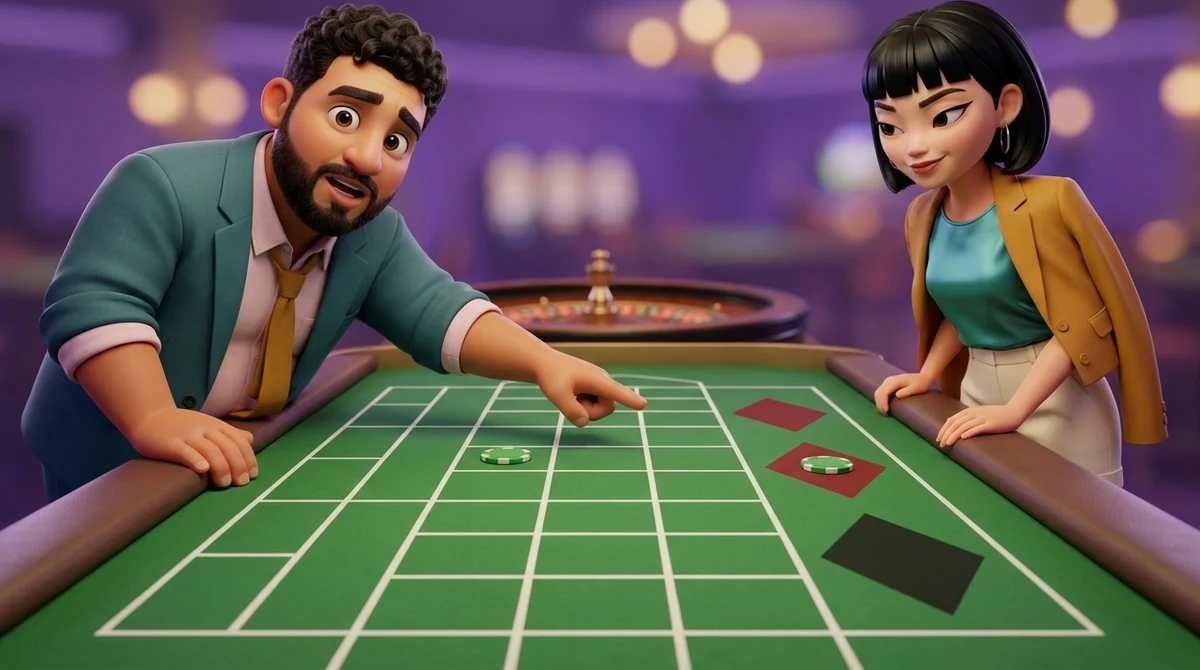

Leoformer dealer · rules and maths
I dealt for years, and the question I was asked most was some version of “which of these is the good bet?” Nobody expects the answer, which is that the table says the price out loud before a chip goes down: the price of every bet is in its payout.
Once you can read the price off the payout, you never need anybody’s opinion about a bet again.
A price, decided before the ball drops
You know what a coffee costs before you order it. A bet looks like the one purchase that works the other way round: you hand the money over first and find out afterwards what the bet cost you. It is not. The price of a bet is settled before the ball is thrown, and the only thing the spin decides is which side pays that price tonight.
The price is an average. It is what a bet loses over many spins, measured against the money you put down on it. Three things follow from that, and none of the three is obvious.
- The price is an average, not tonight’s result.You can sit down, be paid twice and walk out ahead, and the price was still charged on every bet you made. The price shows in the average over many bets, never in any one evening.
- The price is charged on each bet, not on your wallet.The same chips go down again and again across an evening, and the price is charged every time they go down. Lesson 1.3 counts what that does to a night.

Leoformer dealer · rules and maths
People hear “the house has an edge” and take it as a mood, as if the room were simply against them. The house edge is a number. It is the same number for a first-timer and for somebody who has played for thirty years, and you can work it out in ten seconds once you know where to look.
Where the price hides: count the pockets
Here is a wheel with two zeros: 38 pockets, the numbers 1 to 36, a zero and a double zero. Your chip is on 17.
Your chip covers 1 pocket of 38
000123456789101112131415161718192021222324252627282930313233343536The marked pocket is your number. The other 37 pockets belong to the table.
Now count. Picture one full turn of the wheel: 38 spins, with the ball landing in each pocket once. On 37 of those spins your number stays away and you lose one chip each time. On the one spin your number lands, the table pays you. If the table paid 37 chips for that one chip, you would end the full turn exactly where you started, 37 chips out and 37 chips in. That payout has a name, the level payout, and on a single number the level payout is 37 to 1.
Two chips out of 38 is the price of a single number. Written as a share of the wheel, two pockets out of 38 comes to 5.26%, and that share is what the house edge of the bet means.
The price of a bet is the share of the wheel that its payout leaves out. The price is not the size of the payout, it is not how often the bet comes in, and it is not how the last hour went.
The same count in money. Put $10 on that number and keep it there for one full turn of the wheel, and you have made 38 bets of $10, one on each spin.
- Goes down over the full turn$38038 bets of $10, one bet on each spin
- Comes back$360the one spin your number lands, paid 35 to 1, with the bet it was on handed back
- Stays with the table$20one bet for each of the 2 pockets the payout leaves out
Amounts are in Canadian dollars.
One wheel, one price
Now do the same count for red. Red covers 18 of the 38 pockets, and the table pays it 1 to 1: one chip paid for each chip staked.
Red covers 18 pockets of 38
000123456789101112131415161718192021222324252627282930313233343536The 18 marked pockets are the low numbers, 1 to 18. Red is 18 pockets as well, and so are black, odd, even and high: for the price it makes no difference which 18 pockets are yours, only how many. The other 20 pockets belong to the table.
| The count | A single number | Red |
|---|---|---|
| Pockets that are yours | 1 | 18 |
| What the table pays | 35 to 1 | 1 to 1 |
| Chips in your hand after a spin the bet is paid on, for one chip staked | 36 | 2 |
| Chips back over one full turn, for 38 chips put down | 36 | 36 |
| Pockets the payout leaves out | 2 | 2 |
| The level payout | 37 to 1 | 10 to 9 |
| The price of the bet | 5.26% | 5.26% |
That is not a coincidence, and it is the heart of the whole lesson: every payout on this cloth is built for a wheel of thirty-six pockets. A single number paid 35 to 1 brings back 36 chips over a full turn. Red paid 1 to 1 brings back 36. A dozen paid 2 to 1 brings back 36. A wheel with thirty-six pockets and no zeros would take exactly 36 chips over a full turn, one on each spin, and every one of those payouts would be a level payout on it. This wheel has 38 pockets, and the two extra pockets, the zero and the double zero, are the two chips that every payout leaves out.
| Bet | Pockets it covers | How often it is paid | What the table pays | The level payout | The price |
|---|---|---|---|---|---|
| One number | 1 | 2.63% | 35 to 1 | 37 to 1 | 5.26% |
| Two numbers | 2 | 5.26% | 17 to 1 | 18 to 1 | 5.26% |
| Three numbers | 3 | 7.89% | 11 to 1 | 35 to 3 | 5.26% |
| Four numbers | 4 | 10.53% | 8 to 1 | 17 to 2 | 5.26% |
| Zero, double zero, 1, 2, 3 | 5 | 13.16% | 6 to 1 | 33 to 5 | 7.89% |
| Six numbers | 6 | 15.79% | 5 to 1 | 16 to 3 | 5.26% |
| A dozen | 12 | 31.58% | 2 to 1 | 13 to 6 | 5.26% |
| Red, black, odd, even, high, low | 18 | 47.37% | 1 to 1 | 10 to 9 | 5.26% |
The house edge tool does the same count for every bet of every game on this site.
One row is not like the others. The bet on the zero, the double zero and 1, 2 and 3 covers five pockets and is paid 6 to 1, and 6 to 1 on five pockets brings back only 35 chips over a full turn, not 36. That payout leaves 3 pockets out instead of 2, and 3 pockets of 38 is 7.89%. Lesson 4.3 takes the whole cloth apart, that bet included.
The same payout on a shorter wheel
Take the double zero off the wheel and change nothing else. A single number is still paid 35 to 1, and 35 to 1 still brings back 36 chips over a full turn. But a full turn of this wheel is 37 spins, not 38, so the payout leaves only one pocket out instead of two.
| A single number | Wheel with a zero and a double zero | Wheel with one zero |
|---|---|---|
| Pockets on the wheel | 38 | 37 |
| What the table pays | 35 to 1 | 35 to 1 |
| The level payout | 37 to 1 | 36 to 1 |
| Pockets the payout leaves out | 2 | 1 |
| The price of the bet | 5.26% | 2.70% |
The price is about half, on a wheel that looks the same as the other one from a metre away. The payout did not change; the number of pockets that the payout had to stretch across did.
Count the zeros before you sit down
You can check the number of pockets with your own eyes, and you do not need to count all of them: count the zeros. The rule book behind a BCLC table describes its wheel in one line:
The layout and wheel for a roulette game contain the numbers 1-36, 0 and 00.
- Look at the wheel. One zero, or a zero and a double zero?
- Look at the head of the betting cloth. The zeros on the wheel are printed on the layout as well, so a wheel you cannot see past other players can still be read from the cloth.
- Two zeros means 38 pockets, and about twice the price of one zero on every bet the two wheels share. One zero means 37 pockets.
That check takes thirty seconds, standing up, before any money goes down.
House edge, return to player, hold
House edge and return to player are one measurement seen from its two ends. Hold is a different measurement, and it is often mistaken for the house edge.
| Name | What it measures | On a wheel with two zeros |
|---|---|---|
| House edge | The share of each dollar bet that stays with the table, on average, over many bets. | 5.26% |
| Return to player | The same figure from the other end: the share of the money bet that comes back. House edge and return to player add up to the whole dollar. | 94.74% |
| Hold | A different measurement: counted from the money you brought to the table, not from each bet. Because the same money is bet many times over, hold comes out far bigger than the house edge. | no single figure: it depends on how many times the money goes down |
On a wheel, house edge and return to player are one subtraction apart: when 5.26% of the money bet stays with the table, 94.74% of it comes back, and on the wheel with one zero 2.70% stays and 97.30% comes back. Slot machines print the return to player on the glass, and lesson 2.2 takes it apart there.
Hold is the name to watch. Hold counts from the money you brought to the table, not from each bet, and because the same money goes down over and over, hold comes out far larger than the house edge. Lesson 1.3 does that arithmetic, and it is the reason an evening costs more than the price of one bet suggests.
Practice: set a level payout
You are not choosing a bet here, and there is nothing to guess. The wheel is in front of you, your chip is already down, and the only question is what that bet would have to pay to cost nothing at all. Count the pockets that are yours, count the pockets that are not, and the level payout falls out of the two counts.
The practice is one run through three levels. Level 1 is a single number or a pair of numbers, on either wheel. Level 2 is the rest of the cloth: colours, dozens, corners and the one bet with a price of its own. Level 3 turns the question round: the payout is given, and you count the price. Every square on the strip is one moment of the run, and all of the squares are there from the start; when the squares of one level are full, the next level begins by itself.
Lesson done
Review my mistakes (0)
Progress stays in this browser; nothing is sent anywhere.
The practice table needs JavaScript. Here is one moment from it, with the answer.
Level 1 · One number
A wheel of 38 pockets
38 pockets · your bet covers 1
000123456789101112131415161718192021222324252627282930313233343536Your number: 17. The table pays this bet 35 to 1.
What would this bet have to pay to cost nothing at all?
The answer: 37 to 1.
Count, do not guess. 1 pocket is yours and 37 are not, so the level payout is 37 to 1. The table pays 35 to 1 instead, and the 2 pockets between the two payouts are the price: 5.26% of every dollar bet.
Every moment is worked out the same way: count the pockets your bet covers, count the pockets it does not cover, and the payout that balances the two counts is the level payout. What the table pays instead of the level payout is the price.
How the practice table works
Where the moments come from. Nothing is written down as an answer anywhere. Each moment names a wheel and a bet, and the count is done when the page is built: pockets covered, pockets not covered, the payout that balances the two. The wheels and what their tables pay are the same model the house edge tool uses, so a figure you see here and a figure you see there cannot drift apart: they come from the same lines of code.
What you will not see. No moment suggests a bet, and no moment tells you a cheaper bet is a good one. A shorter payout on level 3 is a thought experiment about arithmetic, not a claim about any table anywhere.
One strip, no rounds. Every square on the strip is one moment of this lesson, and all of the squares are there from the start. Your first answer fills the square; when the squares of one level are full, the next level begins by itself, with no button in between. Practising a mistake turns a cross into “fixed in practice” and does not change the count: only first answers do. Progress stays in this browser; nothing is sent anywhere.
Check yourself

Mayaformer floor supervisor · manners, money and breaks
Five quick ones. Pick an answer, then check it. No timer, no points: just whether it stuck.
The question we opened with. Neither: the single number and red cost exactly the same. Both bets leave the same 2 pockets of the wheel unpaid, so both bets carry 5.26% of every dollar bet. What differs between the two bets is only how the evening feels: the single number is paid rarely and pays a lot, red is paid often and pays a little. The price is identical, and that is the point: the price lives in the payout, not in the drama.
Where to check this
19+ (18+ in AB, MB, QC) · Play responsibly · the helplines are at the end of this page
Further reading
- Criminal Code, section 207: permitted lotteries · Justice Laws Website, Government of CanadaThe section that lets a province, and only a province, conduct and manage a lottery scheme — the sentence every casino in the country stands on.
- About Casinos BC · British Columbia Lottery Corporation (Casinos BC)Who conducts the gaming in one province and who runs the room, in the corporation’s own two sentences.
- Annual Report 2024–25 · Ontario Lottery and Gaming CorporationWhat a provincial gaming corporation publishes about itself: what it conducts, and what share of the money brought to the tables it keeps.
- Protecting the public · Independent Gambling Control Office, Province of British ColumbiaWhat a provincial regulator does, who is allowed to run the games, and where a complaint about a casino goes.
- Minimum Technical Standards for Gaming — 11. Game Behaviour · Alcohol and Gaming Commission of OntarioThe floor one regulator sets under a slot machine’s return, and its rule that the floor holds for every bet configuration.
- The house edge of casino games · Wizard of OddsWhere the house edge is defined, and the rating table of rounds an hour this track uses for every game.

Mayaformer floor supervisor · manners, money and breaks
One thing to carry out of here, and it is not about roulette. The price follows the number of bets you make, and the number of bets is the part of the evening you decide, before you sit down, while nothing is happening yet. Game plan is where to write that decision down.
Knowing the price does not make an evening cheaper, and nothing here suggests that an evening at the wheel is a good idea for you. Knowing the price only means you are no longer paying it without knowing.
If it stops being fun
If gambling stops being entertainment, help is available. 19+ in most of Canada; 18+ in Alberta, Manitoba and Quebec. More on responsible gaming.
How it’s worked out
Sources, numbers and hosts
Numbers. Every figure on this page is worked out when the page is built, by the same code that runs the house edge tool: a wheel of so many pockets, a bet covering so many of those pockets, a payout of so much. Nothing is typed in by hand, and each figure is recomputed by our checks from the engine rather than read back from this page.
Sources. The definition and the two published prices come from Wizard of Odds, quoted word for word behind the source buttons on this page, each with the date we read it. They are not decoration: the page refuses to build if the figure our own counting produces is not the figure in the quote. The layout of the wheel is quoted from the rule book published by BCLC for its own tables, dated where it stands.
What is counted, and what is not. The payout a table gives a bet is part of the model this course computes with, the same one the tool uses; the published price is what checks it. 35 to 1 is the only whole-number payout on a wheel of 38 pockets that produces the published 5.26%, and the same 35 to 1 is the only one on 37 pockets that produces 2.70%: one payout, two prices, because the counts differ. So the counting, the model and the published figure are three roads to one place.
The picture of red. The eighteen pockets marked for red on this page are the low numbers, 1 to 18, because the price depends on how many pockets a bet covers and not on which ones; the colour of each pocket is not something this page reads from a rule book, so it is not something this page draws.
What this page does not say. No bet is put forward here as a good one, and no system of any kind is either. A lower price is still a price, charged on every bet, and no arrangement of bets changes it — that is lesson 10.2. What an hour of it costs is lesson 1.2; why an evening usually costs more than this page suggests is lesson 1.3.
Hosts. Leo and Maya are illustrated characters. Their backstories, a former dealer and a former floor supervisor, are written for the course: neither is a real person, and neither speaks for any casino. The rules and numbers on this page come from the sources it cites, not from their experience.
The price of a bet on a wheel with two zeros
The house edge on all bets is 1/19, or 5.26%, except for the 0-00-1-2-3 combination, which carries a house edge of 7.89%.
What the house edge is
The house edge is defined as the ratio of the average loss to the initial bet
The one bet on this wheel that costs more
The house edge on all bets is 1/19, or 5.26%, except for the 0-00-1-2-3 combination, which carries a house edge of 7.89%.
What the house edge is
The house edge is defined as the ratio of the average loss to the initial bet
One wheel, one price
The house edge on all bets is 1/19, or 5.26%, except for the 0-00-1-2-3 combination, which carries a house edge of 7.89%.
The one bet on this wheel that costs more
The house edge on all bets is 1/19, or 5.26%, except for the 0-00-1-2-3 combination, which carries a house edge of 7.89%.
One zero instead of two
However, with one zero the house edge is cut to 1/37, or 2.70%, on all bets.
The wheel, in the words of BCLC
The layout and wheel for a roulette game contain the numbers 1-36, 0 and 00.
Section 1.0 Double Zero, 1.2
Spotted a mistake on this page? Tell us
Been here before? Review us on Trustpilot