Atlassino Academy · Other tables · Lesson 8 of 10
Sic Bo: three dice
Three dice settle every bet on a Sic Bo table. Here is how each bet on the felt is settled, what each one costs, and which one costs least.
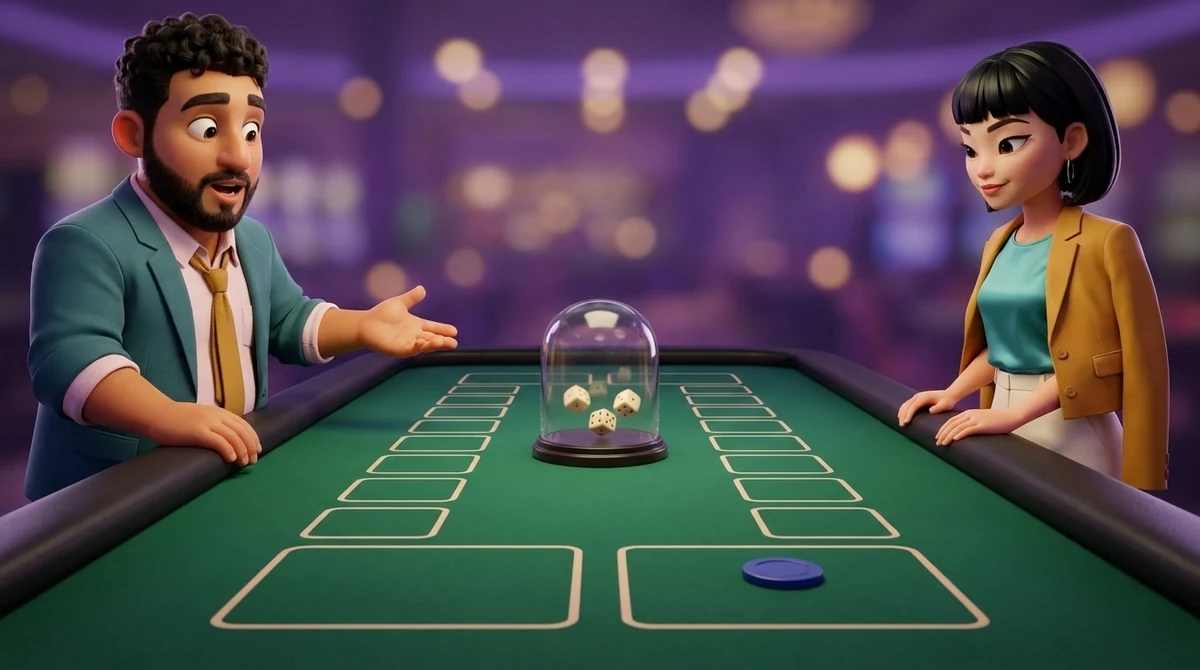
Three dice under the dealer’s shaker, and a felt full of different bets. Which bet on the Loto-Québec table costs least, and what does it cost?
The short answer
Small or Big: about 2.78% of each bet, on average. Every other bet on that felt costs more, from 7.87% for one number to 33.33% for a double. The reason Small and Big are not free at 1 to 1 is the triple: when all three dice show the same number, both are lost.
The bars are for the Loto-Québec table, the one table in this lesson with a full printed pay table. A larger pay line does not make a bet cheaper, and the price does not follow the pay line either way: the longest bar, a double, pays only 8 to 1.

Leoformer dealer · rules and maths
Sic Bo asks for no decision once the dice are in the shaker. Every decision is made before the shake: which bets go on the felt, and how much on each of them.
So the one thing worth learning at this table is how each bet is settled and what each one costs. The felt prints the pays; the price you have to work out, and this lesson does it for you.
Three dice and their 216 rolls
Sic Bo is played with three ordinary dice, each with the numbers one to six on its faces. On the Loto-Québec table the dealer starts the shaker once every bet is down, and the outcome of each die appears on a display.
One roll
Six faces on the first die, times six on the second, times six on the third, make every way three dice can land.
Counting each die separately, three dice can land in 216 different ways, and each of those ways is as likely as any other. Every bet on the felt is settled by which of them comes up, and every price on this page is counted over all of them.
Small and Big, and the triple that takes both
On the Loto-Québec table, Small is a bet that the three dice add up to 4 to 10 and are not a triple, and Big is a bet that they add up to 11 to 17 and are not a triple; both are paid 1 to 1, and the electronic Sic Bo terminals of a casino in Quebec leave the triples out of Small and Big in the same way.
The totals three dice can make, from 3 to 18. Small covers 4 to 10, Big covers 11 to 17; 3 and 18 belong to neither. A triple can make 3, 6, 9, 12, 15 or 18.
Small and Big split the totals between them, and the triples sit in both halves. On the Loto-Québec table a triple takes Small and Big whatever its total, which is why each of the two bets is paid on 105 of the 216 rolls rather than on half of them.
Sic Bo Dynasty, a live dealer on electronic terminals at Fallsview Casino Resort and Casino Niagara, in Ontario, prints Small and Big at 1 to 1 over the same two ranges, and its page says nothing about a triple. This lesson draws no rule for that table from the silence, either way: the player screen of the table is where to look.
| The Loto-Québec table | Sic Bo Dynasty, electronic terminals | |
|---|---|---|
| Small | totals 4 to 10, pays 1 to 1 | totals 4 to 10, pays 1 to 1 |
| Big | totals 11 to 17, pays 1 to 1 | totals 11 to 17, pays 1 to 1 |
| On a triple | Small and Big are both lost | not stated on its page |
| Price | 2.78% | not worked out: the rule for a triple is not printed |
One number, a double, and the triples
A bet on one number is paid by how many of the three dice show it: 1 to 1 for one die, 2 to 1 for two, 3 to 1 for all three. A double is a bet that one number shows on two of the three dice, and a bet on two numbers is paid when both of them show; the Loto-Québec table pays the double 8 to 1 and the two numbers 5 to 1.
| The bet | What has to happen | Pays | Price |
|---|---|---|---|
| One number | the number on one of the dice | 1 to 1 | 7.87% |
| on two of the dice | 2 to 1 | ||
| on all three dice | 3 to 1 | ||
| A double | the number on two of the three dice, or on all three by our reading | 8 to 1 | 33.33% |
| Two numbers | both numbers among the three dice | 5 to 1 | 16.67% |
| A named triple | all three dice show the number you named | 150 to 1 | 30.09% |
| Any triple, Loto-Québec table | all three dice show the same number | 24 to 1 | 30.56% |
| Any triple, Sic Bo Dynasty | all three dice show the same number | 30 to 1 | 13.89% |
Each row is one bet, and the price is counted over all 216 rolls. The bet on one number has three pay lines and one price: the three lines together are what it gives back.
A named triple needs all three dice to show the number you chose, and the Loto-Québec table pays it 150 to 1; a bet on any triple covers all six triples at once. Any triple is paid 24 to 1 on the Loto-Québec table and 30 to 1 on Sic Bo Dynasty: two tables, two pay lines, and each belongs to its own table.
A total, line by line
A bet on a total is a bet on one exact sum of the three dice, from 4 to 17, and each total has its own pay line on the Loto-Québec table. The totals near the middle are made by many rolls and pay the least; the totals at the ends are made by few rolls and pay the most.
| Total | Rolls of the 216 that make it | Pays | Price |
|---|---|---|---|
| 4 | 3 | 50 to 1 | 29.17% |
| 5 | 6 | 30 to 1 | 13.89% |
| 6 | 10 | 18 to 1 | 12.04% |
| 7 | 15 | 12 to 1 | 9.72% |
| 8 | 21 | 8 to 1 | 12.50% |
| 9 | 25 | 6 to 1 | 18.98% |
| 10 | 27 | 6 to 1 | 12.50% |
| 11 | 27 | 6 to 1 | 12.50% |
| 12 | 25 | 6 to 1 | 18.98% |
| 13 | 21 | 8 to 1 | 12.50% |
| 14 | 15 | 12 to 1 | 9.72% |
| 15 | 10 | 18 to 1 | 12.04% |
| 16 | 6 | 30 to 1 | 13.89% |
| 17 | 3 | 50 to 1 | 29.17% |
The cheapest totals are 7 and 14, at 9.72%; the dearest are 4 and 17, at 29.17%. Sic Bo Dynasty prints only the range its totals pay between, not what each total pays, so the table above holds for the Loto-Québec table alone.
The live table, the terminals, and the trend board
Sic Bo also runs on electronic terminals. At Fallsview Casino Resort and Casino Niagara, Sic Bo Dynasty broadcasts a live dealer to the terminals, offers the traditional Sic Bo bets, and leaves further information to the player screen; in a casino in Quebec, electronic Sic Bo terminals pay what the screen displays.
- The live tableThe Loto-Québec tableA dealer, a shaker, and a full pay table printed for every bet on the felt.
- Electronic terminalsSic Bo DynastyAt Fallsview Casino Resort and Casino Niagara: a live dealer broadcast to the terminals; three pay lines printed, more information on the player screen.
- Electronic terminalsA casino in QuebecA bet pays what the screen displays; no pay table printed in any document we could read.
The pay table of the Loto-Québec table belongs to that live table, and it is not carried over to any terminal: a terminal pays its own lines, shown on its own screen. Which rooms run a live table is in our casino listings, not in this lesson.
The screen of Sic Bo Dynasty also shows trend information: the outcomes of past rolls and how often each number has come up.
A record of past rolls
Six rolls already made, each shown as three small dice, and beside them the next roll, which is three dice thrown again with the same 216 outcomes.
Next roll: any of the 216 outcomes, exactly as before the first of these rolls
The trend board is a record of rolls already made, not a hint about the next one. Every roll is three dice thrown again, with the same 216 outcomes as the roll before; no past roll changes the price of a bet on the next.
What each bet costs, and what an hour costs
You may put chips on as many bets as you like in one round, within the limits of the table. Each bet you add brings its own price into the round.
| The bet | Pays | Price |
|---|---|---|
| Small or Big | 1 to 1 | 2.78% |
| One number | 1 to 1, 2 to 1 or 3 to 1 | 7.87% |
| A total | 6 to 1 up to 50 to 1 | 9.72% to 29.17% |
| Two numbers | 5 to 1 | 16.67% |
| A named triple | 150 to 1 | 30.09% |
| Any triple | 24 to 1 | 30.56% |
| A double | 8 to 1 | 33.33% |
No Canadian document we could read prints the price of any Sic Bo bet as a share of the bet: every price here is our own count over the 216 rolls.
No Canadian document we could read prints how many rounds an hour a Sic Bo table plays either. The figure used here is the one in the Las Vegas Strip rating table: 45 rounds an hour.
- One round$0.28the average price of an example $10 on Big, on the Loto-Québec table
- Rounds in an hour45the figure in the Las Vegas Strip rating table
- One hour$12.50on average, the same bet on every round
An example bet of $10 on Big, on every round for an hour, on the Loto-Québec table. The $10 is only an example, not a table minimum and not a suggested bet. Amounts are in Canadian dollars. The hour is a long-run average, and one real hour can come out well above it or well below it. Price of an hour works the same arithmetic for your own bet.

Mayaformer floor supervisor · manners, money and breaks
Three dice, as many bets as you like each round: set the limit before the first roll. A felt with many bets on it can take the money of an evening much faster than one bet on Big would.
A run of dice that went against you is not a debt the table owes you. Putting more down to get it back buys more rounds at the same price; lesson 10.3, Chasing losses, is about exactly that.
If it stops being fun
If gambling stops being entertainment, help is available. 19+ in most of Canada; 18+ in Alberta, Manitoba and Quebec. More on responsible gaming.
The lesson on one card
That is the lesson. Here it is on one card: print it, or keep it on your phone.
| The bet | Pays | Price |
|---|---|---|
| Small or Big | 1 to 1 | 2.78% |
| One number | 1 to 1, 2 to 1 or 3 to 1 | 7.87% |
| A total | 6 to 1 up to 50 to 1 | 9.72% to 29.17% |
| Two numbers | 5 to 1 | 16.67% |
| A named triple | 150 to 1 | 30.09% |
| Any triple | 24 to 1 | 30.56% |
| A double | 8 to 1 | 33.33% |
A triple takes both Small and Big. Electronic terminals pay what the screen displays.
19+ (18+ in AB, MB, QC) · Set a limit before you sit down at the table · Play responsibly · the line for your province is at Helplines by province
Practice: settle the dice
Three dice have stopped, and bets sit on the felt. You say what each bet comes to: paid, and how much, or lost. Level 1 is Small and Big, with and without a triple, on the Loto-Québec table and on Sic Bo Dynasty. Level 2 is one number, a double and the triples. Level 3 is the totals, on the Loto-Québec table only, because Sic Bo Dynasty does not print what each total pays.
Nothing is bet here. The amounts are an example bet of $10, and the dice come from a fixed run of rolls, the same for every visitor.
Lesson done
Review my mistakes (0)
Progress stays in this browser; nothing is sent anywhere.
The practice table needs JavaScript. Here is one roll from it, with the answer.
Level 1 · Small and Big
The Loto-Québec table
- Big$10
All three dice have stopped on the same number. What happens to your bet on Big?
- Paid $10 That pays Big for the total and leaves out the triple. On this table Big is paid only when the three dice are not all the same.
- The bet comes back A triple does not hand Big back: on this table the bet is lost.
- Lost $10 All three dice show the 5. The total, 15, is in the Big range, and on the Loto-Québec table a triple still takes Big.
Big covers 11 to 17, and only when the three dice are not all the same. A triple of fours or fives adds up to a Big total and still takes the bet on the Loto-Québec table.
Level 3 · Totals
The Loto-Québec table
- A total of 7$10
What happens to your bet on a total of 7?
- Paid $120 The dice add up to exactly 7, the total you named, and the line for a total of 7 pays 12 to 1.
- Paid $10 That pays the total at 1 to 1, as if it were Small or Big. A total is paid by its own line.
- Paid $80 That is the pay of a total of 8. A total of 7 has its own line.
A total of 7 can be made in 15 of the 216 rolls. On the Loto-Québec table, a total made by fewer rolls is never paid less.
Every roll in the practice run is worked out the same way: the three dice come from a fixed run of rolls, and each bet on the felt is settled by the pay lines of its table.
How the practice run works
Where the answers come from. Every roll is taken from one run of three-dice rolls made with a fixed seed, and every bet on it is settled when the page is built, by the pay lines of its table. The wrong answers are named mistakes: the bet that comes back counted as part of the payout, the triple left out of Small and Big, the pay line of another bet or another total used in place of the right one. Sic Bo Dynasty is dealt only rolls without a triple, because its page says nothing about what a triple does to Small and Big.
One strip, and no rounds. Every square on the strip is one roll of this lesson, and all of the squares are there from the start. Your first answer fills the square it belongs to; when the squares of one level are full, the next level begins by itself, with no button in between. Practising a roll you got wrong turns its cross into “fixed in practice” and does not change the count, because only first answers count.
Your progress stays in this browser, and nothing is sent anywhere.
Check yourself

Mayaformer floor supervisor · manners, money and breaks
Three quick ones. Pick an answer, then check it. No timer, no points: just whether it stuck.
Back to the question we opened with. On the Loto-Québec table, Small or Big costs least, about 2.78% of each bet, and the triple that takes both is the whole of that price.
Where to go next, and further reading
19+ (18+ in AB, MB, QC) · Play responsibly · the helplines are further up this page
Further reading
- Sic Bo · Loto-QuébecQuébec’s brochure: every bet on the layout and what it pays.
How it’s worked out
Tables, numbers, pace, sources and hosts
Where this happens. The full pay table on this page is the one printed for the live Loto-Québec table, with a dealer and a shaker. Sic Bo Dynasty at Fallsview Casino Resort and Casino Niagara, in Ontario, is a live dealer broadcast to electronic terminals, and only its three printed lines appear here: Small, Big and any triple. Electronic terminals in a casino in Quebec pay what their screen displays, and no document we could read prints their pay table, so no pay of the live table is carried over to them. Which rooms run a live table is in our casino listings, not in the documents this lesson rests on.
Numbers. Every price on this page is counted when the page is built over all 216 rolls of three dice, as an exact fraction printed rounded: for each bet, every roll is paid by the line of its table, and the average against the bet is its price. The price of Small and Big follows the rule of the Loto-Québec table, where a triple takes both. No Canadian document we could read prints the price of any Sic Bo bet as a share of the bet; every percentage here is our own count. The practice rolls come from one run with a fixed seed and are settled by the same engine.
Pace. No Canadian document we could read prints how many rounds an hour a Sic Bo table plays. The figure here is the one our Price of an hour tool uses and names: 45 rounds an hour in the Las Vegas Strip rating table. It carries no source button on this page, and your table may be faster or slower.
What rests on our own reading. That the trend board is a record and not a hint is this lesson’s own words: the screen’s page says only what the board shows, and every roll in our count is a fresh roll of three dice. What Sic Bo Dynasty does with Small and Big on a triple is not printed, and this lesson says nothing about it either way. A double is counted as paid also when its number shows on all three dice, so it is paid on 16 of the 216 rolls: the rule of the Loto-Québec table speaks of two of the three dice and does not say what a triple of that number does to the bet. Read the other way, a double would cost more than the 33.33% shown here, and it would still be the dearest bet on the felt.
What is deliberately absent. The money wheel, another game with nothing to decide after the bet, is lesson 9.9; an hour of Sic Bo set against an hour at the other tables of this track is lesson 9.10; the poker games against the dealer and Pai Gow, where decisions matter, are lessons 9.1 to 9.7. How far an evening swings and when to leave is lesson 10.1, betting systems are lesson 10.2, and chasing losses is lesson 10.3. The totals of Sic Bo Dynasty are not priced here: its page prints only their range.
Sources. Every rule and every claim on this page carries a button with the sentence it rests on, the publisher who wrote that sentence and the date we read it.
Hosts. Leo and Maya are illustrated characters. Their backstories, a former dealer and a former floor supervisor, are written for the course: neither is a real person, and neither speaks for any casino. The rules and numbers on this page come from the sources it cites, not from their experience.
No promise. Sic Bo is played against the house, and every bet on its felt has a price. Knowing how each bet is settled and what it costs lets you check every payment and plan every hour; nothing on this page makes any bet cheaper, and nothing here says how an evening at the table would end.
Three dice
To predict the outcome of three shaken dice.
After all bets have been made, the dealer activates the dice shaker.
The outcome of each of the three dice appears on the display.
Sic Bo is a table game played with three identical six-sided dice marked with a number from one to six of each face.
Small and Big lose on a triple
YOU BET THAT THE SUM OF THE THREE DICE WILL BE EQUAL TO 4, 5, 6, 7, 8, 9 OR 10 AND WILL NOT BE A THREE OF A KIND.
YOU BET THAT THE SUM OF THE THREE DICE WILL BE EQUAL TO 11, 12, 13, 14, 15, 16 OR 17 AND WILL NOT BE A THREE OF A KIND.
Winning bets are paid 1 to 1
Small: Dice total between 4 and 10 (excluding triples)
Big: Dice total between 11 and 17 (excluding triples)
Loto-Québec, Casino de Montréal · Electronic gaming terminals — Electronic Sic Bo · read
Small and Big on Sic Bo Dynasty
A bet placed on Big (dice total between 11 and 17) or Small (dice total between 4 and 10) pays 1:1
One number
YOU BET ON A SINGLE NUMBER THAT MUST APPEAR ON ONE, TWO, OR ALL THREE DICE.
If the number appears on one of the three dice, winning bets are paid 1 to 1.
If the number appears on two of the three dice, winning bets are paid 2 to 1.
If the number appears on all three dice, winning bets are paid 3 to 1.
A double and two numbers
YOU BET ON ONE NUMBER which must appear on two of the three dice.
Winning bets are paid 8 to 1
YOU BET ON TWO DIFFERENT NUMBERS WHICH MUST APPEAR ON AT LEAST TWO OF THE THREE DICE.
Winning bets are paid 5 to 1
A named triple and any triple
YOU BET ON ONE NUMBER WHICH MUST APPEAR ON ALL THREE DICE.
Winning bets are paid 150 to 1
YOU BET THAT THE SAME NUMBER FROM 1 TO 6 WILL APPEAR ON ALL THREE DICE.
Winning bets are paid 24 to 1
Any triple at two tables
YOU BET THAT THE SAME NUMBER FROM 1 TO 6 WILL APPEAR ON ALL THREE DICE.
Winning bets are paid 24 to 1
A bet placed on Any Triple pay 30:1
Totals
YOU BET ON A NUMBER FROM 4 TO 17 WHICH MUST CORRESPOND TO THE SUM OF THE THREE DICE.
If the sum is 4, winning bets are paid 50 to 1
If the sum is 5, winning bets are paid 30 to 1
If the sum is 6, winning bets are paid 18 to 1
If the sum is 7, winning bets are paid 12 to 1
If the sum is 8, winning bets are paid 8 to 1
If the sum is 9, winning bets are paid 6 to 1
If the sum is 10, winning bets are paid 6 to 1
If the sum is 11, winning bets are paid 6 to 1
If the sum is 12, winning bets are paid 6 to 1
If the sum is 13, winning bets are paid 8 to 1
If the sum is 14, winning bets are paid 12 to 1
If the sum is 15, winning bets are paid 18 to 1
If the sum is 16, winning bets are paid 30 to 1
If the sum is 17, winning bets are paid 50 to 1
A bet placed on any Three Dice Total will range from 6:1 to 62:1
Sic Bo on electronic terminals
Sic bo Bet on the roll of the dice!
Loto-Québec, Casino de Montréal · Electronic gaming terminals · read
If your prediction matches the dice, you win your bet and receive the payout displayed.
Loto-Québec, Casino de Montréal · Electronic gaming terminals — Electronic Sic Bo · read
Our dealers are broadcasting to you live from Fallsview Casino Resort.
All traditional Sic Bo bets are available and additional information can be found on the player screen.
Trend information on the player screen
Trend information can be found at the top of the player screen and includes dice outcome and frequency of various numbers.
As many bets as you like
You may wager on as many combinations as desired per game.
ensuring that they are made in accordance with the minimum and maximum limits indicated at the table.
Spotted a mistake on this page? Tell us
Been here before? Review us on Trustpilot