Atlassino Academy · Slots · Lesson 8 of 10
Due, hot, cold and the stop button
What people do when an hour at a machine has given back next to nothing — and what the last ten games actually tell you.
A machine has taken your money for forty minutes and given you next to nothing back. Is it closer to paying now than it was when you sat down?
The short answer
No. The chance on the spin you are about to make is the chance the machine gave your first spin, and the chance it gave every spin in between. What forty minutes of pressing changed is your own pressing and nothing else: how many spins you have made, and how much of your money those spins have sent through the machine.
- Spins you made in forty minutes400at 600 spins an hour
- Your money through the machine$400on a $1 spin
- The chance on your next spinunchangedthe same chance the machine gave your first spin
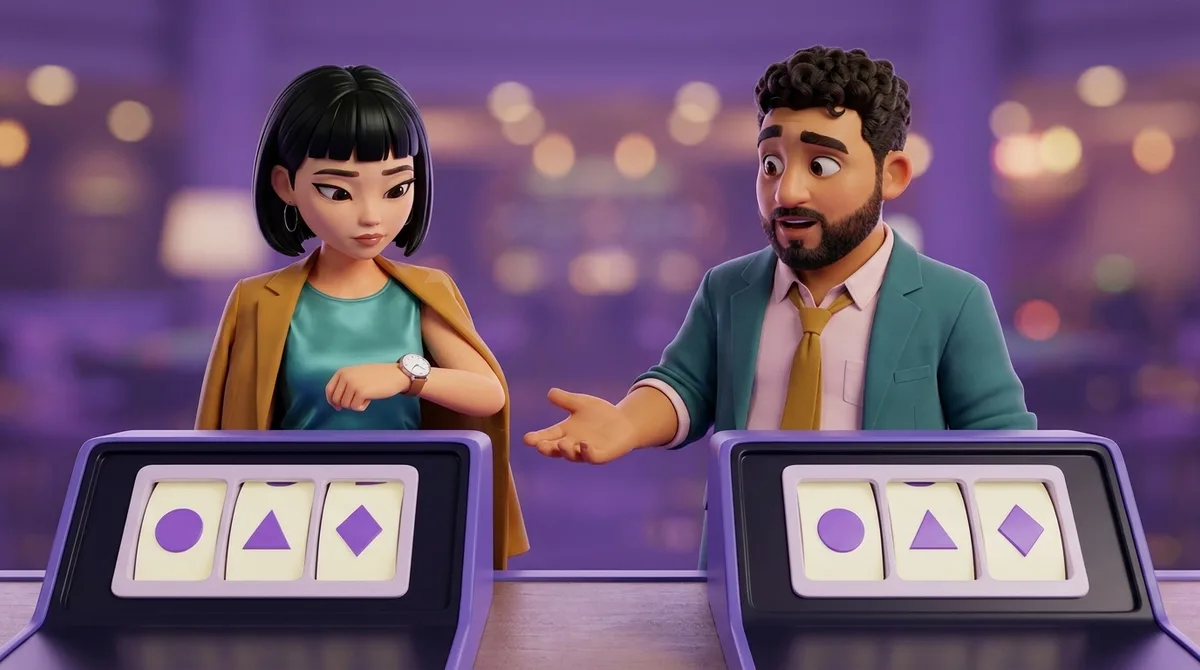

Mayaformer floor supervisor · manners, money and breaks
“It’s due.” “It’s hot.” “It’s cold.” “You have to press it at the right moment.” I have heard all four of those sayings out loud on the floor, and almost never from somebody being silly. You sit in one place for an hour watching the same thing happen, and your head starts hunting for the pattern. That is what heads are for. A slot machine simply is not the kind of object that has a pattern in it.
So this is not about being wrong, and I am not going to tell you the thought is foolish. What I can tell you is what the thought costs, and the cost is not luck and not a jinx. The cost is the extra spins you make while you wait for the machine to do what you have decided it owes you, and the money those extra spins send through the machine.
Four things people say, and the one belief under all four
“It’s due”, “it’s hot”, “it’s cold” and “you have to press it at the right moment” sound like four different claims about four different situations. All four sayings say one and the same thing: that the machine is in some state right now, that the state is either good for you or bad for you, and that you can read which state it is in from what the machine has just been doing.
| What gets said | What it claims | What is there |
|---|---|---|
| “It’s due” | the quiet stretch is building towards something | nothing is stored |
| “It’s hot” | a payout makes the next one likelier | nothing is stored |
| “It’s cold” | a payout makes the next one further off | nothing is stored |
| “Press it right” | the moment of the press can be aimed | the result is already picked |
A machine on this floor is not allowed to put the words Due, Overdue, Ready or Ready to Hit on its screen, in those exact words. The ban is not a verdict on the people who say “it’s due” out loud at a machine. The ban is there because the thought behind the word is so reliable that a machine could be built to feed it, and a machine that printed Due on its screen would be selling you a state the machine does not have.
- Duenever on the screen
- Overduenever on the screen
- Readynever on the screen
- Ready to Hitnever on the screen
There are no hot machines and no cold ones, and sitting at one machine longer does not improve the odds on any spin of that machine. The machine takes the same amount on the spin you make in the fortieth minute as it took on the spin you made in the first minute, and what it is taking is your credits (what a machine counts your money in on screen, which is not the same as dollars until you cash out).
The climbing line is what people picture when they say a machine is due; the flat line is what a machine actually draws.

Leoformer dealer · rules and maths
I dealt cards rather than fixing machines, but I walked past the same rows every shift. What you notice from the aisle is that the quiet machines and the loud ones swap places all evening long, and nobody walking that aisle can tell you which machine will be the loud one a minute from now. Neither can the person already sitting at that machine, and that person is closer to it than anybody else in the building.
What an hour with nothing back actually looks like
Take two machines that give back the same share of everything staked over their lifetimes, and let them do it at two different rhythms. The machine that pays often gives back small amounts many times an hour; the machine that holds its money back gives nothing at all for long stretches and then one large payout. Neither machine is real: both are written out one possible result at a time, which is what makes every figure about the two machines something to be worked out rather than guessed at.
| Teaching machine | How often a spin pays | Longest stretch with nothing back, in a typical hour | Chance the next spin pays, after 100 spins with nothing back |
|---|---|---|---|
| The machine that pays often | 30.0% | 15 spins | 30.0% |
| The machine that holds its money back | 5.1% | 72 spins | 5.1% |
How often a spin pays and the chance after a hundred spins with nothing back come out the same: those hundred spins leave the machine exactly where it started.
On the machine that holds its money back, a stretch of 72 spins with nothing back is the middle of an hour rather than the bad end of it: half of all hours on that machine contain a dead stretch at least that long.
- 50 spins in a row with nothing back93.0%of hours on that machine hold a stretch at least that long
- 72 spins in a row with nothing back50.5%of hours on that machine hold a stretch at least that long
- 100 spins in a row with nothing back13.5%of hours on that machine hold a stretch at least that long
- 150 spins in a row with nothing back0.9%of hours on that machine hold a stretch at least that long
The machine you walked away from, and the award somebody else took
The version of the belief that hurts most — the belief that a machine carries something forward from one spin to the next — is not something people say while they are still playing. It is what they say afterwards. You stand up after two hours at a machine, somebody else sits down in the seat you have just left, and three spins later that person takes the largest award the machine has.
The spin you would have taken
A press made at the instant your own thumb would have chosen, with the largest award standing at 1 in 262,144 on that press.
The spin the next player took
A press made at the instant the next player’s thumb chose, three spins after sitting down, with the largest award standing at 1 in 262,144 on that press as well — and on that press the three symbols came up.
One machine, and two presses made at two different instants. What changes from picture to picture is the instant the button went down and the symbols that instant brought up on the payline. What does not change is the machine — three reels of 64 symbols, with the symbol that matters appearing once on each reel — and the chance of the largest award, which stands at the same figure under both pictures. Standing up did not hand the next player an award that had been waiting for you: standing up changed which instants got pressed, and a press a thousandth of a second apart is a different spin, not the same spin caught better or caught worse.
The belief that a machine carries something forward runs just as often in reverse: the machine has paid heavily, so it must be empty now. A machine that has just paid out a large jackpot can pay another large jackpot on the very next spin. Nothing was taken out of a store when the machine paid, because there is no store inside a machine to take anything out of.
What people picture inside a machine
A store that fills up while the machine is quiet and drains when the machine pays, so that a long quiet stretch leaves a full store waiting for whoever sits down next.
What is actually inside a machine
A certified program holding every result the machine can produce. One result is drawn at each press, and the program is exactly the same after that draw as it was before it.
And the explanation people reach for when a good stretch ends is that somebody in a back office turned the machine down. A machine’s payout cannot be changed while somebody is playing on it, and every result the machine is able to produce already sits in a program that an independent laboratory certified before the machine was ever switched on.
- Before the machine reaches the floorEvery result the machine can ever produce is written into a program, and an independent laboratory certifies that program before the machine is switched on.
- While the machine stands on the floorThe machine plays from that certified program, and the number generator inside the program keeps running day and night, whether anybody is sitting at the machine or not.
- While you are playingNothing is set and nothing is changed. A machine’s payout cannot be altered while somebody is playing on it, and that is the rule the story about a back office runs into.
The number generator inside the machine ran through the whole of your two hours, and through every idle minute before you arrived, and it kept no score of any of it.
When the machine is a website
Put the same game on a licensed website, and the machine behind it behaves in almost exactly the same way. A machine on a floor and a game on a screen are forbidden the same four words, in the same order — Due, Overdue, Ready, Ready to Hit — and on a machine and on a screen alike the result is picked before the picture.
| The point | A machine in a room | A licensed site in Ontario |
|---|---|---|
| The words Due, Overdue, Ready, Ready to Hit | not allowed on the screen | not allowed on the screen |
| When the result of a spin is chosen | at the press, before the picture | at the press, before the picture |
| A button that shortens the wait for the result | legal; the claim that pressing it helps you is not | not permitted at all |
On the licensed gambling sites of Ontario, turbo, quick spin and slam stop are simply not permitted, and a game there may not let you shorten the wait for a result in any way. On a casino floor the stop button is perfectly legal, and the only thing forbidden there is the claim that pressing it helps you.
Neither a casino floor nor a licensed site is the safer of the two places to be. The ban on the button covers the licensed sites of one province and not screens in general, and a ban on shortening the wait says nothing whatever about which of the two places is safer for the person playing. Nor does a game on a screen run more slowly than a machine in a room because of that ban. What the ban takes away is the shortcut through the animation, and not the speed at which one spin follows another.
Practice: read the machine
A machine has no decision left in it once the button is down, so not one of these moments asks you to spin a machine. Each moment asks about the three things you really do decide — which machine you sit at, what you stake, when you get up — and then it checks the reason you gave for deciding, because at a machine the reason is the only part of a decision that anybody can check.
The lesson is one run: every square on the strip below is one moment of it, and they are all there from the start. Level 1 is the button alone. Level 2 puts a machine’s own record of its last ten games in front of you. Level 3 is what you do after a machine pays somebody else. Only your first answer on each moment counts, and when a level’s squares are full the next one begins by itself, with no button in between.
Nothing here keeps a balance, pays credits or makes a sound. There is no money in it at all.
Lesson done
Review my mistakes (0)
Progress stays in this browser; nothing is sent anywhere.
The practice table needs JavaScript. Here is one moment from it, with the answer.
Level 1 · The button
The button · you stopped the reels yourself
- The machine
- a reel machine, one payline
- This spin
- already picked, still turning
- You did
- held the button down until the reels snapped still
The reels snap still the moment you hold the button down. What did that change?
The answer: How long I watched, and nothing else.
The button shortens the show. The result it shows you was picked at the press of Spin, and a bet cannot even be taken after that moment.
All Bets must be committed before the selection of the Game outcome. Any Bet received after the selection of the Game outcome must be voided and returned to the player.AGCO · Minimum Technical Standards for Gaming — 11. Game Behaviour · section 11.3 Determination of Game Outcome · read
Level 2 · The last ten games
The record · ten games, nothing back
- Games shown
- ten
- Paid something
- none of the ten games
- Game by game
- 10 games with nothing
Ten games in a row have paid nothing. What does the record tell you about the next spin?
The answer: Stay, because the next spin is the spin it always was.
A stretch of ten with nothing back is the ordinary shape of an hour, not a signal. On a machine that pays 5.1% of the time, the longest dead stretch in an average hour runs to about 72 spins.
That would be great, but no, a machine doesn’t actually become due for a win – it’s always randomOLG PlaySmart · Slots — strategies · read
machines are never “due to win” and your chances of winning do not improve the longer you playManitoba Liquor & Lotteries · Informed Gambling — Randomness · read
Level 3 · The one you left
Afterwards · the seat you gave up
- You
- stood up after an hour
- The next player
- took the largest award three spins later
You stood up, someone sat down, and three spins later they took the largest award. Do you go back to it?
The answer: Go back or not, but not because of that spin.
Leaving changed which spin got taken, not whether one paid. The chance on that spin was 1 in 262,144 for them and would have been 1 in 262,144 for you.
The outcome is determined by the RNG the second you hit the spin button. The spinning symbols just add entertainment to the game.OLG PlaySmart · Slots — how to play · section The Random Number Generator · read
physical and online slot machines work just like a computer, using RNGs to generate random number codes that determine an unpredictable outcomeOLG PlaySmart · Slot Machines & Randomness · read
Every moment is worked out the same way. The machines are teaching machines, enumerated in full: the run lengths come from the same arithmetic as our streaks tool, and the largest award is three reels of 64 with the symbol once on each. The workings are in “How it’s worked out” at the end of this page.
How the practice table works
What is being marked. The action is not marked; the reason is. Staying, moving and stopping are all fine, and more than one answer to a moment can be right — “I would rather play the other machine” counts, because a preference is not a claim about chance. What does not count is a reason read off the strip of past games.
Where the machines come from. They are ours, and the page says so wherever their figures appear. No operator we could read publishes how often a real machine pays, so every run length here is worked out from a teaching machine we enumerate in full, using the same arithmetic as our streaks tool.
One strip, no rounds. Every square is one moment of this lesson, and your first answer fills it. Practising a mistake turns a cross into “fixed in practice” and does not change the count. Progress stays in this browser; nothing is sent anywhere.
Check yourself

Mayaformer floor supervisor · manners, money and breaks
Five quick ones. Pick an answer, then check it. No timer, no points: just whether it stuck.
The question we opened with. The machine is not closer to paying than it was forty minutes ago. Forty minutes that leave you with next to nothing to show for them is one of the ordinary shapes forty minutes at a machine takes, and the machine has no way of knowing those forty minutes happened at all. What those forty minutes did settle is how much of your money went through the machine, and that figure is the one that keeps climbing for as long as you sit there.
Where to check this
19+ (18+ in AB, MB, QC) · Play responsibly · the helplines for every province are at the end of this page
Further reading
- Minimum Technical Standards for Gaming, 11: Game Behaviour · Alcohol and Gaming Commission of OntarioWhat a slot machine in a room is allowed to do, clause by clause: the payout floor, the reel strip, the odds on the largest prize and the ten games of history every machine can show you.
- How to play slots · Ontario Lottery and Gaming Corporation (PlaySmart)An operator walking through the arithmetic of one spin, with its own worked example: nine lines on a nickel machine, and what one press of it takes.
- How to play slots · British Columbia Lottery Corporation (Casinos BC)Reels, lines and the province’s average return, in the words of the corporation that runs the rooms.
- Understanding chance: slot machines · Loto-Québec (Wise Play)The near miss, volatility and the illusion of control, named and explained by a provincial operator rather than by us.
- Informed Gambling: slots and VLTs · Manitoba Liquor & LotteriesA short brochure on what a payout percentage is and is not, and why two machines with the same one can empty a wallet at different speeds.
- Registrar's Standards for Internet Gaming: game design and features · Alcohol and Gaming Commission of OntarioThe same machine on a screen: what a regulated site in Ontario may not do with the picture after the outcome has been drawn.

Mayaformer floor supervisor · manners, money and breaks
If you take one thing away, take this: believing a machine is due never changes the odds on a single spin, so the only way the belief can reach your evening is through the clock and through the money going into the machine while you wait. That is what makes it easy to handle. Decide the hour while you are still at home, and “it has to be close by now” stops being an argument you are obliged to answer at two in the morning.
And if the pull to stay is the loud part of your evening rather than a passing thought, that is worth talking to somebody about. The lines below are for exactly that, and Game plan helps you set the hour before you go.
If it stops being fun
If gambling stops being entertainment, help is available. 19+ in most of Canada; 18+ in Alberta, Manitoba and Quebec. More on responsible gaming.
How it’s worked out
Sources, numbers and hosts
Sources. Every quoted rule and every operator’s sentence on this page sits behind the source button next to it, with its publisher, the section it comes from and the date we read it. Rules written by a province’s regulator are quoted as that, and not as a statement about any single casino.
Numbers. None of the figures here describes a real machine, and none of them could: no operator or regulator we read publishes how often a machine pays. The two teaching machines are ours, enumerated result by result, built to return the same share over their lifetimes and to do it at different rhythms. Run lengths come from the same function that powers our streaks tool, as an exact calculation rather than a simulation. The pace figures — 600 spins an hour, and about half as many again with the stop button — come from a published study of machines, not from an operator.
What the money columns are. They are turnover: money that passes through the machine. They are not what an evening costs on average, which is a different quantity and a different lesson.
Hosts. Maya and Leo are illustrated characters. Their backstories, a former floor supervisor and a former dealer, are written for the course: neither is a real person, and neither speaks for any casino. The rules and numbers on this page come from the sources it cites, not from their experience.
No promise. Nothing on this page says an evening at a machine is a good idea for you, and nothing here suggests any way of coming out ahead. Every belief it takes apart is one that costs money to hold; none of them is replaced by a better one, because there is no better one.
When the result of a spin is chosen
All Bets must be committed before the selection of the Game outcome. Any Bet received after the selection of the Game outcome must be voided and returned to the player.
Section 11.3 Determination of Game Outcome
AGCO · Minimum Technical Standards for Gaming — 11. Game Behaviour · read
Machines are never due
That would be great, but no, a machine doesn’t actually become due for a win – it’s always random
machines are never “due to win” and your chances of winning do not improve the longer you play
Manitoba Liquor & Lotteries · Informed Gambling — Randomness · read
The words a machine may not use
Game displays must not use language that suggests the probability of a particular outcome is more likely to happen than its actual probability. Examples include the use of the terms, “Due”, “Overdue”, “Ready”, and “Ready to Hit”.
Section 11.1 Rules of Play and Information Display
AGCO · Minimum Technical Standards for Gaming — 11. Game Behaviour · read
A large payout can repeat
That means a machine that’s paid out a big jackpot could pay out another one on the very next spin.
No hot and no cold machines
Each play on the machine is independent and unrelated to previous or future plays, so it’s impossible to predict what will happen the next time you push the button. It’s totally random. There are no hot or cold streaks, and playing longer at a machine doesn’t increase your odds of winning.
A different instant is a different spin
Pushing the button a thousandth of a second earlier or later would result in a completely different outcome.
Manitoba Liquor & Lotteries · Informed Gambling — Randomness · read
The generator never stops
The RNG runs continuously, 24 hours a day, 7 days a week, even when no one is playing.
Manitoba Liquor & Lotteries · Informed Gambling — Randomness · read
The RNG Chip ensures that every play is random and independent from all other plays.
Manitoba Liquor & Lotteries · Informed Gambling — Slots and VLTs (brochure, February 2023) · read
The words a machine may not use
Game displays must not use language that suggests the probability of a particular outcome is more likely to happen than its actual probability. Examples include the use of the terms, “Due”, “Overdue”, “Ready”, and “Ready to Hit”.
Section 11.1 Rules of Play and Information Display
AGCO · Minimum Technical Standards for Gaming — 11. Game Behaviour · read
No hot and no cold machines
Each play on the machine is independent and unrelated to previous or future plays, so it’s impossible to predict what will happen the next time you push the button. It’s totally random. There are no hot or cold streaks, and playing longer at a machine doesn’t increase your odds of winning.
A different instant is a different spin
Pushing the button a thousandth of a second earlier or later would result in a completely different outcome.
Manitoba Liquor & Lotteries · Informed Gambling — Randomness · read
A large payout can repeat
That means a machine that’s paid out a big jackpot could pay out another one on the very next spin.
Nobody adjusts a machine while it is being played
Casinos are not allowed to change a machine’s payout while someone is playing or winning on them, nor can they adjust machines during weekends.
OLG PlaySmart · Slots — odds · read
Every outcome is in a certified program
Every possible outcome is recorded in a computer program that’s been certified by an independent laboratory.
Loto-Québec · Wise Play — Understanding chance: Slot machines · read
The generator never stops
The RNG runs continuously, 24 hours a day, 7 days a week, even when no one is playing.
Manitoba Liquor & Lotteries · Informed Gambling — Randomness · read
The RNG Chip ensures that every play is random and independent from all other plays.
Manitoba Liquor & Lotteries · Informed Gambling — Slots and VLTs (brochure, February 2023) · read
The press is what reads the number
The outcome is determined by the RNG the second you hit the spin button. The spinning symbols just add entertainment to the game.
Section The Random Number Generator
physical and online slot machines work just like a computer, using RNGs to generate random number codes that determine an unpredictable outcome
When the result of a spin is chosen
All Bets must be committed before the selection of the Game outcome. Any Bet received after the selection of the Game outcome must be voided and returned to the player.
Section 11.3 Determination of Game Outcome
AGCO · Minimum Technical Standards for Gaming — 11. Game Behaviour · read
Speed may not be sold as an advantage
The Game must not provide audio messages, graphical messages, animations, nor provide other information that falsely indicates or implies that increasing the speed of Play will increase a player’s chances of winning or the win amount.
Section 11.1 Rules of Play and Information Display
AGCO · Minimum Technical Standards for Gaming — 11. Game Behaviour · read
How you press makes no difference
Many think so, but it doesn’t actually work that way. Slot machines are completely random – which means no player can gain an advantage based on how they spin. Hit it, bump it or tap it – it makes no difference.
The same four words, on the floor and on a screen
Game displays must not use language that suggests the probability of a particular outcome is more likely to happen than its actual probability. Examples include the use of the terms, “Due”, “Overdue”, “Ready”, and “Ready to Hit”.
Section 11.1 Rules of Play and Information Display
AGCO · Minimum Technical Standards for Gaming — 11. Game Behaviour · read
Use language that suggests the probability of a particular outcome is more likely to occur than its actual probability. Examples include the use of the terms, “due”, “overdue”, “ready”, and “ready to hit”.
Section 4.07
AGCO · Registrar's Standards for Internet Gaming — Game Integrity · read
No stop button on a regulated site
For slots games, the gaming system must not permit a customer to reduce the time until the result is presented.
Features such as turbo, quick spin and slam stop are not permitted.
Section 2.19
AGCO · Registrar's Standards for Internet Gaming — Game Design and Features · read
Spotted a mistake on this page? Tell us
Been here before? Review us on Trustpilot