Atlassino Academy · Baccarat · Lesson 7 of 7
Roads, patterns and what they record
The board beside a baccarat table records hands that have already been played. Here is how the Bead Plate and the Big Road are drawn, and why a run on them leaves the next hand where it was.
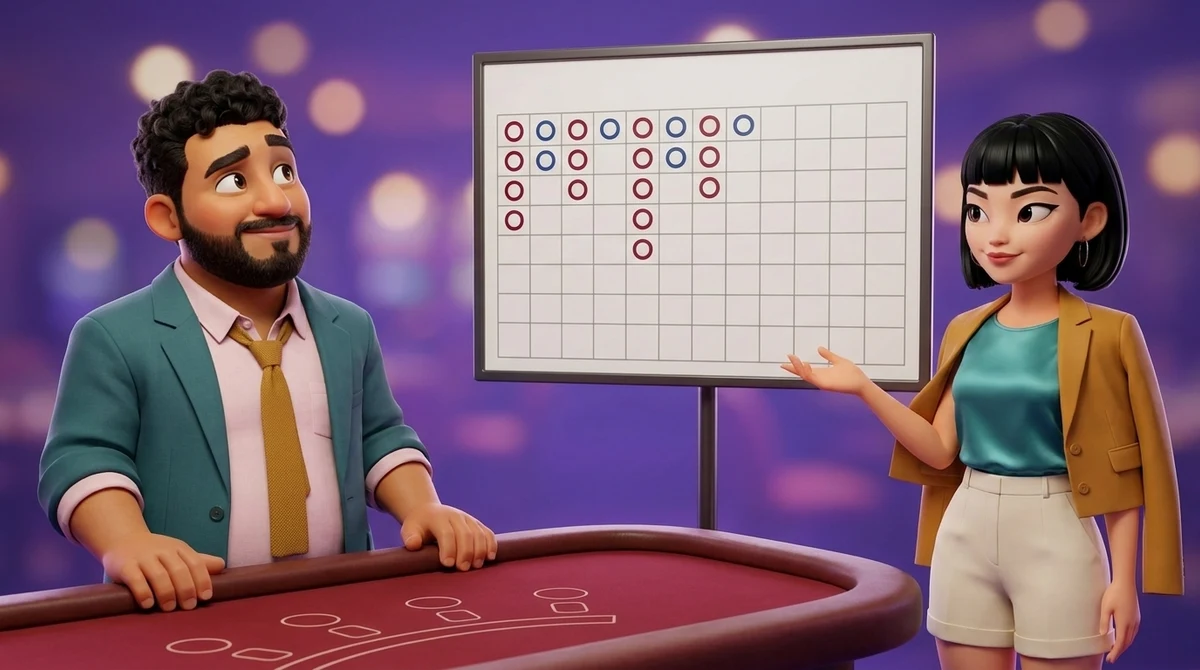
Six Banker hands in a row stand on the board beside a baccarat table. What is the chance that the next hand is a Banker hand?
The short answer
About 45.9%: the same chance as on any hand dealt from a full shoe of eight decks. The board beside the table records hands that have already been played. The Bead Plate gives every hand a bead of its own, and the Big Road gives every run of one side a column of its own. The cards still in the shoe were shuffled in before the first mark went on the board, so a run of six Banker hands leaves the chances of the next hand where they were. Baccarat leaves you one decision, the bet, and no road turns that one decision into a strategy.
Big Road
Next handBanker 45.9%Player 44.6%Tie 9.5%
The first 22 hands of a practice shoe, drawn on a Big Road: a red ring is a hand where Banker came out ahead, a blue ring a hand where Player came out ahead, and a green line through a ring is a tie. The newest column is six Banker hands in a row. The plaque under the road gives the chances of the next hand, and the plaque reads the same under any board.

Mayaformer floor supervisor · manners, money and breaks
On every floor I ran, the board beside the baccarat table was the first thing people read when they sat down, before the felt and before the sign with the limits. Some of them copied the board into a notebook, column by column, as if the next hand were written somewhere in the columns.
The board records hands already played
In three rooms in Quebec, the baccarat tables have a board above them that shows the results of the latest hands, so that the people who follow the game can keep up with how the day has gone. Those rooms describe the board in a sentence and go no further: no document we could read names the roads on the board of a live table, or says how a live table draws them.
The names of the roads, and how each road is drawn, are printed on one card: the card for electronic baccarat (IGT) in B.C. casinos, which describes the screen of an electronic table rather than the board above a live table. The card names five roads, and the five roads give the players a view of the hands that came out ahead before.
- Bead PlateOne bead for every hand, in the order the hands were dealt.Drawn here
- Big RoadOne column for every run of one side; a tie is a line, not a mark.Drawn here
- Big Eye Boy RoadWorked out from the Big Road, starting from the Big Road’s second column.Named, not drawn
- Small RoadWorked out from the Big Road, starting from the Big Road’s third column.Named, not drawn
- Cockroach RoadWorked out from the Big Road, starting from the Big Road’s fourth column.Named, not drawn
Two of the five roads are drawn in this lesson, the way the card describes them: the Bead Plate and the Big Road. The other three roads are worked out from the Big Road, and the card does not say how each of their marks is decided, so the other three are named and not drawn.
The Bead Plate: one bead for every hand
The Bead Plate has at least six rows and twelve columns. Every hand gets one bead: red for a hand where Banker came out ahead, blue for a hand where Player came out ahead, and green for a tie. The beads go in from the upper left corner, one row down at a time, and when a column is full the next bead starts at the upper end of the next column to the right.
Bead Plate
The first 30 hands of the same shoe on a Bead Plate: 5 full columns of six. A tie keeps a bead of its own, in its own place in the order, so the Bead Plate is the one road where every hand of the shoe can be counted. The letters B, P and T on the beads are added here for readers who do not see the colours.
The Big Road: one column for every run
The Big Road is usually six rows high, and its marks also go in from the upper left corner and down the column. The difference is in when a new column starts: a new column starts only when the side that came out ahead changes, from Banker to Player or from Player to Banker. A tie gets no mark of its own; the tie is drawn as a green line through the last mark on the road. When one side comes out ahead more than six times in a row, the run turns right and carries on along the bottom row, in a shape the card calls the dragon.
Big Road
The same 30 hands as the Bead Plate above, on a Big Road. The six Banker hands of the first picture stand in the tallest column. Hand 23 was a tie, drawn as a green line through the sixth Banker mark, and hand 24 was a seventh Banker hand: the seventh mark had no row left below the sixth mark, so the run turned right along the bottom row.
Three roads worked out from the Big Road
The Big Eye Boy Road, the Small Road and the Cockroach Road are all worked out from the Big Road. Each of the three starts from a different column of the Big Road: the Big Eye Boy Road from the hand after the first mark in the second column, the Small Road from the hand after the first mark in the third column, and the Cockroach Road from the hand after the first mark in the fourth column. On all three, red stands for a pattern and blue for randomness.
Big Road
The same 30 hands on the Big Road again, with the mark each derived road starts from: 1 for the Big Eye Boy Road, 2 for the Small Road and 3 for the Cockroach Road. A tie has no mark of its own on the Big Road, so the hand after a first mark is taken here as the next mark on the road.
The rules of an online baccarat game in Quebec add two things the card does not print. The roads and the statistics of the shoe are cleared every time a new shoe comes in, and on the derived roads red and blue do not stand for Banker and Player, and there is no way to tell a tie or a pair from the other marks.
A pattern on a derived road is a description of the Big Road: whether the Big Road has been repeating its own shape. Every derived road is worked out from marks already on the Big Road, so a derived road can say nothing about the next hand that the Big Road cannot say, and the Big Road itself says nothing about the cards still in the shoe.
What the board says about the next hand
The card for electronic baccarat (IGT) in B.C. casinos says two things about the trend information on the player’s screen, and says both in one section. First, the trend information at the upper edge of the screen, with how often Player and Banker came out ahead, the ties and the pairs, “can assist with making bets”. Second, the game is random, and the trends have no effect on the outcome of the hands still to be dealt.
A guide for players puts the point plainly: baccarat is a game of pure chance, many players follow patterns and base their bets on the patterns, and basing bets on streaks or past hands gives no edge, because the cards do not know what happened before.
Big Road
Next handBanker 45.9%Player 44.6%Tie 9.5%
Big Road
Next handBanker 45.9%Player 44.6%Tie 9.5%
Big Road
Next handBanker 45.9%Player 44.6%Tie 9.5%
Three boards drawn for this lesson: they look nothing alike, and the plaque is the same under all three.
An eTable is a virtual table with no cards at all: an eTable decides every play by a random number generated the moment you play, and every play there is independent of the plays before and after. A live table deals real cards from a shoe.
Every hand is dealt from the shoe by the same drawing rules, and the chances of a hand are counted from the cards that can still come out of the shoe, not from the marks on the board. Over a few dozen hands a board can sit far from the plaque. Over thousands of hands the shares on a board come close to the plaque, not because one side catches up, but because every new hand is dealt at the chances on the plaque and the new hands outweigh the old ones.
| Hands dealt | Banker | Player | Tie |
|---|---|---|---|
| 25 | 52.0% | 36.0% | 12.0% |
| 50 | 42.0% | 46.0% | 12.0% |
| 100 | 47.0% | 42.0% | 11.0% |
| 200 | 51.0% | 39.0% | 10.0% |
| 2,000 | 45.8% | 44.6% | 9.6% |
| 20,000 | 46.1% | 44.2% | 9.7% |
| The plaque: every single hand | 45.9% | 44.6% | 9.5% |
One long run of a practice shoe, counted at six points along the way. After 25 hands the shares sit several points from the plaque; after 2,000 hands and after 20,000 hands the shares sit within half a point of the plaque. The plaque is the chance on every one of those hands, on the first hand as much as on the last.

Leoformer dealer · rules and maths
When I dealt, a long red column on the board would bring people over from the next table, half of them sure the run would go on and the other half sure the run was about to break. The shoe in front of me was the same shoe as an hour before. Every card I slid out of that shoe had been shuffled in before anyone looked at the board.
Why baccarat has no strategy to find
A player’s only decision at baccarat is the bet: Banker, Player or a tie. Nobody at the table decides whether a hand takes a card, and no skill improves the chances of a hand. So the honest answer to the question of a baccarat strategy is short: there is no decision during a hand to get right.
| What the bettor does | What the board is taken to say | What changes |
|---|---|---|
| Bets on the side of the newest column | the run will go on | nothing about the next hand |
| Bets against a long run | the other side is due | nothing about the next hand |
| Waits for red marks on a derived road | a pattern is coming | nothing about the next hand |
| Sits out until the board looks right | some hands are worth more than others | how many bets go down, not what each bet costs |
| Chooses Banker, Player or the tie | nothing at all | the price of the bet |
The three bets do not cost the same. Over many hands the Banker bet costs a little less than the Player bet, and the tie bet costs far more than either; what each bet costs is lesson 6.4.
Players do follow the board, and a study shows how strongly. An analysis of 17,970,830 hands of baccarat played by 6,625 customers at one casino found that customers bet more and more often on a run going on as the run grew longer, and that the bets grew slightly larger when customers followed a run. The article’s metadata record names SEGA SAMMY HOLDINGS, Inc. as the funder of the study. The study watched the players of one casino, and the study says nothing about the rooms in Canada.
Money and time at baccarat
A board makes a run easy to see, and a run is the moment people change what they planned: a bigger bet to follow the road, or a bigger bet to fight the road. Both are decisions about money, and money and time are the two parts of an evening that are decided before the shoe starts, away from the board.
- The moneyAn amount for the evening, decided at home before the first hand — Game plan walks you through it.
- The timeAn end to the evening, set before the shoe starts and kept when a run is on the board.
- The breakA new shoe is the natural place to stand up, step away from the board and check the money and the time.
Three signs say that an evening has moved from playing to chasing a loss, and all three signs are easy to miss with a board in front of you.
- A bigger bet to get a loss backThe run turned against you, and the next bet went up to cover the bets that went down.
- Staying for the shoe to turnThe time you set has passed, and you are still at the table waiting for the board to come round.
- Money meant for something elseThe chips on the felt came from money that had another job to do.

Mayaformer floor supervisor · manners, money and breaks
Decide at home how much money the evening gets and when the evening ends, and let a new shoe be the moment you stand up and check both. A run that took money is not a debt the next shoe pays back: putting more down to get a loss back only buys more hands at the same price. If any of the three signs is familiar, the lines below are there for exactly that, and the self-exclusion guide sets out what a term covers and how enrolment works.
If it stops being fun
If gambling stops being entertainment, help is available. 19+ in most of Canada; 18+ in Alberta, Manitoba and Quebec. More on responsible gaming.
Practice: read the scoreboard
The practice board is 200 hands from practice shoes, shown 25 hands at a time. After each stretch the Bead Plate and the Big Road have grown, the plaque underneath has not moved, and one question asks what the board has recorded.
Nothing here is scored, and nothing asks you to call the next hand.
Lesson done
Review my mistakes (0)
Progress stays in this browser; nothing is sent anywhere.
The practice table needs JavaScript. Here is one board from it, with the answer.
The first stretch of the shoe
Hands 1 to 25 of the practice board: the first hands of the shoe.
Bead Plate
Big Road
- A run has turned right along the bottom row. The card does not say where the next column starts after such a run; this practice board starts the next column at the upper end, above the tail of the run.
Next handBanker 45.9%Player 44.6%Tie 9.5%
The Bead Plate holds the first 25 hands of the shoe. How many of those hands were Banker hands?
- 10 10 red beads, one bead for each hand where Banker came out ahead, whatever came before or after that hand.
- 3 That is the number of Banker columns on the Big Road. A Big Road column is a whole run of Banker hands, so one column can hold several Banker hands.
- 11 That is the blue beads: the hands where Player came out ahead.
- 14 That counts the green beads as well. A green bead is a tie, and a tie is neither a Banker hand nor a Player hand.
The Bead Plate gives every hand one bead of its own: red for a Banker hand, blue for a Player hand and green for a tie. The beads fill each column from the upper end down, and then the next column to the right.
Runs longer than four hands
Hands 1 to 75 of the practice board. Hands 51 to 75 are the newest, in full colour; the earlier hands are faded.
Bead Plate
Big Road
- A new shoe starts at hand 65: the cards are shuffled again, and this practice board carries on across the shoes.
- The card gives the Bead Plate at least six rows and twelve columns and does not say what happens when every square is full; this practice board adds columns to the right.
- The rules for B.C. casinos say how the cards are mixed and not how far into a shoe play goes, so this practice shoe is shuffled again once three quarters of the cards are out.
Next handBanker 45.9%Player 44.6%Tie 9.5%
After 75 hands, how many runs on the Big Road are longer than 4 hands?
- 2 Count the columns with 5 marks or more, the marks along the bottom row included: 2.
- 5 That counts the runs of exactly 4 as well. Longer than 4 means 5 hands or more.
- 1 That ends a run at every tie. A tie is drawn as a line through the last mark, and the same column carries on when the same side comes out ahead again.
- 7 That is the length of the longest run on the road, not the number of runs longer than 4.
A run here is one whole column of the Big Road, and a tie does not end a run. That reading is ours: the card draws a tie on the last mark and starts a new column only when the side changes, and the card does not say whether a tie ends a streak.
Every board in the practice run is worked out the same way: the hands come out of shuffled practice shoes, the Bead Plate and the Big Road are drawn from them by the rules on the card, and the answer to each question is counted from the same hands.
How the practice run works
Where the hands come from. Every hand comes out of a practice shoe of eight decks, shuffled with a fixed seed when the page is built, and the shoe is shuffled again once three quarters of its cards are out. The board carries on across the shoes so that all the hands can be counted together, and a note on the board says where a new shoe starts.
Where the answers come from. Every count is worked out by the engine from the same hands that are drawn: the Banker beads, the columns of the Big Road, the runs longer than a length, the longest run, the share of each side. The wrong answers are named mistakes: columns counted as hands, a tie counted as a column or as the end of a run, a board’s own share read as the chance of the next hand, and a run read as a reason for the next hand to go one way.
One level, read through. The level is a reference: there are no squares to fill, the boards come in order, and the run ends after the last board. Your progress stays in this browser, and nothing is sent anywhere.
Check yourself

Mayaformer floor supervisor · manners, money and breaks
Five quick ones. Pick an answer, then check it. No timer, no points: just whether it stuck.
Back to the question we opened with. After six Banker hands in a row, the chance that the next hand is a Banker hand is about 45.9%, the figure on the plaque, the same as on any hand dealt from a full shoe of eight decks.
Where baccarat is played, and further reading
19+ (18+ in AB, MB, QC) · Play responsibly · the helplines are further up this page
Further reading
- How to play baccarat · BCLCB.C.’s plain-words page: who deals at a mini table, how the commission is taken, and the no-commission and squeeze tables.
- Baccarat strategies · OLG PlaySmartWhy your only choice is the bet, and why streaks and past hands give no edge.
- How to play baccarat (electronic baccarat (IGT) in B.C. casinos) · BCLCThe card for the electronic tables in B.C. casinos: the five roads and what each one records.
How it’s worked out
Boards, numbers, sources and hosts
Where this happens. The roads in this lesson are drawn the way the card for electronic baccarat (IGT) in B.C. casinos describes the screen of that electronic table. Three rooms in Quebec say their live baccarat tables have a board of the latest results above them, and no document we could read describes the roads on the board of a live table, so nothing here says that a live table’s board is drawn this way. An online game in Quebec is quoted for two things only, the roads cleared with a new shoe and the ties and pairs that cannot be told apart on its derived roads, and the online game is named as online wherever it is quoted.
The boards. Every board is drawn by our baccarat engine from the card’s rules: the Bead Plate one bead for every hand down each column, the Big Road a new column at every change of side, a tie as a green line through the last mark, and a run longer than six turned right along the bottom row. The letters on the beads and the rings are ours, added so that the two sides read without colour. Where the card says nothing, the boards make a choice and say so: a tie before the first mark goes on the first mark, several ties on one mark are drawn as one line each, the column after a run that turned right starts at the upper end above the tail of the run, and a full Bead Plate gains columns to the right. A run is one whole column of the Big Road, so a tie does not end a run; that reading is ours. The derived roads are named and not drawn, because the card does not say how their marks are decided; the hand each derived road starts from is taken as the next mark on the Big Road, because a tie has no mark of its own.
The practice board. The practice board is 200 hands from practice shoes of eight decks, shuffled with a fixed seed when the page is built. Where a practice shoe ends is our choice, because the rules for B.C. casinos say how the cards are mixed and not how far into a shoe play goes: a practice shoe is shuffled again once three quarters of its cards are out. The practice board carries on across the shoes so that all the hands can be counted together; the card does not say whether a board is cleared when a new shoe starts, and the online game in Quebec clears its roads with every new shoe. The shoe was chosen so that each question’s wrong answers come out different from the right answer and from each other, and so that the first boards show a run of six Banker hands; the hands themselves are dealt by the engine, not written in.
Numbers. The plaque is counted over every way a full shoe of eight decks can deal a hand. Eight decks is an assumption: on six decks the three shares move by less than a tenth of a point. Inside one shoe the cards already dealt move the chances of the next hand a little, one way or the other, and the marks on the board say which side came out ahead, not which cards are left, so the plaque is the figure a board leaves you with. The long run in the table is one sequence of practice shoes; another sequence would land a little differently. Every figure on this page carries a key, and our checks recompute each figure from the engine rather than reading it back from the page.
The study. The study is a research article about the players of one casino. What is taken from the study here is how many hands and customers the study analysed, that customers followed runs more often as runs grew longer, that the bets grew slightly larger when customers followed a run, and who funded the study, as the article’s metadata record names the funder. The article is not a source about Canada, and nothing here carries the study’s findings over to the rooms in Canada.
One sentence in two pieces. On the card for electronic baccarat, the sentence about trends is printed in one piece, with the word affect between the two pieces the source button shows. The word is printed with a joined ff that our text copy of the card loses, so the button shows the two pieces around the gap, and the printed card was read by eye.
What is deliberately absent. Counting a hand and the drawing rules are lessons 6.1 and 6.2; the bets, who deals and the price of an hour are lesson 6.3; what each bet costs and the tables without commission are lesson 6.4; side bets are lesson 6.5; the squeeze and the big table are lesson 6.6. There is no exercise here that asks you to call the next hand, because calling the next hand is not a skill a board can teach, and no road on this page is offered as a way to choose a bet.
Sources. Every rule and every claim on this page carries a button with the sentence it rests on, the publisher who wrote that sentence and the date we read it.
Hosts. Maya and Leo are illustrated characters. Their backstories, a former floor supervisor and a former dealer, are written for the course: neither is a real person, and neither speaks for any casino. The rules and numbers on this page come from the sources it cites, not from their experience.
No promise. Baccarat is played against the house. Reading the board tells you what has already happened at the table; nothing on this page makes any bet cheaper, and nothing here says how an evening at the table would end.
Streaks and past hands
But Baccarat is a game of pure chance, and basing bets on streaks or past hands won’t give you an edge.
Many players follow patterns – and base their bets on them.
The cards don’t know what happened previously.
Betting based on what seem like streaks or patterns won’t give you an edge.
OLG PlaySmart · Get Your Game On — Mini Baccarat (video transcript) · read
The only decision is the bet
A player’s only decision is to bet on the Banker’s hand, the Player’s hand or a Tie, and there are no real strategies to boost the odds to win.
Baccarat is a game of pure chance, meaning you can’t improve your odds using skill.
Trends, on the card for electronic baccarat (IGT) in B.C. casinos
TRACKING TRENDS
Trend information can be found at the top of the player screen and can assist with making bets and includes frequency of Player and Banker wins, Ties, and Pairs.
This game is random and that trends do not
the outcome of the hands that will be dealt.
BCLC · Casinos BC — How to play baccarat (electronic baccarat (IGT) in B.C. casinos) · read
The Big Road, on the card for electronic baccarat (IGT) in B.C. casinos
Baccarat Big Road: Usually 6 rows high.
Hands are recorded from the top left corner and continuing down the column.
A winning Banker hand is red, a winning Player hand is blue, and a tie is recorded with a green line through the last entry.
Each time the winning position changes, a new column begins.
If a position wins more than 6 times in a row, the streak turns right and continues on the bottom row in a pattern called “the dragon.”
BCLC · Casinos BC — How to play baccarat (electronic baccarat (IGT) in B.C. casinos) · read
The Bead Plate, on the card for electronic baccarat (IGT) in B.C. casinos
Bead Plate Road: Contains at least 6 rows and 12 columns.
A winning Banker hand is red, a winning Player hand is blue, and a tie is green.
Hands are recorded from the top left corner, moving down one row at a time, and starting again at the top of the next column to the right.
BCLC · Casinos BC — How to play baccarat (electronic baccarat (IGT) in B.C. casinos) · read
Boards above the baccarat tables in three rooms in Quebec
Au-dessus des tables de baccara se trouve un tableau qui affiche les derniers résultats.
The results of prior games are displayed above the tables to enable Baccarat fans to follow the rhythm of the day’s game.
Le tableau des résultats
Au-dessus des tables de baccara se trouve un tableau qui affiche les derniers résultats. Ce tableau permet aux mordus de baccara de suivre le rythme du jeu.
The five roads, on the card for electronic baccarat (IGT) in B.C. casinos
BACCARAT ROADS
Baccarat roads provide players a view of the preceding winning hands.
The most common are the Bead Plate, the Big Road, the Big Eye Boy Road, the Small Road, and the Cockroach Road.
BCLC · Casinos BC — How to play baccarat (electronic baccarat (IGT) in B.C. casinos) · read
The Bead Plate, on the card for electronic baccarat (IGT) in B.C. casinos
Bead Plate Road: Contains at least 6 rows and 12 columns.
A winning Banker hand is red, a winning Player hand is blue, and a tie is green.
Hands are recorded from the top left corner, moving down one row at a time, and starting again at the top of the next column to the right.
BCLC · Casinos BC — How to play baccarat (electronic baccarat (IGT) in B.C. casinos) · read
The Big Road, on the card for electronic baccarat (IGT) in B.C. casinos
Baccarat Big Road: Usually 6 rows high.
Hands are recorded from the top left corner and continuing down the column.
A winning Banker hand is red, a winning Player hand is blue, and a tie is recorded with a green line through the last entry.
Each time the winning position changes, a new column begins.
If a position wins more than 6 times in a row, the streak turns right and continues on the bottom row in a pattern called “the dragon.”
BCLC · Casinos BC — How to play baccarat (electronic baccarat (IGT) in B.C. casinos) · read
The three derived roads, on the card for electronic baccarat (IGT) in B.C. casinos
Big Eye Boy Road: Derived from the Big Road, it shows whether or not there are discernible patterns.
The first entry is the hand after the first entry in the second column of the Big Road.
Small Road: Also derived from the Big Road.
The first entry is the hand after the first entry in the third column of the Big Road.
Cockroach Road: Also derived from the Big Road.
The first entry is the hand after the first entry in the fourth column of the Big Road.
Red represents a pattern, blue represents randomness.
BCLC · Casinos BC — How to play baccarat (electronic baccarat (IGT) in B.C. casinos) · read
Roads in an online baccarat game in Quebec
Roads and shoe statistics are always cleared when a new shoe is introduced.
However, in these derived roads, the colours red and blue do not correspond to Banker and Player wins, and there is no way to discern ties or pairs.
Loto-Québec (online version) · Peek Baccarat — game rules · read
Trends, on the card for electronic baccarat (IGT) in B.C. casinos
TRACKING TRENDS
Trend information can be found at the top of the player screen and can assist with making bets and includes frequency of Player and Banker wins, Ties, and Pairs.
This game is random and that trends do not
the outcome of the hands that will be dealt.
BCLC · Casinos BC — How to play baccarat (electronic baccarat (IGT) in B.C. casinos) · read
Streaks and past hands
But Baccarat is a game of pure chance, and basing bets on streaks or past hands won’t give you an edge.
Many players follow patterns – and base their bets on them.
The cards don’t know what happened previously.
Betting based on what seem like streaks or patterns won’t give you an edge.
OLG PlaySmart · Get Your Game On — Mini Baccarat (video transcript) · read
eTables: a random number for every play
At these virtual eTables, whether you win or lose is determined by the random number generated in the exact instant you activate each play.
Each play is totally random and independent of previous or future plays, making it impossible to predict what will happen on each turn.
It doesn't matter if you just lost three times in a row, or 40. The odds of winning never change.
The only decision is the bet
A player’s only decision is to bet on the Banker’s hand, the Player’s hand or a Tie, and there are no real strategies to boost the odds to win.
Baccarat is a game of pure chance, meaning you can’t improve your odds using skill.
A study of the baccarat players of one casino
This study investigated the cognitive biases underlying baccarat gambling behaviors through an analysis of 17,970,830 games played by 6625 customers in a casino.
Specifically, customers increasingly placed bets on future outcomes to match past consecutive outcomes as streaks grew longer.
Moreover, betting amounts increased slightly but reliably when gamblers followed trends.
Who funded the study
"funder":[{"name":"SEGA SAMMY HOLDINGS, Inc."}]
Crossref · Metadata record of the same article, DOI 10.1016/j.actpsy.2025.105172 · read
Spotted a mistake on this page? Tell us
Been here before? Review us on Trustpilot