Atlassino Academy · Blackjack · Lesson 21 of 21
Bahama Bonus: no tens, bonuses and redoubles
A shoe with no tens and, at Fallsview, a double that can be doubled again or rescued, and payouts that a second bet on the hand takes away.
At Fallsview, Bahama Bonus is a Spanish 21 table where a double may be doubled again, and that move redraws a corner of the chart. Which corner is it, and what does the table charge for the move?
The short answer
The corner is the double. Played by the chart worked out for these rules, this game doubles in cells where the same game without the redouble takes a card, and after the double card it has a third choice beside standing and doubling again: taking the first bet back and leaving the hand. The chart for this game and the chart for the same game without the redouble name different moves in 21 cells of 330. What the game costs turns on one line posted at the table, and that line is what the dealer does on a soft 17.
One hand: one bet at the start, two bets after the double, four after a redouble, eight after another, sixteen after a third, each step bringing one card. Beside every step after the double stands the rescue, which gives back the first bet only.
- The hand startsone bettwo cards are dealt
- The doubletwo betsone card comes
- A redoublefour betsone more card
- Another redoubleeight betsone more card
- A third redoublesixteen betsone more card
- The rescuethe first bet backevery double on the hand stays with the table
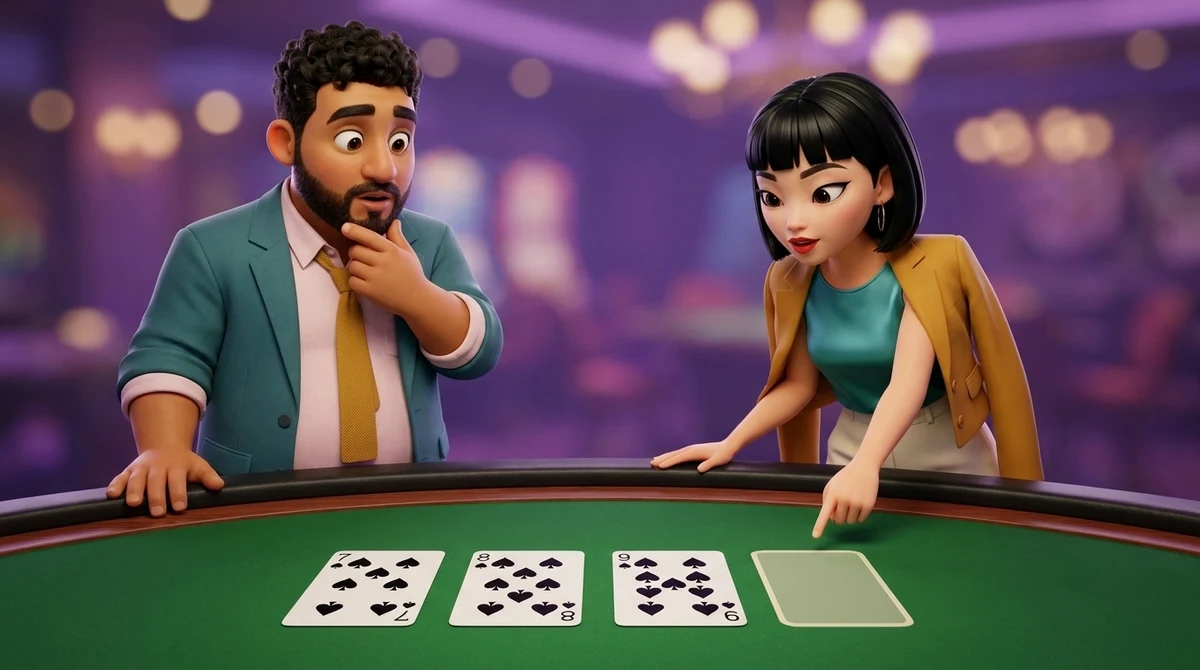
The deck, and what the table prints before any double
Bahama Bonus is dealt from decks with every 10 taken out: the jacks, queens and kings stay, and so does every ace and every card from a 2 to a 9. A card worth ten points is still a common card in this shoe; four of them in every deck are missing.
- A
- 2
- 3
- 4
- 5
- 6
- 7
- 8
- 9
- 10 taken out
- J
- Q
- K
One suit of one deck: thirteen ranks in a standard deck, twelve here, with the rank printed as 10 crossed out. How many such decks go into the shoe is up to the table; at Casino de Montréal, anything from one deck to eight.
Before the double comes into it, four more lines change the plain game, and two rooms word some of them differently.
| The rule | What it means at the table |
|---|---|
| Your blackjack against the dealer’s | At Fallsview a blackjack of yours is paid three to two even when the dealer has one too; at Casino de Montréal it is settled in your favour whatever the dealer holds. |
| Your 21, and a tie | At Casino de Montréal a 21 of yours is settled in your favour, and two equal totals are a push only at 20 or less. |
| Surrender | On the first two cards, before any other move: half of the first bet is lost and the hand leaves the round. At Fallsview there is no surrender against a dealer blackjack. |
| Splitting | Any two cards of equal value, aces too, up to four hands, and a split hand may take cards and be doubled. At Fallsview the Bonus 21 payouts are paid on split hands as well. |
None of the four lines is the redouble, but the chart further down counts every one of them — the 21 rule too: a 21 of yours is counted as settled in your favour, which Casino de Montréal prints and the Fallsview card does not.
The double, and the double again
At Fallsview a second bet may go up on two cards or more, on any total, and after a split as well. After that first double comes the move this game is built around: the hand may be redoubled up to three times, each redouble doubles everything already on the hand, and each redouble brings exactly one card.
| The question | Fallsview, English card | The French card for the same two rooms | Casino de Montréal |
|---|---|---|---|
| When a second bet may go up | On two cards or more, on any total, and after a split | On two cards or more, on any total | On any hand that is not a blackjack or a hard 21, and after a split |
| How many times | One double, then up to three redoubles, one card each time | Once | Once, for one more card only |
| How much a double puts up | A redouble puts up as much as everything already on the hand | The bet is doubled | Up to the first bet, within the limits posted at the table |
So the chart further down belongs to a table that deals by the English wording of the Fallsview card. At a table that prints one double, or at Casino de Montréal, every cell the redouble moved leans on a move that table does not offer, and the chart on this page is the wrong chart to carry there.
Where the redouble moves the chart
A first double that can be followed by more doubles is worth more than a first double that ends the hand, and so the chart before the double moves to match. Here it is for six 48-card decks under the English Fallsview card, with the dealer hitting a soft 17. A cell with a heavy frame and a dot is a cell where the chart for the same game without the redouble names a different move.
| Hard | 2 | 3 | 4 | 5 | 6 | 7 | 8 | 9 | 10 | A |
|---|---|---|---|---|---|---|---|---|---|---|
| 5–7 | H | H | H | H | D, differs from the same game without the redouble | H | H | H | H | H |
| 8 | H | H | H | D, differs from the same game without the redouble | D, differs from the same game without the redouble | H | H | H | H | H |
| 9 | H | D4, differs from the same game without the redouble | D, differs from the same game without the redouble | D, differs from the same game without the redouble | D | H | H | H | H | H |
| 10 | D5 | D5 | D | D | D | D4 | D3 | H | H | H |
| 11 | D4 | D5 | D5 | D5 | D5 | D4 | D4 | D4 | D3 | D3 |
| 12 | H | H | H | H | H | H | H | H | H | H |
| 13 | H | H | H | H | S4* | H | H | H | H | H |
| 14 | H | H | S4* | S5† | S6‡ | H | H | H | H | H |
| 15 | S4* | S5† | S6 | S6 | S | H | H | H | H | H |
| 16 | S6 | S6 | S6 | S | S | H | H | H | H | Rh |
| 17 | S | S | S | S | S | S | S6 | S6 | S6 | Rh |
| 18+ | S | S | S | S | S | S | S | S | S | S |
- Hhit
- Sstand
- Ddouble
- D3double with up to 2 cards; with 3 or more, hit
- D4double with up to 3 cards; with 4 or more, hit
- D5double with up to 4 cards; with 5 or more, hit
- S4stand; hit with 4 or more cards
- S5stand; hit with 5 or more cards
- S6stand; hit with 6 or more cards
- Rhsurrender, otherwise hit
- *hit if the two cards are 6-7, 6-8 or 7-8 (a 6-7-8 bonus is still possible)
- †hit if those two cards are of one suit
- ‡hit if those two cards are both spades
- •differs from the same game without the redouble
| Soft | 2 | 3 | 4 | 5 | 6 | 7 | 8 | 9 | 10 | A |
|---|---|---|---|---|---|---|---|---|---|---|
| A,2 | H | D3, differs from the same game without the redouble | D, differs from the same game without the redouble | D, differs from the same game without the redouble | D, differs from the same game without the redouble | H | H | H | H | H |
| A,3 | H | D3, differs from the same game without the redouble | D4, differs from the same game without the redouble | D, differs from the same game without the redouble | D, differs from the same game without the redouble | H | H | H | H | H |
| A,4 | H | H | D4, differs from the same game without the redouble | D4, differs from the same game without the redouble | D5 | H | H | H | H | H |
| A,5 | H | H | D3, differs from the same game without the redouble | D4 | D5 | H | H | H | H | H |
| A,6 | H | H | D3 | D4 | D5 | H | H | H | H | H |
| A,7 | S4 | S4 | D4 | D5 | D6 | S6 | S4 | H | H | H |
| A,8 | S | S | S | S | S | S | S | S | S6 | S6 |
| A,9 | S | S | S | S | S | S | S | S | S | S |
- Hhit
- Sstand
- Ddouble
- D3double with up to 2 cards; with 3 or more, hit
- D4double with up to 3 cards; with 4 or more, hit
- D5double with up to 4 cards; with 5 or more, hit
- D6double with up to 5 cards; with 6 or more, hit
- S4stand; hit with 4 or more cards
- S6stand; hit with 6 or more cards
- •differs from the same game without the redouble
| Pair | 2 | 3 | 4 | 5 | 6 | 7 | 8 | 9 | 10 | A |
|---|---|---|---|---|---|---|---|---|---|---|
| 2,2 | P | P | P | P | P | P | P | H | H | H |
| 3,3 | P | P | P | P | P | P | P | H | H | H |
| 4,4 | H | H | H | D, differs from the same game without the redouble | D, differs from the same game without the redouble | H | H | H | H | H |
| 5,5 | D | D | D | D | D | D | D | H | H | H |
| 6,6 | H | H | P | P | P | H | H | H | H | H |
| 7,7 | P | P | P | P | P | P | H | H | H | H |
| 8,8 | P | P | P | P | P | P | P | P | P | Rh |
| 9,9 | S | P | P | P | P | S | P | P | S | S |
| 10,10 | S | S | S | S | S | S | S | S | S | S |
| A,A | P | P | P | P | P | P | P | P | P | P |
- Hhit
- Sstand
- Ddouble
- Psplit
- Rhsurrender, otherwise hit
- •differs from the same game without the redouble
In every marked cell this chart doubles, and the chart for the same game without the redouble does something else: the redouble is the only rule that differs between the two, and the only move it moves is the double. Hard totals that play alike share a row, so a dot in that row stands for each total in it.
- Hard 5double against 6, where the chart without the redouble says “take a card”.
- Hard 6double against 6, where the chart without the redouble says “take a card”.
- Hard 7double against 6, where the chart without the redouble says “take a card”.
- Hard 8double against 5 and 6, where the chart without the redouble says “take a card”.
- Hard 9double against 3 to 5, where the chart without the redouble says “take a card”.
- Soft 13double against 3 to 6, where the chart without the redouble says “take a card”.
- Soft 14double against 3 to 6, where the chart without the redouble says “take a card”.
- Soft 15double against 4 and 5, where the chart without the redouble says “take a card”.
- Soft 16double against 4, where the chart without the redouble says “take a card”.
- A pair of 4sdouble against 5 and 6, where the chart without the redouble says “take a card”.
The marked cells in words, row by row.
Set beside the chart of the Spanish 21 lesson — the same decks, no redouble, and no bonus paid on a split hand — the count of cells with a different move is 22. The one cell that is not about the double is a pair of 2s against an 8, which this game splits and that chart takes a card on, because here a split hand can still be paid a bonus.
A double the chart calls for can still lose, and on a redoubled hand it loses every bet on that hand at once. Playing by the chart makes the share the house keeps smaller; over all the hands of an evening it does not take that share away.
The way out after a double
At Fallsview a hand that has been doubled and has not gone over 21 may be rescued: the player takes back the first bet only, gives up every double and redouble on the hand, and leaves the round.
Two rooms, two rescues. At Fallsview the first bet comes back and every double stays with the table. Casino de Montréal words its rescue the other way round: the amount added as a double comes back, and the first bet is lost.
A rescue is not a surrender. A surrender comes before any other move on your first two cards and costs half of the first bet; a rescue comes only after a double, and at Fallsview it costs everything on the hand except the first bet.
The chart after the double card
Once the double card has come, two bets are on the hand and there are three choices: double again, stand, or rescue. A plain blackjack chart has no row for this moment at all. Here are the rows worked out for it, for the same six decks and the same dealer rule.
| Total | 2 | 3 | 4 | 5 | 6 | 7 | 8 | 9 | 10 | A |
|---|---|---|---|---|---|---|---|---|---|---|
| 6 | S | D | D | D | D | D | X | X | X | X |
| 7 | D | D | D | D | D | D | X | X | X | X |
| 8 | D | D | D | D | D | D | D | X | X | X |
| 9 | D | D | D | D | D | D | D | D | D | X |
| 10 | D | D | D | D | D | D | D | D | D | D |
| 11 | D | D | D | D | D | D | D | D | D | D |
| 12 | S | S | S | S | S | D | D | X | X | X |
| 13 | S | S | S | S | S | S | X | X | X | X |
| 14 | S | S | S | S | S | S | X | X | X | X |
| 15 | S | S | S | S | S | S | X | X | X | X |
| 16 | S | S | S | S | S | S | X | X | X | X |
| 17 | S | S | S | S | S | S | S | S | S | X |
| 18 | S | S | S | S | S | S | S | S | S | S |
| 19 | S | S | S | S | S | S | S | S | S | S |
| 20 | S | S | S | S | S | S | S | S | S | S |
- Sstand
- Ddouble again
- Xrescue: take the first bet back, give up the doubles
| Total | 2 | 3 | 4 | 5 | 6 | 7 | 8 | 9 | 10 | A |
|---|---|---|---|---|---|---|---|---|---|---|
| Soft 13 | D | D | D | D | D | D | D | D | D | X |
| Soft 14 | D | D | D | D | D | D | D | D | D | X |
| Soft 15 | D | D | D | D | D | D | D | D | D | X |
| Soft 16 | D | D | D | D | D | D | D | D | D | X |
| Soft 17 | D | D | D | D | D | D | D | D | D | X |
| Soft 18 | S | S | D | D | D | S | S | S | S | S |
| Soft 19 | S | S | S | S | S | S | S | S | S | S |
| Soft 20 | S | S | S | S | S | S | S | S | S | S |
- Sstand
- Ddouble again
- Xrescue: take the first bet back, give up the doubles
Every cell here is a hand that has already been doubled once and has just taken its double card. The rescue appears where the hand is weak and the dealer’s card is strong, and a 10 or an 11 is doubled again against every dealer card.
The two tables above, row by row in words
- Hard 6stand against 2; double again against 3 to 7; rescue: take the first bet back, give up the doubles against 8 to ace.
- Hard 7double again against 2 to 7; rescue: take the first bet back, give up the doubles against 8 to ace.
- Hard 8double again against 2 to 8; rescue: take the first bet back, give up the doubles against 9 to ace.
- Hard 9double again against 2 to 10; rescue: take the first bet back, give up the doubles against ace.
- Hard 10double again against every dealer card.
- Hard 11double again against every dealer card.
- Hard 12stand against 2 to 6; double again against 7 and 8; rescue: take the first bet back, give up the doubles against 9 to ace.
- Hard 13stand against 2 to 7; rescue: take the first bet back, give up the doubles against 8 to ace.
- Hard 14stand against 2 to 7; rescue: take the first bet back, give up the doubles against 8 to ace.
- Hard 15stand against 2 to 7; rescue: take the first bet back, give up the doubles against 8 to ace.
- Hard 16stand against 2 to 7; rescue: take the first bet back, give up the doubles against 8 to ace.
- Hard 17stand against 2 to 10; rescue: take the first bet back, give up the doubles against ace.
- Hard 18stand against every dealer card.
- Hard 19stand against every dealer card.
- Hard 20stand against every dealer card.
- Soft 13double again against 2 to 10; rescue: take the first bet back, give up the doubles against ace.
- Soft 14double again against 2 to 10; rescue: take the first bet back, give up the doubles against ace.
- Soft 15double again against 2 to 10; rescue: take the first bet back, give up the doubles against ace.
- Soft 16double again against 2 to 10; rescue: take the first bet back, give up the doubles against ace.
- Soft 17double again against 2 to 10; rescue: take the first bet back, give up the doubles against ace.
- Soft 18stand against 2, 3 and 7 to ace; double again against 4 to 6.
- Soft 19stand against every dealer card.
- Soft 20stand against every dealer card.
With four bets up, and again with eight, the chart has no rescue in it at all; a rescue at that point would hand back one bet of four, or one bet of eight.
| Total | 2 | 3 | 4 | 5 | 6 | 7 | 8 | 9 | 10 | A |
|---|---|---|---|---|---|---|---|---|---|---|
| 6 | S | S | D | D | D | S | S | S | S | S |
| 7 | D | D | D | D | D | D | S | S | S | S |
| 8 | D | D | D | D | D | D | D | D | S | S |
| 9 | D | D | D | D | D | D | D | D | D | D |
| 10 | D | D | D | D | D | D | D | D | D | D |
| 11 | D | D | D | D | D | D | D | D | D | D |
| 12 | S | S | S | S | S | D | D | S | S | S |
| 13 | S | S | S | S | S | S | S | S | S | S |
| 14 | S | S | S | S | S | S | S | S | S | S |
| 15 | S | S | S | S | S | S | S | S | S | S |
| 16 | S | S | S | S | S | S | S | S | S | S |
| 17 | S | S | S | S | S | S | S | S | S | S |
| 18 | S | S | S | S | S | S | S | S | S | S |
| 19 | S | S | S | S | S | S | S | S | S | S |
| 20 | S | S | S | S | S | S | S | S | S | S |
- Sstand
- Ddouble again
The same hard totals with four bets on the hand. The choices left are to double again or to stand, and the bet on the table is now four times the bet the hand started with.
What the table pays in place of even money
At Fallsview nine hands are paid at more than one to one, and each of those payouts is the payout of the whole hand, made in place of the one to one the hand would otherwise be paid — not an extra amount added to it.
| The hand, with no second bet on it | Paid, in place of one to one |
|---|---|
| A 21 in five cards | 3 to 2 |
| A 21 in six cards | 2 to 1 |
| A 21 in seven cards or more | 3 to 1 |
| A 6-7-8 or a 7-7-7 in mixed suits | 3 to 2 |
| A 6-7-8 or a 7-7-7 all in one suit | 2 to 1 |
| A 6-7-8 or a 7-7-7 all in spades | 3 to 1 |
A second bet on the hand takes every one of these payouts away: a five-card 21 on a doubled hand is settled as an ordinary hand. Casino de Montréal does not pay them on a doubled hand either.
- The Super BonusAt Fallsview, a suited 7-7-7 against a dealer 7 is paid a fixed sum, and every other player with a bet at the table is paid a smaller fixed sum. A split or a double on the hand voids it.
- Match UpA second bet of your own beside the main one, on either of your first two cards matching the dealer’s up card in rank, settled before the round begins on a payout table of its own. Every side bet is a gamble of its own, and none of them is a way to get money back.
| Your first two cards against the dealer’s up card | Paid |
|---|---|
| Two suited matches | 24 to 1 |
| One suited match and one not suited | 15 to 1 |
| One suited match | 12 to 1 |
| Two matches, neither suited | 6 to 1 |
| One match, not suited | 3 to 1 |
The Super Bonus is paid on the hand and needs no bet beside it; Match Up is a bet of your own, settled before the round, and the chart counts it nowhere. The share the house keeps on either is not worked out on this page.

Mayaformer floor supervisor · manners, money and breaks
The payouts are the part people remember from this table, and they arrive on hands you were going to finish anyway. A payout is not a reason to leave the chart, and Match Up is a second bet: decide whether it belongs in the evening’s money before you sit, not because the last hand nearly matched.
What the game costs, and the line that decides it
At Fallsview the dealer’s rule on a soft 17 is on the sign at the table, which posts one of two rules. So this one game has two prices, and the sign decides which of the two is yours.
Each bar is the share of every bet the house keeps from a player who follows the chart on every hand. One line on the sign separates the upper two, a gap of 0.39 percentage points. The bottom bar, without the redouble, is the longest: played by the chart, the redouble takes part of the price off.
The sign also carries the smallest and the largest bet the table takes, and the largest payout it makes.
The game is listed on the floor at Fallsview, at Casino de Montréal and at Lac-Leamy. What a floor deals changes, and a table that dealt this game last month may be dealing something else tonight.

Leoformer dealer · rules and maths
Two lines on the sign before the first chip goes down: the dealer rule and the limits. The dealer rule tells me which of the two prices I am paying, and the limits tell me how far one redoubled hand can go at that table.
Mayaformer floor supervisor · manners, money and breaks
Redoubling can raise the bet up to three times on one hand, to sixteen times the first bet, and every raise puts up as much again as everything already on that hand. Set the limit before the shoe, not in the middle of a hand: decide how much the evening gets and how much one hand may carry, and stop when either one is used up.
A losing run is not a debt the table owes you, and putting more money down to get it back only makes the evening dearer. If the money on the table starts to feel like money you need, take a break and call one of the lines below — that is what they are for.
If it stops being fun
If gambling stops being entertainment, help is available. 19+ in most of Canada; 18+ in Alberta, Manitoba and Quebec. More on responsible gaming.
The chart on one card
That is the lesson. The chart for this game is on one card: print it, or keep it on your phone.
| Hard | 2 | 3 | 4 | 5 | 6 | 7 | 8 | 9 | 10 | A |
|---|---|---|---|---|---|---|---|---|---|---|
| 5–7 | H | H | H | H | D | H | H | H | H | H |
| 8 | H | H | H | D | D | H | H | H | H | H |
| 9 | H | D4 | D | D | D | H | H | H | H | H |
| 10 | D5 | D5 | D | D | D | D4 | D3 | H | H | H |
| 11 | D4 | D5 | D5 | D5 | D5 | D4 | D4 | D4 | D3 | D3 |
| 12 | H | H | H | H | H | H | H | H | H | H |
| 13 | H | H | H | H | S4* | H | H | H | H | H |
| 14 | H | H | S4* | S5† | S6‡ | H | H | H | H | H |
| 15 | S4* | S5† | S6 | S6 | S | H | H | H | H | H |
| 16 | S6 | S6 | S6 | S | S | H | H | H | H | Rh |
| 17 | S | S | S | S | S | S | S6 | S6 | S6 | Rh |
| 18+ | S | S | S | S | S | S | S | S | S | S |
| Soft | 2 | 3 | 4 | 5 | 6 | 7 | 8 | 9 | 10 | A |
|---|---|---|---|---|---|---|---|---|---|---|
| A,2 | H | D3 | D | D | D | H | H | H | H | H |
| A,3 | H | D3 | D4 | D | D | H | H | H | H | H |
| A,4 | H | H | D4 | D4 | D5 | H | H | H | H | H |
| A,5 | H | H | D3 | D4 | D5 | H | H | H | H | H |
| A,6 | H | H | D3 | D4 | D5 | H | H | H | H | H |
| A,7 | S4 | S4 | D4 | D5 | D6 | S6 | S4 | H | H | H |
| A,8 | S | S | S | S | S | S | S | S | S6 | S6 |
| A,9 | S | S | S | S | S | S | S | S | S | S |
| Pair | 2 | 3 | 4 | 5 | 6 | 7 | 8 | 9 | 10 | A |
|---|---|---|---|---|---|---|---|---|---|---|
| 2,2 | P | P | P | P | P | P | P | H | H | H |
| 3,3 | P | P | P | P | P | P | P | H | H | H |
| 4,4 | H | H | H | D | D | H | H | H | H | H |
| 5,5 | D | D | D | D | D | D | D | H | H | H |
| 6,6 | H | H | P | P | P | H | H | H | H | H |
| 7,7 | P | P | P | P | P | P | H | H | H | H |
| 8,8 | P | P | P | P | P | P | P | P | P | Rh |
| 9,9 | S | P | P | P | P | S | P | P | S | S |
| 10,10 | S | S | S | S | S | S | S | S | S | S |
| A,A | P | P | P | P | P | P | P | P | P | P |
- Hhit
- Sstand
- Ddouble
- D3double with up to 2 cards; with 3 or more, hit
- D4double with up to 3 cards; with 4 or more, hit
- D5double with up to 4 cards; with 5 or more, hit
- D6double with up to 5 cards; with 6 or more, hit
- S4stand; hit with 4 or more cards
- S5stand; hit with 5 or more cards
- S6stand; hit with 6 or more cards
- Psplit
- Rhsurrender, otherwise hit
- *hit if the two cards are 6-7, 6-8 or 7-8 (a 6-7-8 bonus is still possible)
- †hit if those two cards are of one suit
- ‡hit if those two cards are both spades
19+ (18+ in AB, MB, QC) · Set a limit before you sit down, not in the middle of a hand · Play responsibly · the line for your province is at Helplines by province
Practice: redouble or stand?
The practice table deals this game by the English Fallsview card, with the dealer hitting a soft 17. Level 1, “More doubles”, is the cells where the redouble makes this chart double, with cells beside them where both charts name the same move, so the answer is not always the same button. Level 2, “After the double card”, is the moment with two bets up: double again, stand or rescue. Level 3, “Bonuses and the rescue”, is the payouts and the rescue as the Fallsview card prints them, and that level names the room because Casino de Montréal words its double and its rescue differently.
Nothing is bet here. The table plays one dealer rule of the two, takes no Match Up bet and counts no money.
Lesson done
Review my mistakes (0)
Progress stays in this browser; nothing is sent anywhere.
The practice table needs JavaScript. Here is one hand from it, with the answer.
Bahama Bonus · Fallsview rules · six 48-card decks · dealer hits a soft 17
You hold a 4 and a 2 — a hard 6 — and the dealer shows a 6. What does the chart for this game say?
The answer: Put a second bet up and take one card.
The chart for the same game without the redouble says “hit”; this game’s chart says “double”. The only rule between the two charts is the redouble: at Fallsview, after the double card you may double again, up to three times, so the first double is worth more, and this chart doubles where the chart without the redouble takes a card.
Every answer about the chart comes from the engine that works out the chart for this game; the questions about payments and the rescue follow the Fallsview rules card.
How the practice run works
One strip, and no rounds. Every square on the strip is one hand of this lesson, and all of the squares are there from the start. Your first answer fills the square it belongs to; when the squares of one level are full, the next level begins by itself, with no button in between. Practising a hand you got wrong turns its cross into “fixed in practice” and does not change the count, because only first answers count.
The cards. No hand in the practice table holds a card of the rank printed 10, because that rank is not in the shoe: a ten-value card is a jack, a queen or a king. The cards before each question follow this game’s chart, so no hand asks you about a spot the chart would never have led you into.
Your progress stays in this browser, and nothing is sent anywhere.
Check yourself

Mayaformer floor supervisor · manners, money and breaks
Five quick ones. Pick an answer, then check it. No timer, no points: just whether it stuck.
Back to the question at the start. The corner the redouble redraws is the double itself: more first doubles before the double card, a row of its own after it with the rescue in it, and a price that still turns on the dealer rule printed on the sign. The table charges nothing for the move itself: played by the chart, the same game without the redouble keeps a larger share.
Where to play, and further reading
19+ (18+ in AB, MB, QC) · Play responsibly · the helplines are further up this page
Further reading
- Bahama Bonus BlackJack · Fallsview Casino Resort and Casino NiagaraThe deck without tens, the redouble and the rescue, the nine bonus payouts and the Match Up table.
How it’s worked out
Rules, numbers and hosts
Where this happens. Every table on this page is a table in a room you can walk into, and every rule on it is quoted from what that room publishes. A game on a screen at home is asked for different things by a different book of rules, and it belongs to a track of its own.
Numbers. The three shares in the bars, the counts of cells and every chart are worked out when the page is built, by the engine behind our blackjack strategy tool, for six 48-card decks under the English Fallsview card: up to three redoubles, a rescue that gives back the first bet, the Bonus 21 payouts made on split hands as well, and a double that voids them. The engine also settles a 21 of yours in your favour and pushes equal totals only at 20 or less, as Casino de Montréal prints; the Fallsview card does not print that rule, and a Fallsview table that settles it otherwise would have a different price. No document we could read prints the number of decks for this game at Fallsview, and Casino de Montréal prints anything from one deck to eight, so six decks is our reading. None of the rules cards for this game that we could read prints the dealer rule on a soft 17, and the general blackjack card of the same rooms leaves it to the table, so the page carries both prices. All three figures assume a player who never departs from the chart and cards shuffled after every hand.
The counts of cells. The chart for the same game without the redouble is the same engine with the redouble taken away, and that game is Spanish 21 with the bonus payouts made on split hands. That is why the count against the Spanish 21 chart of the earlier lesson, where no bonus is paid after a split, is the larger of the two counts on this page. A cell counts when the two charts name a different move; a cell where only the number of cards a move holds for has changed is not counted.
Two cards for the same rooms, and a page for another room. The English Fallsview card prints the redouble up to three times, while the French card published for the same two rooms prints a double made once; this page follows the English card and says so wherever it matters. Casino de Montréal publishes its own rules for this game, with a double that brings one more card and a rescue worded the other way round, and its page says that where it differs from the By-law, the By-law prevails.
What is deliberately absent. No price is worked out here for the Match Up bet or for the Super Bonus, and there is no figure for how long money lasts at this table. Spanish 21 itself, with its chart for a table that pays no bonus after a split, has a lesson of its own in this track; so do Free Bet Blackjack, Blackjack Switch, Zappit and Double Down Madness, and so do the side bets that sit beside an ordinary blackjack hand.
Hosts. Maya and Leo are illustrated characters. Their backstories, a former floor supervisor and a former dealer, are written for the course: neither is a real person, and neither speaks for any casino. The rules and numbers on this page come from the sources it cites, not from their experience.
No promise. Bahama Bonus is played against the house at both of the tables this page describes. A redouble the chart calls for can lose every bet on the hand at once, nothing here makes the game free of cost, and nothing here says how an evening at this table will end.
A blackjack of yours against the dealer’s
Player Blackjack always beats Dealer Blackjack and pays odds of 3 to 2.
Fallsview Casino Resort and Casino Niagara · Bahama Bonus BlackJack · read
Your blackjack always wins, even if the dealer has a blackjack.
Loto-Québec, Casino de Montréal · Bahama Bonus Blackjack · read
A 21 of yours, and a tie
If your hand count totals 21, your bet wins.
If your hand and the dealer’s hand tie at 20 or less, your hand is a push; it neither wins nor loses and you may take it back.
Loto-Québec, Casino de Montréal · Bahama Bonus Blackjack · read
Surrender on the first two cards
If a Player is dissatisfied with their first two cards, they may surrender instead of ‘taking a hit’ or ‘standing’, thereby forfeiting half (½) of the original bet and removing themselves from the current round of play.
Surrendering is not allowed on a Dealer Blackjack.
Fallsview Casino Resort and Casino Niagara · Bahama Bonus BlackJack · read
Surrender: if you are not satisfied with your two first cards. By surrendering, you remove yourself from the current round of play and lose half of your initial bet.
Loto-Québec, Casino de Montréal · Bahama Bonus Blackjack · read
Splitting, and the payouts on split hands
A Player may split cards of equal value including Aces creating up to four hands – hitting and doubling of split hands, including Aces is allowed.
Bonus 21 payouts are paid on split hands.
Fallsview Casino Resort and Casino Niagara · Bahama Bonus BlackJack · read
Split a pair: i.e. two cards of the same value, including aces, up to a maximum of four hands.
There can be no blackjack on split pairs.
Bahama Bonus payouts apply, if applicable, on split pairs. Super Bonus payouts do not apply to split pairs.
Loto-Québec, Casino de Montréal · Bahama Bonus Blackjack · read
Doubling on any number of cards
A Player may Double Down with two or more cards, on any total, even after splitting.
Fallsview Casino Resort and Casino Niagara · Bahama Bonus BlackJack · read
The French card: one double
Un joueur peut doubler la mise une fois avec deux cartes ou plus, sur n'importe quel total,
Fallsview Casino Resort and Casino Niagara · Bahama Bonus BlackJack (FR) · read
A Player may Double Down with two or more cards, on any total, even after splitting.
Players may re-double up to 3 times, however the Player must double their total wager to that point and will get one additional card each time they re-double.
Fallsview Casino Resort and Casino Niagara · Bahama Bonus BlackJack · read
Doubling at Casino de Montréal
Double down: i.e. wager an additional amount equal to or less than your initial bet, in accordance with the limits indicated at the table, to receive on your hand, only one additional card, you may not double down if your hand is a blackjack or totals a hard 21.
You may, however, double down after splitting a pair.
Loto-Québec, Casino de Montréal · Bahama Bonus Blackjack · read
The redouble, up to three times
Players may re-double up to 3 times, however the Player must double their total wager to that point and will get one additional card each time they re-double.
Fallsview Casino Resort and Casino Niagara · Bahama Bonus BlackJack · read
The redouble, up to three times
Players may re-double up to 3 times, however the Player must double their total wager to that point and will get one additional card each time they re-double.
Fallsview Casino Resort and Casino Niagara · Bahama Bonus BlackJack · read
The rescue at Fallsview
If after doubling, a Player is dissatisified with their non-busted hand, they may rescue or take back only their original wager and forfeit the doubled and re-doubled portions of their bet.
A Double Down Rescue removes the Player from the current round of play.
Fallsview Casino Resort and Casino Niagara · Bahama Bonus BlackJack · read
The rescue at Casino de Montréal
Double down rescue: i.e. if you are not satisfied with the value of your hand after a double down and your hand count does not exceed 21. You therefore remove yourself from the current round of play, retrieve the amount you added as a double down and lose only your initial bet.
Loto-Québec, Casino de Montréal · Bahama Bonus Blackjack · read
A double voids the bonuses
Remember, doubling down voids all Bonus 21 Payouts.
Splitting or doubling voids the Super Bonus.
Fallsview Casino Resort and Casino Niagara · Bahama Bonus BlackJack · read
Bahama Bonus and Super Bonus payouts do not apply to doubled down hands.
Loto-Québec, Casino de Montréal · Bahama Bonus Blackjack · read
A deck with no tens
Bahama Bonus is played with a deck consisting of 2, 3, 4, 5, 6, 7, 8, 9, Jack, Queen, King, & Ace…no 10’s!
Fallsview Casino Resort and Casino Niagara · Bahama Bonus BlackJack · read
Bahama Bonus BlackjackTM is played with 1 to 8 decks of 48 cards, with Number 10 cards removed from each deck.
Loto-Québec, Casino de Montréal · Bahama Bonus Blackjack · read
The dealer rule is posted at the table
The Dealer must draw cards according to the rules posted on the table;
This means that the dealer will hit their hand up to and including an ace or aces that can be totaled as either 7 or 17.
"Dealer Must Stand on 17" - This means that the dealer will hit their hand on anything less than a total of 17.
Section Blackjack
A deck with no tens
Bahama Bonus is played with a deck consisting of 2, 3, 4, 5, 6, 7, 8, 9, Jack, Queen, King, & Ace…no 10’s!
Fallsview Casino Resort and Casino Niagara · Bahama Bonus BlackJack · read
Bahama Bonus BlackjackTM is played with 1 to 8 decks of 48 cards, with Number 10 cards removed from each deck.
Loto-Québec, Casino de Montréal · Bahama Bonus Blackjack · read
Doubling on any number of cards
A Player may Double Down with two or more cards, on any total, even after splitting.
Fallsview Casino Resort and Casino Niagara · Bahama Bonus BlackJack · read
The redouble, up to three times
Players may re-double up to 3 times, however the Player must double their total wager to that point and will get one additional card each time they re-double.
Fallsview Casino Resort and Casino Niagara · Bahama Bonus BlackJack · read
The rescue at Fallsview
If after doubling, a Player is dissatisified with their non-busted hand, they may rescue or take back only their original wager and forfeit the doubled and re-doubled portions of their bet.
A Double Down Rescue removes the Player from the current round of play.
Fallsview Casino Resort and Casino Niagara · Bahama Bonus BlackJack · read
The rescue at Casino de Montréal
Double down rescue: i.e. if you are not satisfied with the value of your hand after a double down and your hand count does not exceed 21. You therefore remove yourself from the current round of play, retrieve the amount you added as a double down and lose only your initial bet.
Loto-Québec, Casino de Montréal · Bahama Bonus Blackjack · read
What a surrender costs
If a Player is dissatisfied with their first two cards, they may surrender instead of ‘taking a hit’ or ‘standing’, thereby forfeiting half (½) of the original bet and removing themselves from the current round of play.
Surrendering is not allowed on a Dealer Blackjack.
Fallsview Casino Resort and Casino Niagara · Bahama Bonus BlackJack · read
Surrender: if you are not satisfied with your two first cards. By surrendering, you remove yourself from the current round of play and lose half of your initial bet.
Loto-Québec, Casino de Montréal · Bahama Bonus Blackjack · read
The nine Bonus 21 payouts
Bahama Bonus features nine different Bonus 21 Payouts.
5 Card 21 Pays 3 to 2
6 Card 21 Pays 2 to 1
7+ Card 21 Pays 3 to 1
6 - 7 - 8 Mixed Suit Pays 3 to 2
6 - 7 - 8 Same Suit Pays 2 to 1
6 - 7 - 8 Spades Only Pays 3 to 1
7 - 7 - 7 Mixed Suit Pays 3 to 2
7 - 7 - 7 Same Suit Pays 2 to 1
7 - 7 - 7 Spades Only Pays 3 to 1
Fallsview Casino Resort and Casino Niagara · Bahama Bonus BlackJack · read
A double voids the bonuses
Remember, doubling down voids all Bonus 21 Payouts.
Splitting or doubling voids the Super Bonus.
Fallsview Casino Resort and Casino Niagara · Bahama Bonus BlackJack · read
Bahama Bonus and Super Bonus payouts do not apply to doubled down hands.
Loto-Québec, Casino de Montréal · Bahama Bonus Blackjack · read
The Super Bonus
Bahama Bonus also pays a Super Bonus of $1000 to the winner and $50 to every other betting Player!
A Super Bonus occurs when the Player holds suited 7-7-7 and the Dealer’s up card is a 7 (any Suit).
When a Super Bonus occurs, the Envy Bonus of $50 is paid to all other betting Players at the table, no side bet required.
Fallsview Casino Resort and Casino Niagara · Bahama Bonus BlackJack · read
The Match Up bet
In addition to their regular bet, a Player can bet on the possibility that either of their first two cards will exactly match the Dealer’s up card in rank.
Matches can be Suited or Non-Suited with five possible payouts.
A player makes a Bahama Bonus wager, and then places an optional second wager in the Match Up betting area.
All Match Up bets are settled before the start of the Bahama Bonus round.
2 Suited Matches 24 to 1
1 Non-Suited & 1 Suited Match 15 to 1
1 Suited Match 12 to 1
2 Non-Suited Matches 6 to 1
1 Non-Suited Match 3 to 1
Fallsview Casino Resort and Casino Niagara · Bahama Bonus BlackJack · read
Side bets are a gamble
All side bets are a risky gamble, meant for fun. Using them to get even when down in chips is never advised.
Section Variations and side wagers
The dealer rule is posted at the table
The Dealer must draw cards according to the rules posted on the table;
This means that the dealer will hit their hand up to and including an ace or aces that can be totaled as either 7 or 17.
"Dealer Must Stand on 17" - This means that the dealer will hit their hand on anything less than a total of 17.
Section Blackjack
Limits and payouts are posted at the table
Minimums and maximums, and maximum payouts are posted at the table.
Fallsview Casino Resort and Casino Niagara · Bahama Bonus BlackJack · read
Where the game is listed
On the main gaming floor, limited table games are available for Roulette, Bahama Bonus Blackjack, Casino War, 6 to 5 Blackjack, Mississippi Stud Poker, Three Card Poker, Ultimate Texas Poker, Mini Baccarat and Pai Gow.
Bahama Bonus Blackjack
Bahama Bonus Blackjack
What a floor deals changes
Please note offerings are subject to change.
The By-law prevails at Casino de Montréal
In case of a discrepancy between the rules in this text and those in the By-law, the rules in the By-law prevail.
Loto-Québec, Casino de Montréal · Bahama Bonus Blackjack · read
Spotted a mistake on this page? Tell us
Been here before? Review us on Trustpilot