Atlassino Academy · Blackjack · Lesson 18 of 21
Blackjack Switch: when to trade the second cards
Two hands, one trade of their second cards, and a table that pays for the trade with an even-money blackjack and a dealer 22 that pushes.
Two hands are in front of you, and the dealer offers to swap their second cards. Is the swap a gift from the table, or something the table charges for?
The short answer
Two hands and one trade: the switch is the move this table is built around, and it is paid for with a blackjack that pays even money and a dealer 22 that pushes. Take the trade when the two hands after it, added together, are worth more than the two hands as dealt; keep a dealt blackjack; and play the hands that follow by this game’s own chart, because the ordinary chart answers for a different game.
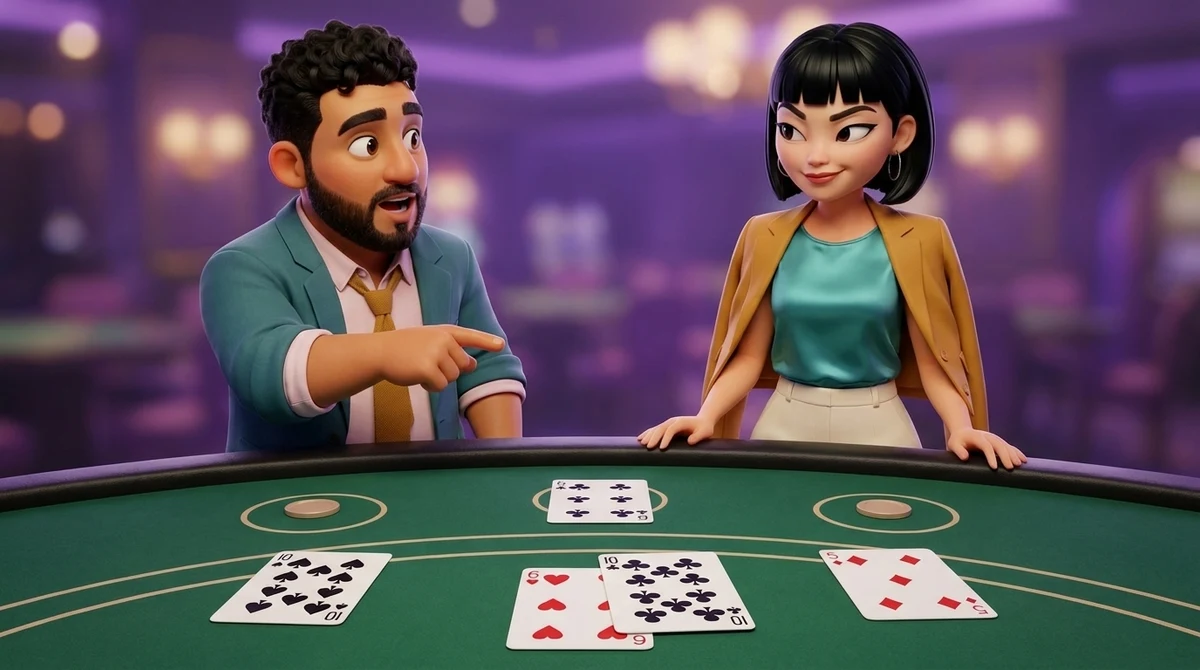

Leoformer dealer · rules and maths
The first time people sit at this table they treat the trade as a way to rescue the worse of their two hands. The trade is not a rescue. It is a choice between two pairs of hands: the two hands as they were dealt, and the two hands as they would be after the trade.
Two hands and one trade
Each round you put two bets of the same size down, one on each of two hands, and the cards come the way they come at any blackjack table. A round runs in this order.
| The step | What happens at the table |
|---|---|
| The shoe and the table | At one operator’s casinos, six to eight decks and no more than five players at the table. |
| The deal | A first card to each of your two hands and one face up to the dealer; then a second card to each of your hands and one face down to the dealer. |
| The trade | If the dealer has no blackjack, you keep the two hands as dealt or ask for the second cards of the two hands to be swapped with each other — once, and only before any other move. |
| A blackjack dealt to you | At one casino, a dealt blackjack you keep, rather than trade away, is paid on the spot. Against a dealer blackjack, a dealt blackjack of yours pushes. |
| After the trade | Both hands are played out with the usual moves, doubling and splitting included; at one operator’s tables a pair of aces is split only once, with one card on each ace. |
As dealt
Dealer
Hand 1 16
Hand 2 15
After the trade
Dealer
Hand 1 20
Hand 2 11
The first cards stay where they were dealt: the 10 on the first hand and the 5 on the second. Only the second cards change places — the 6 goes to the second hand and the other 10 to the first — and a 16 and a 15 against the dealer’s 6 become a 20 and an 11.
What the table cuts to pay for the trade
A trade that turns two weak hands into one strong hand is worth a great deal to the player, and the table takes that value back in three places, each one written into the rules of the game.
| What the table settles | At this table | At an ordinary table |
|---|---|---|
| A blackjack dealt to you | Paid even money. Some tables post their own payment for a blackjack, anywhere from one to one up to ten to one. | Paid three to two. |
| An ace and a 10-value card brought together by a trade | A soft 21, and not a blackjack. | There is no trade to make one. |
| A dealer hand of exactly 22 | A push for every hand still standing: the bet comes back and nothing is added. | A dealer bust: every hand still standing is paid. |
| Hands and bets every round | Two hands and two bets of the same size. | One hand and one bet. |
Same rules in both bars, each played by its own full chart; only the trade is taken away from the upper one. The longer the bar, the larger the share of every bet the house keeps.
Two bets go down every round, so a round here puts twice as much money on the felt as one hand at an ordinary table. That is a price per round, set by the size of your bets, and not a share of each bet the house keeps.
When to trade, and when to keep
Compare the two hands as dealt with the two hands after the trade by how each pair stands against the dealer’s card, not by adding up the card totals, which the trade never changes. Worked out over every deal, the trade is worth more in about 35% of deals.
- Judge the two hands as a pair.Two hands after the trade against the same two hands as dealt. One strong hand — a 20, a 21, an 11 or a 10 — is usually worth more than two middling ones.
- Keep a dealt blackjack.Kept, it is paid even money; traded away, the ace and the 10-value card are only a soft 21.
Kept as dealt
Dealer
Hand 1 blackjack
Hand 2 12
If traded
Dealer
Hand 1 soft 18
Hand 2 15
Traded, the blackjack is gone: the same four cards make a soft 18 and a 15. Keeping is the answer here, and in almost every deal that brings a blackjack.
After the trade: this game’s chart
Once the trade is decided, both hands are played by a chart, and at this table it is a chart of its own. The dealer 22 that pushes is the reason: a move that leans on the dealer going over 21 — putting a second bet up, splitting a pair, standing on a low total — is worth less when one of the dealer’s busts is taken back from you.
- A hard 9 against a 3 or a 4Take a card, where the ordinary chart puts a second bet up.
- A hard 10 against a 9Take a card, where the ordinary chart puts a second bet up.
- A hard 11 against a 10 or an aceTake a card, where the ordinary chart puts a second bet up.
- A pair of 2s against a 2, a 3 or a 4Take a card, where the ordinary chart splits the pair.
- A pair of 3s against a 2, a 3 or a 4Take a card, where the ordinary chart splits the pair.
- A hard 12 against a 4Take a card, where the ordinary chart stands.
- A hard 13 against a 2Take a card, where the ordinary chart stands.
Against the ordinary chart for the same six decks and the same dealer rule, this game’s chart names a different move in 38 of its 330 cells. The full chart, with those cells marked, is on the lesson card below.
Which table, which price
The dealer rule is written on the felt, not in the name of the game: a table may have the dealer hit a soft 17 or stand on it, and at one casino the dealer hits. The number of decks moves the price as well, by much less.
The same game three times, each played by the full chart for its own rules and taking the trade whenever it is worth more. A dealer who stands on a soft 17 takes 0.40 percentage points off the share the house keeps; two more decks in the shoe add a little to it.
- The smallest and largest betAt one casino, posted at the table along with the largest payout; the smallest bet goes down twice every round here.
- A side bet, at one casinoOne casino deals a side bet on matches among your first four cards. It is a separate bet with a price of its own, and every side bet is a risky gamble.
The game is dealt at a handful of casinos, and a casino’s list of games can change. Read the felt of the table in front of you, not your memory of another one.

Mayaformer floor supervisor · manners, money and breaks
The trade makes this table cheap only because the payouts were cut first. Played without it, this is the dearest blackjack on the floor.
Decide how much money the evening gets while you are still at home — counting two bets a round, not one — and stop when it is used up. Get up from the table for a break now and then, too. A bad run is not something the next round owes you back, and chasing it only makes the evening dearer. If the money on the table starts to feel like money you need, call one of the lines below; that is what they are for.
If it stops being fun
If gambling stops being entertainment, help is available. 19+ in most of Canada; 18+ in Alberta, Manitoba and Quebec. More on responsible gaming.
The chart on one card
That is the lesson. The chart for this game is on one card: print it, or keep it on your phone.
| Hard | 2 | 3 | 4 | 5 | 6 | 7 | 8 | 9 | 10 | A |
|---|---|---|---|---|---|---|---|---|---|---|
| 5–8 | H | H | H | H | H | H | H | H | H | H |
| 9 | H | H, differs from the ordinary chart for six decks with the dealer hitting a soft 17 | H, differs from the ordinary chart for six decks with the dealer hitting a soft 17 | Dh | Dh | H | H | H | H | H |
| 10 | Dh | Dh | Dh | Dh | Dh | Dh | Dh | H, differs from the ordinary chart for six decks with the dealer hitting a soft 17 | H | H |
| 11 | Dh | Dh | Dh | Dh | Dh | Dh | Dh | Dh | H, differs from the ordinary chart for six decks with the dealer hitting a soft 17 | H, differs from the ordinary chart for six decks with the dealer hitting a soft 17 |
| 12 | H | H | H, differs from the ordinary chart for six decks with the dealer hitting a soft 17 | S | S | H | H | H | H | H |
| 13 | H, differs from the ordinary chart for six decks with the dealer hitting a soft 17 | S | S | S | S | H | H | H | H | H |
| 14 | S | S | S | S | S | H | H | H | H | H |
| 15 | S | S | S | S | S | H | H | H | H | H |
| 16 | S | S | S | S | S | H | H | H | H | H |
| 17+ | S | S | S | S | S | S | S | S | S | S |
| Soft | 2 | 3 | 4 | 5 | 6 | 7 | 8 | 9 | 10 | A |
|---|---|---|---|---|---|---|---|---|---|---|
| A,2 | H | H | H | H, differs from the ordinary chart for six decks with the dealer hitting a soft 17 | H, differs from the ordinary chart for six decks with the dealer hitting a soft 17 | H | H | H | H | H |
| A,3 | H | H | H | H, differs from the ordinary chart for six decks with the dealer hitting a soft 17 | H, differs from the ordinary chart for six decks with the dealer hitting a soft 17 | H | H | H | H | H |
| A,4 | H | H | H, differs from the ordinary chart for six decks with the dealer hitting a soft 17 | H, differs from the ordinary chart for six decks with the dealer hitting a soft 17 | H, differs from the ordinary chart for six decks with the dealer hitting a soft 17 | H | H | H | H | H |
| A,5 | H | H | H, differs from the ordinary chart for six decks with the dealer hitting a soft 17 | H, differs from the ordinary chart for six decks with the dealer hitting a soft 17 | Dh | H | H | H | H | H |
| A,6 | H | H, differs from the ordinary chart for six decks with the dealer hitting a soft 17 | H, differs from the ordinary chart for six decks with the dealer hitting a soft 17 | Dh | Dh | H | H | H | H | H |
| A,7 | S, differs from the ordinary chart for six decks with the dealer hitting a soft 17 | S, differs from the ordinary chart for six decks with the dealer hitting a soft 17 | S, differs from the ordinary chart for six decks with the dealer hitting a soft 17 | Ds | Ds | S | S | H | H | H |
| A,8 | S | S | S | S | S, differs from the ordinary chart for six decks with the dealer hitting a soft 17 | S | S | S | S | S |
| A,9 | S | S | S | S | S | S | S | S | S | S |
| Pair | 2 | 3 | 4 | 5 | 6 | 7 | 8 | 9 | 10 | A |
|---|---|---|---|---|---|---|---|---|---|---|
| 2,2 | H, differs from the ordinary chart for six decks with the dealer hitting a soft 17 | H, differs from the ordinary chart for six decks with the dealer hitting a soft 17 | H, differs from the ordinary chart for six decks with the dealer hitting a soft 17 | P | P | P | H | H | H | H |
| 3,3 | H, differs from the ordinary chart for six decks with the dealer hitting a soft 17 | H, differs from the ordinary chart for six decks with the dealer hitting a soft 17 | H, differs from the ordinary chart for six decks with the dealer hitting a soft 17 | P | P | P | H | H | H | H |
| 4,4 | H | H | H | H, differs from the ordinary chart for six decks with the dealer hitting a soft 17 | H, differs from the ordinary chart for six decks with the dealer hitting a soft 17 | H | H | H | H | H |
| 5,5 | Dh | Dh | Dh | Dh | Dh | Dh | Dh | H, differs from the ordinary chart for six decks with the dealer hitting a soft 17 | H | H |
| 6,6 | H, differs from the ordinary chart for six decks with the dealer hitting a soft 17 | H, differs from the ordinary chart for six decks with the dealer hitting a soft 17 | P | P | P | H | H | H | H | H |
| 7,7 | S, differs from the ordinary chart for six decks with the dealer hitting a soft 17 | P | P | P | P | P | H | H | H | H |
| 8,8 | P | P | P | P | P | P | P | P | H, differs from the ordinary chart for six decks with the dealer hitting a soft 17 | H, differs from the ordinary chart for six decks with the dealer hitting a soft 17 |
| 9,9 | S, differs from the ordinary chart for six decks with the dealer hitting a soft 17 | S, differs from the ordinary chart for six decks with the dealer hitting a soft 17 | P | P | P | S | P | P | S | S |
| 10,10 | S | S | S | S | S | S | S | S | S | S |
| A,A | P | P | P | P | P | P | P | P | P | P |
- Hhit
- Sstand
- Dhdouble, otherwise hit
- Dsdouble, otherwise stand
- Psplit
- •differs from the ordinary chart for six decks with the dealer hitting a soft 17
19+ (18+ in AB, MB, QC) · Set a limit before you sit down · Play responsibly · the line for your province is at Helplines by province
Practice: switch or keep?
Level 1 deals clear trades: deals where trading, or keeping the hands as dealt, is worth a good deal more than the other choice. Level 2 deals close calls, where the two choices are near each other and only adding up both hands decides. Level 3 is the hand after the trade, in the cells where this game’s chart and the ordinary chart name different moves.
The practice table asks for your first decision only: it does not play the rest of the round, and there is no money on it.
Lesson done
Review my mistakes (0)
Progress stays in this browser; nothing is sent anywhere.
The practice table needs JavaScript. Here is one hand from it, with the answer.
Blackjack Switch · two hands · six decks · dealer hits a soft 17
Hand 1 is a 5 and a 10; Hand 2 is a queen and a 6. The dealer shows an 8. Trade the second cards, or keep both hands as dealt?
The answer: Trade: 11 and 20.
Judge the two hands as a pair, before and after: against an 8, 11 and 20 are worth more together than 15 and 16. The trade is decided by the pair, not by rescuing the weaker hand. These are averages over many deals like this one: either hand can still lose, and over all hands the house keeps its share.
Every answer in the practice table comes from the engine that works out the chart for this game; none of them is typed in by hand.
How the practice run works
Where the deals come from. On levels 1 and 2 the two hands as dealt and the two hands after the trade are each valued against the dealer’s card, and the answer is whichever pair of hands is worth more, added together. Where an answer shows an amount, it is an average for an example bet on each hand — an example, not a suggested bet, and not a forecast of any one deal. On level 3 the answer is the cell of this game’s chart.
One strip, and no rounds. Every square on the strip is one deal of this lesson, and all of the squares are there from the start. Your first answer fills the square it belongs to; when the squares of one level are full, the next level begins by itself. Practising a deal you got wrong turns its cross into “fixed in practice” and does not change the count, because only first answers count.
Your progress stays in this browser, and nothing is sent anywhere.
Check yourself

Mayaformer floor supervisor · manners, money and breaks
Three quick ones. Pick an answer, then check it. No timer, no points: just whether it stuck.
Back to the question we opened with. The trade is not a gift from the table. The table pays for it in advance, with an even-money blackjack and a push on a dealer 22, and without the trade the same rules would cost many times more.
Where to play, and further reading
19+ (18+ in AB, MB, QC) · Play responsibly · the helplines are further up this page
Further reading
- Game Rules — Blackjack Switch · Société des casinos du Québec (Loto-Québec)The full rules of the two-hand game: the switch, the even-money payout and the dealer 22 that pushes.
How it’s worked out
Rules, numbers and hosts
Where this happens. Every table on this page is a real table in a room you can walk into, and every rule quoted on it comes from a rule book or a rules card its publisher makes public. Where two documents say different things — what a blackjack is paid, and what the dealer does on a soft 17 — the page gives both, with each publisher behind its own button.
Numbers. Every share of a bet on this page is worked out when the page is built, by the blackjack engine behind our strategy tool, for each set of rules played by the full chart worked out for it and taking the trade whenever it is worth more. Six decks are an assumption: the operator’s rule book prints six to eight, and the casino rules card that prints the dealer rule does not print a number of decks, so eight decks are shown as a second price beside the first. The share of deals where the trade is worth more comes from the same engine. In the engine the two hands are valued independently, the way split hands are — each as if the shoe were missing that hand’s own two cards and the dealer’s card; a simulation puts the effect of that shortcut on the price at less than one hundredth of a percentage point.
The count of cells. This game’s chart is compared cell by cell with the ordinary chart for the same six decks and the same dealer rule, with a blackjack paid three to two and a dealer 22 counted as a bust. A cell counts when the two charts name different moves. The cells the text names one by one — the hard 9, 10, 11, 12 and 13 and the pairs of 2s and 3s — are checked against the engine every time the page is built.
What the prices assume. The operator’s rule book caps a split at four hands without saying whether that counts both of your hands together; the prices assume up to four hands from each hand, doubling after a split, no surrender, and a dealer blackjack settled before the trade is offered. Insurance at the casino whose rules card is quoted is not printed there and is left out. Every answer in the practice comes from the same engine as the chart. There is no figure here for how long money lasts at this table. The ordinary chart has lessons of its own earlier in the track (3.6 to 3.10), and so do the side bets (3.13), Free Bet Blackjack (3.14), Spanish 21 (3.15), Zappit (3.19), Double Down Madness (3.20) and Bahama Bonus (3.21).
Sources. Every claim on this page carries a button with the sentence it rests on, the publisher who wrote that sentence and the date we read it.
Hosts. Leo and Maya are illustrated characters. Their backstories, a former dealer and a former floor supervisor, are written for the course: neither is a real person, and neither speaks for any casino. The rules and numbers on this page come from the sources it cites, not from their experience.
No promise. Blackjack Switch is played against the house, like every other game in this course. The trade lowers the share of each bet the house keeps compared with the same rules without it; it does not make the game free of cost, a hand played by the chart can still lose, and nothing on this page says how an evening will end.
When the trade may be made
After getting the first two cards for each hand, if the house does not get a blackjack and before the house’s second card is revealed, players may choose to keep their cards as dealt or ask the dealer to switch up the second cards they received for each of their hands.
The Switch option may only be used if no other option has been used yet.
Switch: i.e. After having received the first two cards of your two hands, and if the dealer did not draw a blackjack, you may choose to either keep your hand as dealt or ask the dealer to switch the second cards dealt to each of your two hands.
What a blackjack is paid at this table
The payout on any winning bet is 1 to 1.
Blackjack pays even money.
A blackjack payment posted at the table
If the player gets a blackjack, the payout is issued according to the payout indicated at the table.
Where appropriate, the payout may vary between 1 to 1, and 10 to 1, in which case this payout will replace any provision to the contrary indicated in the general rules.
No blackjack after a trade
Players cannot get a blackjack following a switch. If applicable, the total of those 2 cards is a soft 21.
“Blackjack” is on the original hand only – a hand switched to make an Ace/Ten is 21.
If a player switches to a Blackjack, it counts as 21 points
Section Variations and side wagers
You cannot obtain a blackjack through a switch ; however, the two-card total will count as a soft 21.
A tie, and a dealer 22
The same applies if the point count of the player’s hand is 21 or less and the house’s hand totals the same value or a hard 22.
The Dealer will hit on soft 17. If the Dealer draws to a total of 22 (hard total), all remaining hands push.
Blackjack Switch is a “Push 22 game”: if a dealer busts (loses) with a total of 22, any bets left in action are “pushed”, meaning they don’t win – they’re just returned to their player.
Section Variations and side wagers
If the total value of your hand is 21 or less, and is not a blackjack, and if the total value of the dealer’s hand constitutes a hard 22, your hand is a push.
Two hands, two equal bets, one trade
Players start the Blackjack Switch game with two hands each and may switch the second card from one of their hands to the other, as described below.
Using chips purchased at the casino, players place two initial bets of equal value, one on each hand.
Blackjack Switch is a fun Blackjack variant that involves playing two Blackjack hands with the cards being dealt the same way as regular Blackjack.
Once the hands are dealt, the Player is allowed to "switch" over the top two cards of each Blackjack hand to create stronger combinations.
You must make two identical initial bets, one for each hand to be played.
Once they’re dealt, players can switch the two secondary cards between hands – getting as close to 21 as possible.
Section Variations and side wagers
Decks and seats
Blackjack Switch is played with 6 to 8 decks of 52 cards.
The maximum number of players at a Blackjack Switch table is five, whether seated or standing.
Blackjack Switch is played with 6 to 8 decks of 52 cards.
How the cards are dealt
The dealer deals one card to each player’s two hands and one card face up to the house. The dealer then deals a second card to each player’s two hands, and a second card face down to the house.
When the trade may be made
After getting the first two cards for each hand, if the house does not get a blackjack and before the house’s second card is revealed, players may choose to keep their cards as dealt or ask the dealer to switch up the second cards they received for each of their hands.
The Switch option may only be used if no other option has been used yet.
Switch: i.e. After having received the first two cards of your two hands, and if the dealer did not draw a blackjack, you may choose to either keep your hand as dealt or ask the dealer to switch the second cards dealt to each of your two hands.
A kept blackjack paid on the spot
The Dealer will pay the Player's Blackjack immediately if the Player does not choose to "switch" out of their Blackjack.
Both blackjacks push
The hand is a push (neither wins nor loses) if both the player and the house get a blackjack.
After the trade, ordinary play
Once the Player has decided whether to switch or not switch, the hands play out as in regular Blackjack.
All doubling and splitting is allowed as in regular Blackjack. Double Down bets must be equal to the original bet.
SPLIT, i.e. separate two cards of the same value (e.g. king and 10, pair of 9s) to play more than two hands, for a maximum of four hands.
DOUBLE DOWN, i.e. bet an additional amount equal to their initial bet on a two-card hand, except if the hand is a blackjack.
Players may also double down on each hand after SPLITTING two cards of the same value, except in the case of a pair of aces.
In any event, once the player doubles down, they are dealt one last card.
Split aces
In the case of a pair of aces, players can split only once and can hit for only one additional card for each hand.
There can be no blackjack on split hands.
What a blackjack is paid at this table
The payout on any winning bet is 1 to 1.
Blackjack pays even money.
A blackjack payment posted at the table
If the player gets a blackjack, the payout is issued according to the payout indicated at the table.
Where appropriate, the payout may vary between 1 to 1, and 10 to 1, in which case this payout will replace any provision to the contrary indicated in the general rules.
No blackjack after a trade
Players cannot get a blackjack following a switch. If applicable, the total of those 2 cards is a soft 21.
“Blackjack” is on the original hand only – a hand switched to make an Ace/Ten is 21.
If a player switches to a Blackjack, it counts as 21 points
Section Variations and side wagers
You cannot obtain a blackjack through a switch ; however, the two-card total will count as a soft 21.
A dealer 22 pushes
The same applies if the point count of the player’s hand is 21 or less and the house’s hand totals the same value or a hard 22.
The Dealer will hit on soft 17. If the Dealer draws to a total of 22 (hard total), all remaining hands push.
Blackjack Switch is a “Push 22 game”: if a dealer busts (loses) with a total of 22, any bets left in action are “pushed”, meaning they don’t win – they’re just returned to their player.
Section Variations and side wagers
If the total value of your hand is 21 or less, and is not a blackjack, and if the total value of the dealer’s hand constitutes a hard 22, your hand is a push.
Two bets a round
Blackjack Switch gives you more flexibility to win but costs more per round than other versions.
Players must make two bets of equal size before receiving two sets of cards.
Section Variations and side wagers
The dealer rule is posted at the table
the dealer completes the house’s hand, if necessary, according to the house strategy indicated at the table which may either be:
HIT on a count of soft 17 or less and STAND on a count of hard 17 or more, or
HIT on a count of 16 or less and STAND on a count of (soft or hard) 17 or more.
The dealer rule at one casino
The same applies if the point count of the player’s hand is 21 or less and the house’s hand totals the same value or a hard 22.
The Dealer will hit on soft 17. If the Dealer draws to a total of 22 (hard total), all remaining hands push.
Blackjack Switch is a “Push 22 game”: if a dealer busts (loses) with a total of 22, any bets left in action are “pushed”, meaning they don’t win – they’re just returned to their player.
Section Variations and side wagers
If the total value of your hand is 21 or less, and is not a blackjack, and if the total value of the dealer’s hand constitutes a hard 22, your hand is a push.
Limits are posted at the table
Minimums and maximums, and maximum payouts are posted at the table.
A side bet on the first four cards
Optional "SUPER MATCH" wager ~ matches are based on the Player's initial four cards.
Player must have placed main wagers to play Super Match.
One pair 1-1
Three of a kind 5-1
Two pair 8-1
Four of a kind 40 - 1
Side bets are a gamble
All side bets are a risky gamble, meant for fun. Using them to get even when down in chips is never advised.
Section Variations and side wagers
Where the game is dealt
At Blackjack Switch, you may choose to switch the second cards dealt in each of your hands unless the dealer draws a blackjack.
Blackjack Switch
Blackjack Switch is a fun Blackjack variant that involves playing two Blackjack hands with the cards being dealt the same way as regular Blackjack.
Games on offer change
Please note offerings are subject to change.
Spotted a mistake on this page? Tell us
Been here before? Review us on Trustpilot