Atlassino Academy · Blackjack · Lesson 11 of 21
The rules on the sign, and what they change
The lines on the sign beside a blackjack table are the terms the hand is settled by, and one of them moves the cost of playing far further than the rest.
The sign beside a blackjack table says what the smallest bet is, what a blackjack is paid, and what the dealer does with a soft 17. Which of those three lines changes what the game costs you the most?
The short answer
What a blackjack is paid. All three lines are terms of the hand, but they are not worth the same amount of money. The line that says what a blackjack is paid moves the share the house keeps of every bet further than the other two do. The line about the dealer and a soft 17 moves that share a little, and in the direction most people do not expect. The smallest bet the table takes does not move the share at all: it decides how much money each hand takes out of your pocket, which is a different question and just as worth asking.
A table sign drawn as an example. The two bet lines are left blank: those are each table’s own figures.
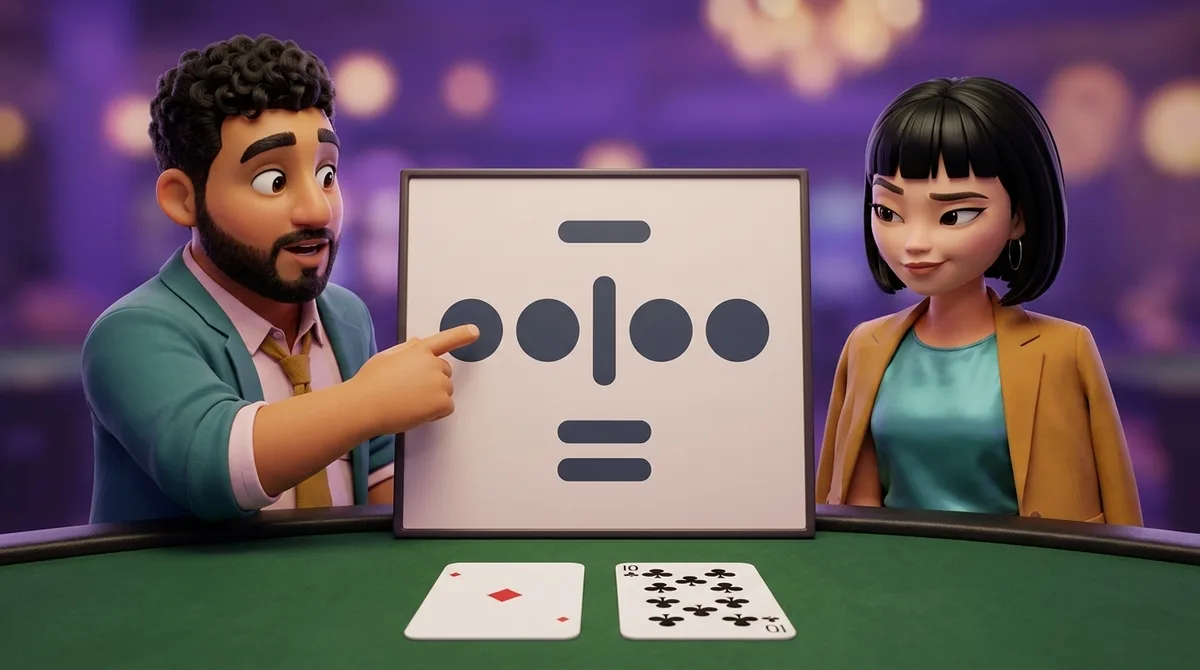

Leoformer dealer · rules and maths
People walk the floor looking for a table that feels right, and the sign is the one thing on that table that will actually tell them something. It takes about ten seconds to read and it is written in shorthand, which is why most people walk past it. A short list of lines, and two of them change what every hand you play is going to cost you.
What the sign carries, and why it stands at the table
The smallest and the largest bet a blackjack table takes, and the largest payout it will make, are posted at the table itself and not announced once at the door of the room. Where the rule book leaves the dealer’s drawing rule to the table, that rule is posted at the table too. Those lines are not advertising and they are not decoration: each one is a term the hand is settled by, in the same way that the price on a shelf edge is a term of the sale. And because they are posted at the table rather than at the door, the lines at the table you are sitting down at are the ones that describe the game you are about to play.
- The smallest and the largest betThe smallest bet and the largest bet decide how much money each hand takes out of your pocket. Neither of them touches the share the house keeps of that money.
- What a blackjack is paidThis figure decides how many chips come back when your first two cards make 21. It is the line with the most money behind it.
- What the dealer does with a soft 17This line decides how the dealer’s own hand finishes when the dealer holds an ace counted as eleven. It settles every hand at the table, including yours.
Not every term is posted at the table: some, such as doubling down after splitting a pair, are settled in advance by the rule book the table’s game is dealt under.
What a blackjack is paid
A hand the dealer pays at blackjack is paid 1 to 1: put out a bet, take back the bet and the same again. The one exception is a blackjack itself, an ace beside a ten, jack, queen or king on the first two cards, and the published figure for a blackjack is 3 to 2.
| How the hand ends | What comes back |
|---|---|
| The dealer pays the hand, and it is not a blackjack | The bet, and the same again beside it: 1 to 1. |
| The first two cards make 21: a blackjack | The bet, and three for every two staked beside it: 3 to 2. |
| The hand and the dealer’s hand come out equal | The bet comes back and nothing is added to it: a tie. |
Blackjack pays 3 to 2
Blackjack pays 1 to 1
Same two cards, same bet: three counters back for every two staked at 3 to 2, two at 1 to 1.
That 3-to-2 figure is not a fixed feature of the game. The payout a table posts may replace the general rule, anywhere from 1 to 1 up to 10 to 1.
How far a posted payout may move, with 3 to 2 marked. The bottom of the range is what a rule book allows, not a report that any table posts it.
The table that pays a blackjack 6 to 5
A second published rule book sets out a blackjack game of its own, played by the same rules as the ordinary game with one term changed: the payout for a blackjack. At that table a blackjack is paid 6 to 5. One casino operator prints both figures in its guide and sends the player to the table’s layout to see which one applies.
Two signs, one line of difference. A player who reads only the dealer’s line and the bet lines misses the line that carries the most money.
The rule book that sets out the 6 to 5 game makes a table dealing it show that payout on the felt and on further signage at the table, and keeps a table paying 3 to 2 open for play whenever a 6 to 5 table is open. So the dearer table has to say so, and a 3 to 2 table is open at the same hour.
What the dealer does with a soft 17
An ace and a six make seventeen, and they also make seven, because an ace counts either way. A hand like that is a soft 17, and it is the one hand where the dealer’s rule book has to choose: stop at seventeen, or draw again on the chance of turning seven into something larger.
| The dealer holds an ace and a six | The hand counts | What that makes it |
|---|---|---|
| The ace counted as eleven | 17 | A soft 17. A third card cannot take this hand over 21, because the ace can drop back to counting one. |
| The ace counted as one | 7 | Seven, which is a total no dealer is allowed to stop on under either of the two wordings. |
A soft 17 is the one total where the two wordings a sign may carry tell the dealer different things.
The set of rules BCLC publishes for B.C. casinos settles that choice in advance for every table it covers: the dealer draws on a soft 17 and stands on a hard 17. Where that choice is left to the table instead, the table posts one of two wordings: draw on a soft 17 and stand on a hard 17, or stand on any 17 at all, soft or hard.
Dealer must hit soft 17
Dealer must stand on 17
Which of the two wordings is the cheaper one to sit down against is not obvious, and most people guess it the wrong way round. A dealer who draws on a soft 17 does go over 21 slightly more often, which sounds like good news; but the same extra card also turns a great many soft 17s into 18, 19, 20 and 21, and those hands take more of your bets than the extra busts give back. The arithmetic is in the price table further on.
The same game, dealt two ways
At B.C. tables the game is six decks dealt out of a shoe, and only the dealer touches the cards. Elsewhere a table may deal from one deck to eight. The same rule book also sets out a second, two-deck game, dealt by hand or from a shoe.
| Term of the table | The game dealt from a shoe | The game dealt by hand |
|---|---|---|
| How many decks the cards come from | Six decks, dealt out of a shoe. | Two decks, dealt by the dealer’s own hand or out of a shoe. |
| Giving the hand up before playing it | Offered on the first two cards, and the dealer takes half of the first bet. | Not offered at all. |
What each line is worth
Played by the full chart, the set of rules BCLC publishes for B.C. casinos leaves the house about 0.53% of every bet on average. That share is what moves when a line on the sign is set the other way, and it moves by very different amounts depending on which line it is.
| The line as the B.C. rules have it | The same line set the other way | The house’s share of every bet then |
|---|---|---|
| A blackjack is paid 3 to 2 | A blackjack is paid 6 to 5 | 1.89% |
| A blackjack is paid 3 to 2 | A blackjack is paid 1 to 1 | 2.79% |
| The dealer draws on a soft 17 | The dealer stands on 17 | 0.33% |
| Surrender is offered | Surrender is not offered | 0.61% |
| Six decks, dealt from a shoe | Two decks | 0.32% |
One line changes in each row; the mark on each bar is the share the B.C. rules leave the house. The dealer standing on 17 and two decks stop short of it: a term of the table is not automatically a trap. The 1 to 1 row is the bottom of the range a rule book allows, and no publisher we could read reports a table posting it.
The payout line is worth more than the other three lines put together, several times over: if you have time to read one line on the sign before you sit down, read the one that says what a blackjack is paid. A share of every bet is also a hard thing to feel. Turned into money, at $10 a hand — an example bet, not a suggested one — and at 70 hands an hour, the three payout figures come out like this.
Same chart, same bet, same hour of play, same everything except one line on one sign. The figures are averages over a great many hours; no single hour comes out at the average, and a run of hands can finish a long way from it on either side.
What the sign does not say
Reading the sign is worth doing and it is worth doing every time you change tables. It is also worth being clear about what a sign is. It is a list of terms, and a list of terms is not a description of how the next hour will go.
| The line on the sign | What that line settles | What that line does not settle |
|---|---|---|
| What a blackjack is paid | How many chips come back when your first two cards make 21. | How often an ace lands beside a ten-value card. That belongs to the shoe and to nothing else. |
| What the dealer does with a soft 17 | How the dealer’s hand finishes, and so what every hand at the table is measured against. | Which cards the dealer draws. The wording says when to draw, never what will come. |
| The smallest and the largest bet | How much money each hand takes out of your pocket. | The share the house keeps of that money, which the other lines set. |
Playing every hand the way the chart says lowers what the game costs. It does not make the correct play into a hand that is paid: those are two different things. The whole chart, for whichever set of rules your table posts, is in the lesson on the full chart.
- The sign says what the hand is settled by. Every line on it is a term: how much you may bet, what a blackjack is paid, how the dealer’s hand finishes.
- The sign says nothing about the cards that are coming. A payout of 3 to 2 is not a statement that a blackjack is due, and a dealer rule is not a statement about the shoe.
- A share is an average over a great many hands. It is not a forecast of your evening, and an evening can finish a long way from it in either direction.

Mayaformer floor supervisor · manners, money and breaks
Here is the part of reading the sign that has nothing to do with arithmetic. Decide how much money the evening gets and how long it runs while you are still at home (Game plan walks you through it in a couple of minutes), and stop when either one is used up, whatever the sign at the table says.
A cheaper table is still a table that costs money, and a run of losing hands is not a debt the table owes you. Putting more money down to get it back only makes the hour dearer. If the money on the felt starts to feel like money you need, stop and call one of the lines below — that is exactly what they are for, day or night.
If it stops being fun
If gambling stops being entertainment, help is available. 19+ in most of Canada; 18+ in Alberta, Manitoba and Quebec. More on responsible gaming.
Practice table
The practice table deals hands from a shuffled shoe and checks your first decision on each hand against the chart. Switch the table rules and the chart is worked out again, as it would be at a table with a different sign. Decide with the buttons or with the keys H, S, D and R. There is no money on this table, and nothing adds up from one hand to the next: the amounts beside each decision are averages for the example bet you pick.
Rules differ by province. Pick the rules closest to the table where you play; this table then answers by the chart for those rules. The bet is only an example for the amounts shown, not a suggested bet.
Dealer
You
Lesson done
Review my mistakes (0)
Progress stays in this browser; nothing is sent anywhere.
The practice table needs JavaScript. Here is one hand from it, with the answer.
Dealer shows a 7
You hard 16
The chart says: Hit.
Hard 16 against a 7: The dealer card is strong: standing on 16 loses whenever the dealer finishes on 17 or more, 73.8% of hands against a 7.
Average result per hand on an example bet of $10 (a minus means money lost): stand −$4.77 · hit −$4.09 · double −$8.17 · surrender −$5.00. Standing instead costs about $0.68 more each time.
How the practice table works
One strip, no rounds. Every square on the strip is one hand of this lesson, and they are all there from the start. The square keeps your first move on that hand; later moves in the same hand are still checked and explained. When a level’s squares are full the next level begins by itself, with no button in between.
Levels. Level 1: hard 12 to 16 against every dealer card. Level 2: hard 5 to 19, doubles included. Level 3: hard 9 to 16 against every dealer card; the clock is optional.
Dealing. Cards come from a shuffled shoe with a fresh seed each visit, and a hand that does not belong to the level is set aside unseen, so the shoe runs down faster than it would at a real table. The correct play is the chart’s cell for the rules you pick, and the averages come from the same engine as the price table above. Hard totals on their own, decision by decision, are a lesson of their own.
Check yourself

Mayaformer floor supervisor · manners, money and breaks
Five quick ones. Pick an answer, then check it. No timer, no points: just whether it stuck.
And the question at the start
What a blackjack is paid. Setting that line to the bottom of the range a rule book allows a table to post takes the house’s share of every bet from 0.53% to 2.79%, and no other line on the sign comes close to moving it that far. The dealer’s soft-17 line is the one people expect to matter most, and it is worth a fraction of the payout line; the smallest bet the table takes does not move the share at all.
Where to play, and further reading
19+ (18+ in AB, MB, QC) · Play responsibly · help, day or night: Gambling Support BC 1-888-795-6111, 24 hours
Further reading
- Rules of Play for Table Games: Blackjack · British Columbia Lottery Corporation (BCLC)The rules this track follows section by section: six decks, the dealer on soft 17, doubling, splitting and surrender.
- Game rules: Blackjack · Loto-Québec (Société des casinos du Québec)Québec’s rules: one to eight decks, a face-down dealer card, and the soft-17 rule left to the sign at the table.
- Playing Blackjack · Fallsview Casino Resort and Casino NiagaraOne Ontario operator’s own booklet, including both blackjack payouts and both dealer rules it may post.
- Blackjack: how to play · OLG PlaySmartOntario’s beginner page: the moves, the hand signals it describes, and what insurance is.
- Know the game: Blackjack · Casinos Regina & Moose Jaw (SaskGaming)A Saskatchewan operator on what the chart does and does not do, and where to pick one up in the building.
- Blackjack basics · Wizard of OddsWhat three common ways of playing blackjack without the chart cost, on that author’s own table.
How it’s worked out
Rules, numbers and hosts
Which rules the figures follow. Every share on this page starts from one published set of table rules: six decks from a shoe, the dealer drawing on a soft 17, a blackjack paid 3 to 2, doubling on any two cards and after a split, surrender offered, and no face-down dealer card. It is a set for learning from, not a statement about any one casino.
Numbers. Each share is worked out when the page is built, by the same engine as our Blackjack strategy tool, and it assumes the full chart — hard totals, soft hands and pairs together — with the cards shuffled after every hand. In each row of the price table exactly one term is changed and everything else is left alone, so the figure in that row is the price of that term and of nothing else. A share turned into money uses an example bet and a rate of 70 hands an hour taken from a Las Vegas Strip rating table, which is a figure from one American floor and a rating table, not a measurement of Canadian tables.
What is deliberately absent. There is no price here for a blackjack paid at more than 3 to 2, although one rule book allows a table to post one: our engine does not work the chart out again above 3 to 2, and a figure it cannot recompute does not go on a page. There is no statement that any particular casino runs any particular table on any particular terms — that is a fact about one table on one night, and it belongs beside the casino rather than in a lesson. And there is no count of how many tables in the country post which payout, because no publisher we could read counts them. The share and the hour given for a blackjack paid 1 to 1 are the price of the bottom of the range that rule book allows: no publisher we could read reports a table posting it, and the figure on this page is not a claim that one does. The share and the hour given for a blackjack paid 6 to 5 carry no such caveat and are not the same kind of figure: a second rule book sets that payout out as a blackjack game of its own and says that every other term of the game stays as it is, which is exactly what the 6 to 5 row does: the row changes the payout and leaves the rest of that rule book’s terms where they stand.
Hosts. Leo and Maya are illustrated characters. Their backstories, a former dealer and a former floor supervisor, are written for the course: neither is a real person, and neither speaks for any casino. The rules and numbers on this page come from the sources it cites, not from their experience.
No promise. Blackjack is played against the house, and the house keeps a share of every bet at every table priced above. Reading the sign tells you which of those tables is the dearer to sit at. It does not make any table free of cost, and nothing on this page says how an evening will end.
How many decks, and where they come from
In our words: The dealer deals from a shoe holding six ordinary decks.
Section 1.0 Basic Blackjack, 1.1 to 1.3.1
BCLC · Rules of Play for Table Games — Blackjack · read
Doubling after a split
In our words: Doubling is allowed on hands that came from a split.
Section 1.0 Basic Blackjack, 4.4 to 4.4.9
BCLC · Rules of Play for Table Games — Blackjack · read
Players may also double down on each hand after SPLITTING two cards of the same value, except in the case of a pair of aces.
Section The player options
You may also "double down" on the first two cards of each hand after the split, except when splitting Aces.
Section Blackjack terms
Giving the hand up, and the price of it
In our words: after your first two cards and before you act, you may surrender.
In our words: When you surrender, the house keeps half your bet and returns the rest.
Section 1.0 Basic Blackjack, 4.5 to 4.5.2
BCLC · Rules of Play for Table Games — Blackjack · read
What is posted at the table
Minimums and maximums, and maximum payouts are posted at the table.
Section Blackjack
The dealer’s rule, and where it is written
After revealing the house's face-down card, the dealer completes the house's hand, if necessary, according to the house strategy indicated at the table which may either be:
HIT on a count of soft 17 or less and STAND on a count of hard 17 or more, or
HIT on a count of 16 or less and STAND on a count of (soft or hard) 17 or more.
Section The house strategy
The Dealer must draw cards according to the rules posted on the table;
This means that the dealer will hit their hand up to and including an ace or aces that can be totaled as either 7 or 17.
"Dealer Must Stand on 17" - This means that the dealer will hit their hand on anything less than a total of 17.
Section Blackjack
What a hand is paid, and what a blackjack is paid
In our words: Apart from a blackjack, every paid hand gets even money, 1 to 1.
In our words: A blackjack pays 3 to 2.
In our words: Equal totals are a tie, called a push: the bet stays where it is.
Section 1.0 Basic Blackjack, 7.1 to 7.3
BCLC · Rules of Play for Table Games — Blackjack · read
If the player gets a blackjack, the bet is paid 3 to 2, except when the house's hand is also a blackjack.
Section The payouts, General rules
Six decks from a shoe
In our words: The dealer deals from a shoe holding six ordinary decks.
Section 1.0 Basic Blackjack, 1.1 to 1.3.1
BCLC · Rules of Play for Table Games — Blackjack · read
The two-deck game, dealt by hand
In our words: Double Deck uses two ordinary decks; the casino decides whether the dealer pitches them by hand or deals from a shoe.
In our words: You may lift your first two cards, using one hand.
In our words: Use just one hand whenever you handle the cards.
Section 5.0 Double Deck Blackjack, 1.1 to 5.5
BCLC · Rules of Play for Table Games — Blackjack · read
Surrender, and what the dealer takes for it
In our words: after your first two cards and before you act, you may surrender.
In our words: When you surrender, the house keeps half your bet and returns the rest.
Section 1.0 Basic Blackjack, 4.5 to 4.5.2
BCLC · Rules of Play for Table Games — Blackjack · read
No surrender on the two-deck game
In our words: Double Deck games do not offer surrender.
Section 5.0 Double Deck Blackjack, 1.1 to 5.5
BCLC · Rules of Play for Table Games — Blackjack · read
What is posted at the table
Minimums and maximums, and maximum payouts are posted at the table.
Section Blackjack
Where the dealer’s rule is written down
After revealing the house's face-down card, the dealer completes the house's hand, if necessary, according to the house strategy indicated at the table which may either be:
HIT on a count of soft 17 or less and STAND on a count of hard 17 or more, or
HIT on a count of 16 or less and STAND on a count of (soft or hard) 17 or more.
Section The house strategy
The Dealer must draw cards according to the rules posted on the table;
This means that the dealer will hit their hand up to and including an ace or aces that can be totaled as either 7 or 17.
"Dealer Must Stand on 17" - This means that the dealer will hit their hand on anything less than a total of 17.
Section Blackjack
Doubling after a split
In our words: Doubling is allowed on hands that came from a split.
Section 1.0 Basic Blackjack, 4.4 to 4.4.9
BCLC · Rules of Play for Table Games — Blackjack · read
Players may also double down on each hand after SPLITTING two cards of the same value, except in the case of a pair of aces.
Section The player options
You may also "double down" on the first two cards of each hand after the split, except when splitting Aces.
Section Blackjack terms
The payout a table posts replaces the general rule
Where appropriate, the payout may vary between 1 to 1, and 10 to 1, in which case this payout will replace any provision to the contrary indicated in the general rules.
Section Variations
The 6 to 5 game, and the one term it changes
In our words: A 6 to 5 game is run under the ordinary blackjack rules;
In our words: only the blackjack payout is different; everything else stays the same;
Section 4.0 6 to 5 Blackjack, 1.1 to 6.1.1
BCLC · Rules of Play for Table Games — Blackjack · read
What a blackjack is paid at a 6 to 5 table
In our words: A blackjack pays 6 to 5.
Section 4.0 6 to 5 Blackjack, 1.1 to 6.1.1
BCLC · Rules of Play for Table Games — Blackjack · read
Both payout figures, and where to read which one applies
If you receive an Ace and ten, Jack, Queen or King as your first two cards, you have "Blackjack" and will be paid odds as marked on the layout (3 to 2 or 6 to 5).
Section Blackjack
Where a 6 to 5 payout has to appear
In our words: a 6 to 5 payout has to be printed on the felt and shown on a sign at the table too;
Section 4.0 6 to 5 Blackjack, 1.1 to 6.1.1
BCLC · Rules of Play for Table Games — Blackjack · read
The 3 to 2 table that stays open beside it
In our words: Whenever a 6 to 5 game is open, a game paying 3 to 2 for a blackjack has to be open as well.
Section 4.0 6 to 5 Blackjack, 1.1 to 6.1.1
BCLC · Rules of Play for Table Games — Blackjack · read
The dealer’s rule these figures follow
In our words: draw on 16 or less, and on soft 17;
In our words: and stop drawing at hard 17.
Section 1.0 Basic Blackjack, 8.5 to 8.9
BCLC · Rules of Play for Table Games — Blackjack · read
This means that the dealer will hit their hand up to and including an ace or aces that can be totaled as either 7 or 17.
Section Blackjack
The two wordings a sign may carry
After revealing the house's face-down card, the dealer completes the house's hand, if necessary, according to the house strategy indicated at the table which may either be:
HIT on a count of soft 17 or less and STAND on a count of hard 17 or more, or
HIT on a count of 16 or less and STAND on a count of (soft or hard) 17 or more.
Section The house strategy
The Dealer must draw cards according to the rules posted on the table;
This means that the dealer will hit their hand up to and including an ace or aces that can be totaled as either 7 or 17.
"Dealer Must Stand on 17" - This means that the dealer will hit their hand on anything less than a total of 17.
Section Blackjack
Six decks from a shoe
In our words: The dealer deals from a shoe holding six ordinary decks.
Section 1.0 Basic Blackjack, 1.1 to 1.3.1
BCLC · Rules of Play for Table Games — Blackjack · read
Who may touch the cards
In our words: Handling the cards is the dealer’s job alone.
Section 1.0 Basic Blackjack, 1.1 to 1.3.1
BCLC · Rules of Play for Table Games — Blackjack · read
There's no reason to handle the cards you’re dealt, so be sure not to touch them.
How many decks a table may use
Blackjack is played with 1 to 8 decks of 52 cards.
Section The cards
The two-deck game, dealt by hand
In our words: Double Deck uses two ordinary decks; the casino decides whether the dealer pitches them by hand or deals from a shoe.
In our words: You may lift your first two cards, using one hand.
In our words: Use just one hand whenever you handle the cards.
Section 5.0 Double Deck Blackjack, 1.1 to 5.5
BCLC · Rules of Play for Table Games — Blackjack · read
What following the chart does to the cost of playing
By following basic strategy you can reduce the house advantage and your cost of play.
Hands an hour
This table was given to me anonymously by an executive with a major Strip casino and is used for rating players.
Table “Hands per Hour and Average House Edge”, row “Blackjack”, column “Hands/Hour”: 70
What following the chart does
By following basic strategy you can reduce the house advantage and your cost of play.
The right play and the outcome are not the same thing
Blackjack has an element of skill, but making the statistically correct play does not ensure a winning outcome.
Spotted a mistake on this page? Tell us
Been here before? Review us on Trustpilot