The goal. Get a higher total than the dealer without going over 21. If the dealer goes over 21 and you have not, you are paid. Equal totals push: nobody is paid, and your bet stays yours.
What the cards count.
The number printed on the cardTen each: the 10, the jack, the queen and the kingThe ace: 1 or 11, your choice
Blackjack. An ace beside a ten, jack, queen or king on the first two cards. A blackjack pays 3 to 2 and outranks a 21 made of three or more cards.
Who plays first. You play before the dealer. Go over 21 and your bet is gone, even if the dealer goes over later.
Hard total. No ace in the hand, or an ace forced down to 1. A 10 and a 6 is hard 16.
Hit: take another card.
Stand: take no more cards and keep your total.
Double: a second bet, up to the size of the first, for exactly one more card. The second bet can lose too. The figures in this lesson assume it is the full size of the first.
Split: two cards of equal value, played as two hands.
Surrender (B.C. tables offer it): give up half your bet and end the hand, right after your first two cards. If the dealer then has blackjack, the surrender does not count. The dealer’s blackjack then takes the whole bet.
The house edge. The house keeps an edge even if you never make a mistake. Played by the full chart, these B.C. rules leave the house about 0.53% of every bet on average. The chart makes the game cheaper, not free.
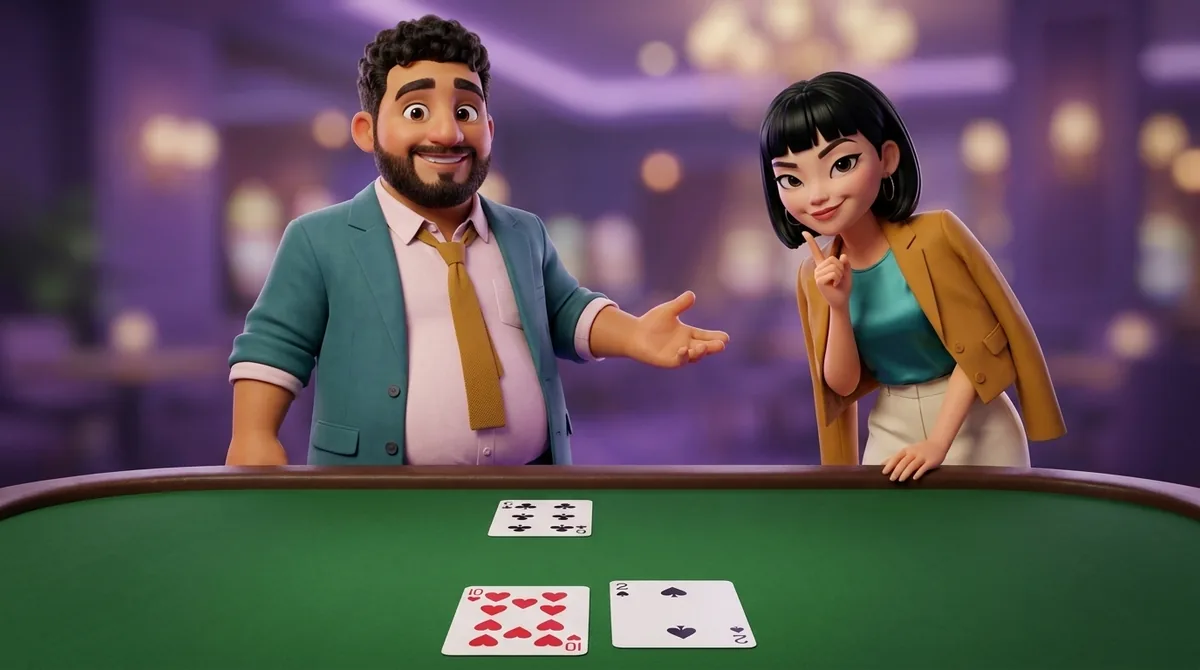
You hold a 10 and a 2. The dealer shows a 6. Do you take a card?
The short answer
On a hard 12 to 16, stand when the dealer shows 2 to 6 and take a card when the dealer shows 7 to ace — with one exception: hit 12 when the dealer shows a 2 or a 3. On a hard 11 or less, never stand: double where the chart shows Dh, and hit everywhere else. On a hard 17 or more, stand. Where surrender is allowed, the chart gives up half the bet on a hard 15, 16 and 17 against a 9, a 10 or an ace, though not on every one of those pairings.
Leoformer dealer · rules and maths
Your gut says hit: twelve feels like nothing to stand on. Stand anyway. The reason is a number, not a hunch — how often a dealer showing a 6 goes over 21 — and I dealt this game for years before I taught it.
How a hand goes
At B.C. tables the cards come out of a shoe — six decks shuffled together — and nobody but the dealer touches them. Every hand goes through the same five steps, and the pictures follow the hand from the question above: your 10 and 2 against the dealer’s 6.
Bet
Put your chips in your betting spot before the deal starts, and leave them there until the hand is settled.
The deal
The dealer gives you one card face up, takes one card face up, then gives you your second card. The dealer’s own second card comes later, after you have played.
Your turn
Hit or stand with a hand signal, or double: a second bet for exactly one more card. In the picture you stand on 12.
The dealer’s turn
The dealer has no choices to make: the dealer draws on 16 or less and on soft 17 (an ace and a 6), and stands on hard 17 or more. In the picture the 6 and a 10 make 16, so the dealer must draw again, and a 9 makes 25.
Result
A hand over 21 loses at once. A total higher than the dealer’s is paid 1 to 1, a blackjack is paid 3 to 2, a total lower than the dealer’s loses, and equal totals push. In the picture the dealer went over 21, so your 12 is paid.
A dealer showing a 6 goes over 21 on 43.9% of hands. That is often, and it is still less than half the time: standing on 12 against a 6 is the better bet, not a sure thing.
Leoformer dealer · rules and maths
Look at step 5, the result, again. You act first, and going over 21 takes your bet right there, even when the dealer goes over a moment later. That order — you first, the dealer second — is where the house edge comes from.
Hard means the hand has one total and only one: there is no ace in the hand, or the ace has to count as 1. If the ace can still count as 11, the hand is soft, and soft hands are a lesson of their own.
Hard 16. The hand has one total, 16, and one more card can take the hand over 21.Soft 17. The ace can still count as 11, so the hand is 7 or 17, and no single card can take the hand over 21.
The key idea: the dealer’s face-up card
Leoformer dealer · rules and maths
You see one of the dealer’s two cards and none of the cards still to come. That one face-up card decides how the dealer’s hand is likely to end, and the whole chart is built on it.
How the dealer’s hand ends, by the face-up card % of hands, by the dealer’s final total · six decks, dealer hits soft 17
Dealer shows
17
18
19
20
21
Blackjack
Over 21
Weak cards: 2 to 6
2
13.0
13.6
13.2
12.6
12.0
–
35.7
3
12.6
13.2
12.7
12.2
11.6
–
37.7
4
12.2
12.5
12.3
11.8
11.3
–
39.8
5
11.8
12.3
11.8
11.2
10.9
–
42.0
6
11.5
11.5
11.5
11.0
10.6
–
43.9
Strong cards: 7 to ace
7
36.9
13.8
7.8
7.9
7.4
–
26.2
8
12.9
36.0
12.9
6.9
6.9
–
24.4
9
12.0
11.7
35.2
12.0
6.1
–
22.9
10
11.2
11.2
11.2
34.0
3.5
7.7
21.2
Ace
5.7
14.3
14.3
14.3
6.6
30.9
13.9
Each row of the table is one face-up card, and the last column is how often the dealer’s hand ends over 21. Read down that column and the ten cards split into two groups, with the split between the 6 and the 7.
A weak card: 2 to 6
The dealer goes over 21 on 35.7% to 43.9% of hands.
So on a hard 13 to 16 you stand and let the dealer take that risk. A hard 12 stands too, except against a 2 or a 3.
A strong card: 7 to ace
The dealer goes over 21 on only 13.9% to 26.2% of hands.
So on a hard 12 to 16 you take a card yourself, or surrender where the chart shows Rh: waiting for the dealer to go over 21 is a poor bet against a strong card.
The cards in the two tiles are the only thing that differs between the two groups. The rules of the game are the same, the shoe is the same, and the dealer draws by the same rule; how often the dealer goes over 21 changes with the face-up card alone, and your move on a hard 12 to 16 changes with that card.
A weak card makes the dealer draw. Showing 2 to 6, the dealer needs at least two more cards — even a 6 and an ace make a soft 17, which the dealer has to hit — and every extra card is another chance to go over 21. So on 12 to 16 you stand and let the dealer take that chance (12 against a 2 or a 3 is the one exception).
A strong card ends the dealer’s hand fast. A ten turns a 7 into 17: with a 7 showing, the dealer lands on exactly 17 on 36.9% of hands and on 17 or more 73.8% of the time. Stand on 12 to 16 and you lose to every one of those hands, so you take the card yourself.
The dealer’s own blackjack. The dealer’s second card comes after you play, so against a 10 or an ace the hand sometimes ends before your choice matters at all: a dealer showing a 10 has blackjack on 7.7% of hands, and a dealer showing an ace on 30.9%. The dealer’s blackjack takes your original bet, unless you hold a blackjack too and the hand is a push; a doubled or split bet comes back to you.
Hard totals: the chart
Three rules cover almost every hard hand you will be dealt, and the chart under them fills in the few cells the rules leave out.
12 to 16. These are called stiff hands: one card can take them over 21. Stand when the dealer shows 2 to 6, hit when the dealer shows 7 to ace — and hit 12 when the dealer shows a 2 or a 3.
11 or less. No single card can take you over 21, so never stand. Double where the chart shows Dh, and hit everywhere else.
17 or more: stand, except where the chart surrenders: 17 against an ace.
Surrender gives up half your bet and ends the hand before you play it. If you would rather not surrender, play the letter after the R: h means hit, s means stand.
Where the chart surrenders
Your hard total
The dealer shows
15
10, ace
16
9, 10, ace
17
ace
Six decks · dealer hits soft 17 · blackjack pays 3:2 · double on any two cards · surrender · house edge 0.53% with the full chart, soft hands and pairs included
Hard totals, rules published by BCLC for B.C. casinos
Hard
2
3
4
5
6
7
8
9
10
A
5–8
H
H
H
H
H
H
H
H
H
H
9
H
Dh
Dh
Dh
Dh
H
H
H
H
H
10
Dh
Dh
Dh
Dh
Dh
Dh
Dh
Dh
H
H
11
Dh
Dh
Dh
Dh
Dh
Dh
Dh
Dh
Dh
Dh•
12
H
H
S
S
S
H
H
H
H
H
13
S
S
S
S
S
H
H
H
H
H
14
S
S
S
S
S
H
H
H
H
H
15
S
S
S
S
S
H
H
H
Rh
Rh•
16
S
S
S
S
S
H
H
Rh
Rh
Rh
17
S
S
S
S
S
S
S
S
S
Rs•
18+
S
S
S
S
S
S
S
S
S
S
Hhit
Sstand
Dhdouble; hit if you cannot double
Rhsurrender; hit if you cannot surrender
Rssurrender; stand if you cannot surrender
• Where the sign says the dealer stands on all 17s: 11 against an ace, hit; 15 against an ace, hit; 17 against an ace, stand.
Find your hard total down the left edge of the chart, then read across to the card the dealer shows: the letters in that cell are your move. Soft hands, pairs and tables with other rules are in the Blackjack strategy tool.
The chart in words, row by row
5–8: hit against every dealer card.
9: hit against 2 and 7 to ace; double against 3 to 6 (hit if doubling is not allowed).
10: double against 2 to 9 (hit if doubling is not allowed); hit against 10 and ace.
11: double against every dealer card (hit if doubling is not allowed).
12: hit against 2, 3 and 7 to ace; stand against 4 to 6.
13: stand against 2 to 6; hit against 7 to ace.
14: stand against 2 to 6; hit against 7 to ace.
15: stand against 2 to 6; hit against 7 to 9; surrender against 10 and ace (hit if surrender is not allowed).
16: stand against 2 to 6; hit against 7 and 8; surrender against 9 to ace (hit if surrender is not allowed).
17: stand against 2 to 10; surrender against ace (stand if surrender is not allowed).
18 or more: stand against every dealer card.
Three mistakes that cost the most
Leoformer dealer · rules and maths
Three habits come up at the table again and again, and each of the three has a price per hand that can be measured.
Every amount below is in Canadian dollars, for an example bet of $10. The ten dollars is an example, not a suggestion: bet twice as much and each mistake costs roughly twice as much.
The careful mistake
Standing on 12 to 16 against 7 to ace
You hold
against
The dealer shows
$0.68
each time you stand on 16 against a 7. Standing on 14 against a 9 costs $1.13, and standing on 12 against a 7 costs $2.61. Standing feels safe because you cannot go over 21 — but a hand under 17 is paid only when the dealer goes over 21, and against a strong card the dealer usually does not.
Fix: on 12 to 16 against 7 to ace, take the card, or surrender where the chart shows Rh.
The impatient mistake
Hitting 13 to 16 against 2 to 6
You hold
against
The dealer shows
$3.13
each time you hit 16 against a 6, and hitting 13 against a 6 costs $1.20. Hard 12 is the exception, and the exception runs the other way: standing on 12 against a 2 costs $0.34, and standing on 12 against a 3 costs $0.14.
Fix: against 2 to 6, stand on 13 to 16 — and stand on 12 against a 4, 5 or 6.
The missed double
Not doubling 10 and 11
You hold
against
The dealer shows
$3.37
each time you hit 11 against a 6 instead of doubling. Hitting 11 against a 10 instead of doubling costs $0.59, and hitting 10 against a 9 instead of doubling costs $0.30 (counting the hands where the dealer does not make blackjack).
Fix: double where the chart shows Dh. The second bet can still lose, and over all hands the house keeps its edge.
16 against a 10
The hand players find hardest is nearly a coin toss between standing and hitting: on an example bet of $10, hitting does better than standing by $0.05 a hand. At B.C. tables, surrendering does better than either standing or hitting.
Stand
loses $5.40 a hand on average
Hit
loses $5.35 a hand on average
Surrender
loses $5.00 a hand on average
Each bar is the average loss of one move on the same hand, 16 against a 10, and the bars are almost the same length. That is what a coin toss looks like in money: whichever move you make, the hand costs about the same, and the chart only picks the smallest of those losses.
Researchers who watched players at real tables found the same pattern: most mistakes were on the careful side, standing where the chart says hit (Keren and Wagenaar, 1985; Carlin and Robinson, 2009).
At the table, with Maya
Mayaformer floor supervisor · manners, money and breaks
Knowing the chart is half of playing a hand well. The other half is making your move the way the dealer expects to see it, so that nothing you do is read as something else.
Hit: tap the tableThe hand signal is what counts; saying “hit” out loud is not enough.Stand: wave it offWave a flat hand side to side above your cards.Double: chips behind your betThe second bet goes behind the first bet, and the dealer gives you one card and no more.
Only the dealer touches the cards.
Once the deal starts, leave your bet alone. Your bet changes only when you double or split, and then only by the second bet you add.
Doubling for less. B.C. lets you put up less than your first bet on a double, down to the table minimum. The chart assumes a full double: on 11 against a 10, a second bet smaller than 33.2% of the first bet does worse than simply hitting.
What the chart does to the price
What you bet on one hand, times the hands the table deals in an hour, times the share of every bet the house keeps, makes what an hour costs on average.
Your bet on one hand$10An example, not a suggestion.
×
Hands the table deals in an hour70The pace in the Las Vegas Strip rating table.
×
The share of every bet the house keeps0.53%With the full chart, soft hands and pairs included.
=
What an hour costs on average$3.68An average over many evenings, not the price of any one evening.
Played by the full chart — these hard totals plus soft hands and pairs — B.C. rules still leave the house a share of every bet, and every move off the chart makes that share bigger. Of the three numbers that multiply, the share is the only one you cannot change: the bet is yours to set, and the pace is the table’s. What the three make is an average over many evenings, and a single evening can land far above that average or far below it. Put your own bet and your own pace into Price of an hour.
Maya’s rule: the timer is set before the first hand.
Mayaformer floor supervisor · manners, money and breaks
Two habits matter more than any chart. Decide your time and your budget before you sit down (Game plan walks you through both), and take the break when the time is up.
A losing streak is not a debt the table owes you: betting more to get the money back only makes the hour dearer. And if the money on the table starts to feel like money you need, or you play to get away from something, stop and call one of the lines below — that is what they are for.
If it stops being fun
If gambling stops being entertainment, help is available. 19+ in most of Canada; 18+ in Alberta, Manitoba and Quebec. More on responsible gaming.
Cards come from a shuffled 6-deck shoe, dealt in the B.C. order from the five steps above. Decide with the buttons or the keys H, S, D and R, and the table says what the chart does, why, and what each choice costs on average — for an example bet of $10 unless you pick another bet. The lesson is one run: every square on the strip below is one hand of it, and they are all there from the start. Only your first move on each hand is scored, and when a level’s squares are full the next level begins by itself. Level 1 deals hard 12 to 16.
Rules differ by province. Pick the rules closest to the table where you play; this table then answers by the chart for those rules.The bet is only an example for the amounts shown, not a suggested bet.
Progress stays in this browser; nothing is sent anywhere.
The practice table needs JavaScript. Here is one hand from it, with the answer.
Dealer shows a 7
You hard 16
The chart says: Hit.
Hard 16 against a 7: The dealer card is strong: standing on 16 loses whenever the dealer finishes on 17 or more, 73.8% of hands against a 7.
Average result per hand on an example bet of $10 (a minus means money lost): stand −$4.77 · hit −$4.09 · double −$8.17 · surrender −$5.00. Standing instead costs about $0.68 more each time.
How the practice table works
One strip, no rounds. Every square on the strip is one hand of this lesson, and they are all there from the start. The square shows your first move on that hand: right first time, or a mistake. Later moves in the same hand are checked and explained, but the square keeps your first answer. When a level’s squares are full the next level begins by itself, with no button in between.
Example bet. The amounts are averages for the example bet you pick: $5, $10 or $25. At a bet twice as large, each amount is about twice as much. The bet is only there to show amounts: there is no balance, and nothing adds up from one hand to the next. At the end of the run, one line adds up the costs shown for your first moves that did not match the chart: how much more they cost on average than the chart’s moves would have.
Practice. Each mistake on a first move goes on your list (up to 30 hands). Practising deals those hands again. When you answer one right, it leaves the list, and any cross it has on the strip changes to “fixed in practice”. Practice does not change the count: only your first answer on each hand does.
Jumping ahead. The level buttons above the table are all live: press one and the run carries on there. The squares you left empty stay empty on the strip.
Dealing. The shoe is shuffled with a fresh random seed each visit and reshuffled when about a quarter is left. Cards are dealt in B.C. order: your first card, the dealer’s card, your second card; at tables with a face-down card, the dealer’s second card comes next and is checked for blackjack before you play. A hand that does not belong to the level (a pair, an ace, a total outside the level) is set aside unseen, so the shoe runs down faster than at a real table. The correct play is the chart’s cell for the table rules you pick, and the averages come from the same engine as the chart. A double here is always the full size of your bet, as the chart assumes. Level 1: hard 12 to 16 against every dealer card. Level 2: hard 5 to 19, doubles included. Level 3: hard 9 to 16 against every dealer card; the clock is optional. A hand that turns soft after a hit is shown with the chart’s play but not graded. There is no money on this table: the amounts are averages for the example bet, and only your decisions are counted.
Check yourself
Mayaformer floor supervisor · manners, money and breaks
Five quick ones. Pick an answer, then check it. No timer, no points: just whether it stuck.
Rules. The rules published by BCLC for B.C. casinos: six decks, dealer hits soft 17, blackjack pays 3 to 2, double on any two cards and after splitting, surrender, and no face-down dealer card (a dealer blackjack takes only your original bet). It is a preset for learning, not a statement about any one casino: check the signs at your table.
Numbers. Every figure on this page is worked out when the page is built, by the same engine as our Blackjack strategy tool, which is checked cell by cell against published charts. The chart gives, for each hard total, the play with the higher average result over all two-card hands of that total, pairs aside. A mistake’s cost is the average result of the chart’s play minus that of the mistake, per hand. The page shows it in dollars for an example bet of $10, with each average rounded to the cent first, so a cost is always the difference of the two amounts shown; at a bet twice as large it is about twice as much. Against a 10 or an ace it counts only the hands where the dealer does not make blackjack, because then your decision changes nothing. The house edge assumes the full chart, soft hands and pairs included, and cards shuffled after every hand; with a cut card it is a little higher, and every move off the chart raises it. The three bars under “16 against a 10” are the same averages drawn to scale: the longest bar is the largest loss, and each bar is labelled with its own amount.
The dealer’s table. The dealer’s second card is drawn after the players, as at B.C. tables, so blackjack is an outcome of its own. Your own two cards stay in the shoe; with them taken out the figures shift a little. A row may not add up to exactly 100 because of rounding.
Hosts. Leo and Maya are illustrated characters. Their backstories, a former dealer and a former floor supervisor, are written for the course: neither is a real person, and neither speaks for any casino. The rules and numbers on this page come from the sources it cites, not from their experience.
No promise. Blackjack is played against the house. The chart lowers the price of playing; nothing on this page makes it free or tells you how an evening will end.
Source
Pace: hands an hour
This table was given to me anonymously by an executive with a major Strip casino and is used for rating players.
Table “Hands per Hour and Average House Edge”, row “Blackjack”, column “Hands/Hour”: 70
In our words: If the dealer has a blackjack, a doubled hand loses only its first bet; the extra chips come back.
In our words: If the dealer has a blackjack, a split hand loses only its first bet; the extra bet for the split comes back.
Section 1.0, 4.3.4.a, 4.4.8.a
BCLC · BCLC Rules of Play for Table Games - Blackjack · read
Source
Hand signals at B.C. tables
In our words: To take a card, tap the felt.
Section 1.0, 4.1.2
BCLC · BCLC Rules of Play for Table Games - Blackjack · read
In our words: To stand, wave your hand flat over your cards.
Section 1.0, 4.2.1
BCLC · BCLC Rules of Play for Table Games - Blackjack · read
In our words: Handling the cards is the dealer’s job alone.
Section 1.0, 1.2
BCLC · BCLC Rules of Play for Table Games - Blackjack · read
Source
The goal of the game
In our words: The aim is to finish with a higher total than the dealer while staying at 21 or under.
Section 1.0, 1.3.1
BCLC · BCLC Rules of Play for Table Games - Blackjack · read
In our words: Apart from a blackjack, every paid hand gets even money, 1 to 1.
In our words: A blackjack pays 3 to 2.
In our words: Equal totals are a tie, called a push: the bet stays where it is.
Section 1.0, 7.1, 7.1.1, 7.2
BCLC · BCLC Rules of Play for Table Games - Blackjack · read
Source
Card values
In our words: You choose whether each ace is worth 1 or 11.
In our words: Jacks, queens and kings are each worth 10.
In our words: Every other card is worth the number printed on it.
Section 1.0, 2.1, 2.2, 2.2.1
BCLC · BCLC Rules of Play for Table Games - Blackjack · read
Source
Blackjack
In our words: A blackjack means your opening two cards add up to 21.
In our words: A two-card 21 ranks above any 21 made with three cards or more.
In our words: A blackjack pays 3 to 2.
Section 1.0, 3.1, 3.1.1, 7.1.1
BCLC · BCLC Rules of Play for Table Games - Blackjack · read
In our words: A blackjack against a dealer blackjack is a push.
Section 1.0, 3.1.2
BCLC · BCLC Rules of Play for Table Games - Blackjack · read
Source
Order of play and going over 21
In our words: Going over 21 is a bust: the bet is lost on the spot, apart from the special cases for doubled and split hands.
In our words: A busted hand is cleared at once, unless it is a split or doubled hand and the dealer’s face-up card is an ace or a ten-value card.
In our words: When every player has finished, the dealer plays by fixed rules:
Section 1.0, 7.3, 8.6, 8.8
BCLC · BCLC Rules of Play for Table Games - Blackjack · read
Source
Hard and soft hands
In our words: You choose whether each ace is worth 1 or 11.
In our words: A soft hand holds an ace and can be read two ways, both of them 21 or under.
In our words: A hand is hard when it holds no ace, or when its ace can only be counted as 1.
Section 1.0, 2.1, 3.2, 3.3
BCLC · BCLC Rules of Play for Table Games - Blackjack · read
Source
Hit
In our words: Hit means taking more cards.
Section 1.0, 4.1
BCLC · BCLC Rules of Play for Table Games - Blackjack · read
Source
Stand
In our words: Stand means taking no more cards.
Section 1.0, 4.2
BCLC · BCLC Rules of Play for Table Games - Blackjack · read
Source
Doubling down
In our words: you may double on any first two cards by adding a second bet.
In our words: The extra chips for a double go behind your first bet.
In our words: A doubled hand gets exactly one more card.
Section 1.0, 4.3, 4.3.2, 4.3.3
BCLC · BCLC Rules of Play for Table Games - Blackjack · read
In our words: The extra bet for a double can be up to the size of your first bet, and no less than the table minimum.
Section 1.0, 4.3.1
BCLC · BCLC Rules of Play for Table Games - Blackjack · read
Source
Pair splitting
In our words: if your first two cards have the same value, you can split them into separate hands.
Section 1.0, 4.4
BCLC · BCLC Rules of Play for Table Games - Blackjack · read
Source
Surrender
In our words: after your first two cards and before you act, you may surrender.
In our words: Surrender is not available when the dealer holds a blackjack.
In our words: When you surrender, the house keeps half your bet and returns the rest.
Section 1.0, 4.5, 4.5.1, 4.5.2
BCLC · BCLC Rules of Play for Table Games - Blackjack · read
Source
Six decks; only the dealer touches the cards
In our words: The dealer deals from a shoe holding six ordinary decks.
Section 1.0, 1.1
BCLC · BCLC Rules of Play for Table Games - Blackjack · read
In our words: Handling the cards is the dealer’s job alone.
Section 1.0, 1.2
BCLC · BCLC Rules of Play for Table Games - Blackjack · read
Source
Bets
In our words: A bet counts only if it sits in the betting spot before the first card is dealt.
In our words: Once play starts, your bet stays as it is, apart from adding chips to split or double.
In our words: Once the dealer starts dealing, keep your hands off your chips.
Section 1.0, 5.1, 5.2, 5.3
BCLC · BCLC Rules of Play for Table Games - Blackjack · read
Source
Order of the deal
In our words: The dealer gives every player one face-up card, set in front of the bet;
In our words: then deals the dealer’s own card face up, in front of the chip rack;
In our words: then gives every player a second card, also face up;
Section 1.0, 8.2.1 to 8.2.3
BCLC · BCLC Rules of Play for Table Games - Blackjack · read
Source
Your options
In our words: To take a card, tap the felt.
Section 1.0, 4.1.2
BCLC · BCLC Rules of Play for Table Games - Blackjack · read
In our words: To stand, wave your hand flat over your cards.
Section 1.0, 4.2.1
BCLC · BCLC Rules of Play for Table Games - Blackjack · read
In our words: you may double on any first two cards by adding a second bet.
In our words: The extra chips for a double go behind your first bet.
In our words: A doubled hand gets exactly one more card.
Section 1.0, 4.3, 4.3.2, 4.3.3
BCLC · BCLC Rules of Play for Table Games - Blackjack · read
Source
The dealer’s rule
In our words: draw on 16 or less, and on soft 17;
In our words: and stop drawing at hard 17.
Section 1.0, 8.8
BCLC · BCLC Rules of Play for Table Games - Blackjack · read
Source
Payouts and the bust rule
In our words: Apart from a blackjack, every paid hand gets even money, 1 to 1.
In our words: A blackjack pays 3 to 2.
In our words: Equal totals are a tie, called a push: the bet stays where it is.
Section 1.0, 7.1, 7.1.1, 7.2
BCLC · BCLC Rules of Play for Table Games - Blackjack · read
In our words: Going over 21 is a bust: the bet is lost on the spot, apart from the special cases for doubled and split hands.
Section 1.0, 7.3
BCLC · BCLC Rules of Play for Table Games - Blackjack · read
Source
Hard and soft hands
In our words: You choose whether each ace is worth 1 or 11.
In our words: A soft hand holds an ace and can be read two ways, both of them 21 or under.
In our words: A hand is hard when it holds no ace, or when its ace can only be counted as 1.
Section 1.0, 2.1, 3.2, 3.3
BCLC · BCLC Rules of Play for Table Games - Blackjack · read
Source
How the dealer’s hand ends
Worked out: for each face-up card, every order in which the dealer’s next cards can come out of a six-deck shoe with that card taken out, following the BCLC dealer rule; the same engine as our Blackjack strategy tool.
In our words: The dealer deals from a shoe holding six ordinary decks.
Section 1.0, 1.1
BCLC · BCLC Rules of Play for Table Games - Blackjack · read
In our words: draw on 16 or less, and on soft 17;
In our words: and stop drawing at hard 17.
Section 1.0, 8.8
BCLC · BCLC Rules of Play for Table Games - Blackjack · read
Source
Dealer blackjack at B.C. tables
In our words: If the dealer has a blackjack, a doubled hand loses only its first bet; the extra chips come back.
In our words: If the dealer has a blackjack, a split hand loses only its first bet; the extra bet for the split comes back.
Section 1.0, 4.3.4.a, 4.4.8.a
BCLC · BCLC Rules of Play for Table Games - Blackjack · read
In our words: A blackjack against a dealer blackjack is a push.
Section 1.0, 3.1.2
BCLC · BCLC Rules of Play for Table Games - Blackjack · read
Source
Surrender at B.C. tables
In our words: after your first two cards and before you act, you may surrender.
In our words: Surrender is not available when the dealer holds a blackjack.
In our words: When you surrender, the house keeps half your bet and returns the rest.
Section 1.0, 4.5, 4.5.1, 4.5.2
BCLC · BCLC Rules of Play for Table Games - Blackjack · read
Source
Hit signal
In our words: To take a card, tap the felt.
Section 1.0, 4.1.2
BCLC · BCLC Rules of Play for Table Games - Blackjack · read
Source
Stand signal
In our words: To stand, wave your hand flat over your cards.
Section 1.0, 4.2.1
BCLC · BCLC Rules of Play for Table Games - Blackjack · read
Source
Doubling down
In our words: you may double on any first two cards by adding a second bet.
In our words: The extra chips for a double go behind your first bet.
In our words: A doubled hand gets exactly one more card.
Section 1.0, 4.3, 4.3.2, 4.3.3
BCLC · BCLC Rules of Play for Table Games - Blackjack · read
Source
Only the dealer touches the cards
In our words: Handling the cards is the dealer’s job alone.
Section 1.0, 1.2
BCLC · BCLC Rules of Play for Table Games - Blackjack · read
Source
Bets
In our words: A bet counts only if it sits in the betting spot before the first card is dealt.
In our words: Once play starts, your bet stays as it is, apart from adding chips to split or double.
In our words: Once the dealer starts dealing, keep your hands off your chips.
Section 1.0, 5.1, 5.2, 5.3
BCLC · BCLC Rules of Play for Table Games - Blackjack · read
Source
Doubling for less
In our words: The extra bet for a double can be up to the size of your first bet, and no less than the table minimum.
Section 1.0, 4.3.1
BCLC · BCLC Rules of Play for Table Games - Blackjack · read