Atlassino Academy · Other tables · Lesson 5 of 10
Let It Ride
Three equal bets, and two of them can come back before the cards are all out. Here is how a hand goes, which signal does what, what each hand pays, and what an hour costs.
You have an example $10 on each of three circles at a Let It Ride table, and three cards in front of you. Which of the three bets can you still take back?
The short answer
The first two, one at a time: bet 1 once you have seen your three cards, and bet 2 once the first community card is face up. The third bet is mandatory and stays in until the hand is settled. A hand pays from a pair of tens up. With both decisions made by the count of every card still to come, a hand costs 3.506% of one bet on the pay table for B.C. casinos. With an example $10 on each circle, that is about $17.53 an hour; the $10 is an example bet, not a table minimum and not a suggested bet.
Three circles, each with an example bet of the same size: bet 1 can come back after your three cards, bet 2 can come back after the first community card, and the third bet stays in until the hand is settled.
The three circles hold equal bets; what differs is the moment at which each bet can come back.
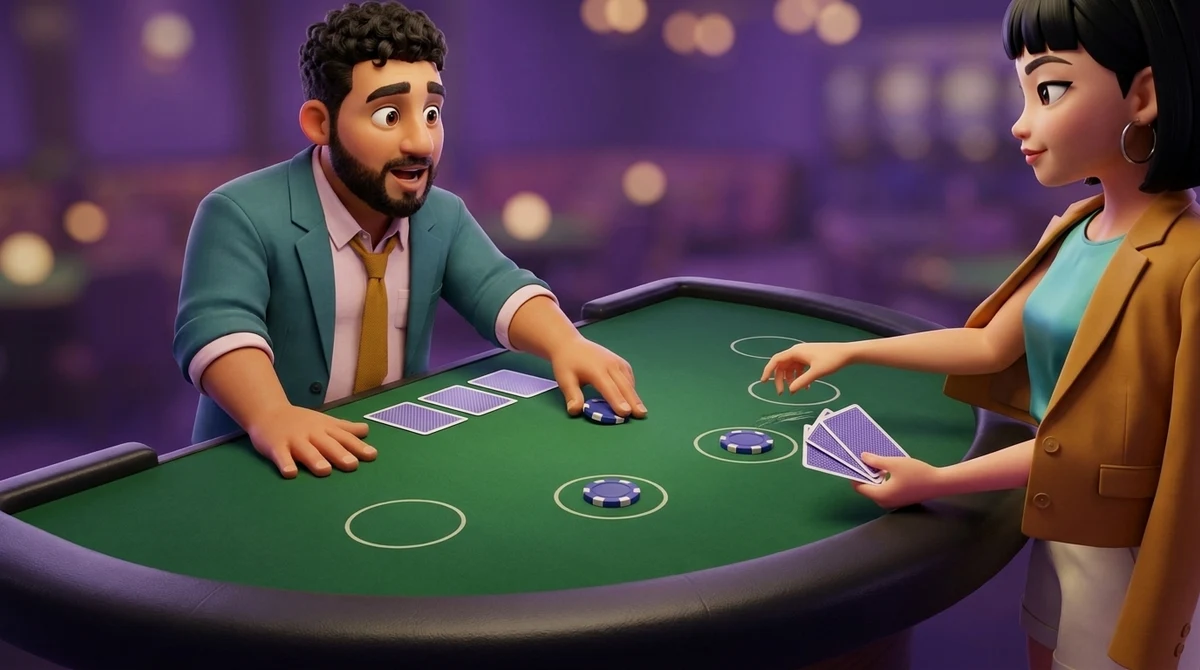

Leoformer dealer · rules and maths
At this table you ask for a bet back with a signal, not by picking the chips up yourself; in Quebec the rules say so outright. Which signal depends on where you are sitting.
Two of your three bets are a decision, and the third bet is not. I ask people to say that to themselves before the first card: two can come back, one stays.
How a hand goes
Every player puts three equal bets on three circles, and the third bet is mandatory: the hand is not played without the third bet. You play against the pay table, not against the dealer or the other players: there is no dealer hand to compare with, and every hand that pays is paid by the casino at the rates on the table. In Quebec casinos the game goes by the name Grand Prix Poker.
- Before the dealAn example $10 on each of the three circles.
- Three cardsBet 1 left in is worth 1.436 of a bet on average, so the count says leave bet 1 in.
- The first community cardBet 2 left in is worth 2.750 of a bet on average, so the count says leave bet 2 in.
- The second community cardTwo pair, kings and sevens: +$60 for the hand, at the pay table for B.C. casinos.
One hand from the first chip to the last card, dealt by our engine. The count beside steps 2 and 3 is explained further down this page.
Each player gets three cards, and two community cards are turned up that every player adds to three cards of their own. A hand pays when those five cards make a pair of tens or anything higher.
There are two chances to take a bet back, one for each of the first two bets: bet 1 after you have looked at your three cards and before any community card is shown, and bet 2 after the first community card is face up.
- A bet taken backcomes back wholeneither paid nor lost
- A bet left inpaid or lostpaid by the table if the hand pays, lost if the hand does not
Wave, scratch, and whose rule each one is
How you tell the dealer depends on where you sit, and the documents name different gestures. Under the rules for B.C. casinos the cards stay in full view and over the table at all times, a player who stays in waves off, and a player who takes a bet back makes a scratching motion on the table.
| Where | To leave a bet in | To take a bet back | And |
|---|---|---|---|
| B.C. casinos | a “wave off” | a “scratching motion” on the table | cards in full view, over the table |
| Quebec casinos | no gesture printed | “scratching the layout” | never withdraw the bet yourself |
| Two casinos in Ontario | no gesture named | a signal for the dealer to push the bet back | nothing more printed |
Each row is one document, and a greyed cell means that document names nothing there, not that anything will do.
In Quebec you take a bet back by scratching the layout, and the rules say outright that you must not withdraw the bet yourself. The guide of two casinos in Ontario says only that you signal for the dealer to push the bet back, and names no gesture.
What each hand pays, at three tables
The pay tables for B.C. casinos and for Quebec casinos are the same line for line. Two casinos in Ontario print a table where the royal flush, the straight flush and four of a kind pay half as much, and every other line is the same.
| The hand | B.C. casinos | Quebec casinos | Two casinos in Ontario |
|---|---|---|---|
| Royal flush | 1,000 to 1 | 1,000 to 1 | 500 to 1 |
| Straight flush | 200 to 1 | 200 to 1 | 100 to 1 |
| Four of a kind | 50 to 1 | 50 to 1 | 25 to 1 |
| Full house | 11 to 1 | 11 to 1 | 11 to 1 |
| Flush | 8 to 1 | 8 to 1 | 8 to 1 |
| Straight | 5 to 1 | 5 to 1 | 5 to 1 |
| Three of a kind | 3 to 1 | 3 to 1 | 3 to 1 |
| Two pair | 2 to 1 | 2 to 1 | 2 to 1 |
| A pair of tens or higher | 1 to 1 | 1 to 1 | 1 to 1 |
The three highlighted lines are the only lines where the three tables differ. A bet that is paid also gets back the bet itself; a bet taken back is not on the table at all.
The table for B.C. casinos has one more column, Bonus Payout. That column pays the optional $1 bonus bet: a separate bet from the three circles, with a price of its own that this page does not count. The three bets of the game are paid only by the lines shown above.
The rules for B.C. casinos and the guide of two casinos in Ontario set a ceiling on what one round pays all the players together, and that ceiling is not a limit on your bet. In Quebec, pays run up to the maximum shown at the table.
- B.C. casinos$50,000the most a round of the game pays all players together
- Two casinos in Ontario$75,000the most a round pays all players together
- Quebec casinosshown at the tablepays run “up to the maximum indicated at the table”
The ceilings for B.C. casinos and for the two casinos in Ontario are for the whole table in one round. A bet at any size the table allows is still paid at the rates above; such a ceiling only matters on a round where the hands at the table pay out that much between them.
Leave it in or take it back
No document we could read prints which hands to leave in. The decisions on this page are our own count: for a bet you may still take back, every card still to come is dealt out in turn, each finished hand is paid by the table, and the bet is worth leaving in when, on average, the bet pays back more than it loses.
| Your three cards | What the cards are | Bet 1 left in is worth | So the count says |
|---|---|---|---|
| A pair of tens or better, which already pays | 1.436 | Leave bet 1 in | |
| Three cards to a royal flush | 0.997 | Leave bet 1 in | |
| Three cards of one suit close enough for a straight flush | −0.265 | Take bet 1 back | |
| Three cards of one suit close enough for a straight flush | 0.122 | Leave bet 1 in | |
| A pair below tens, which does not pay yet | −0.060 | Take bet 1 back | |
| Three cards of one suit | −0.311 | Take bet 1 back |
A value below nothing means the bet left in loses that much of itself on average, each time those cards come up; a bet taken back is worth nothing either way. The two hands of one suit show that the same kind of hand can go either way.
Our count, in one line, for bet 1: leave it in with three of a kind, a pair of tens or higher, or three cards to a royal flush; take it back with any other hand, except some three cards of one suit close enough for a straight flush. With those, the more straight flushes the three cards could still be part of, and the more of them are ten or higher, the more bet 1 is worth, and the better ones are worth leaving in. Bet 2 is counted the same way, with the first community card as a fourth card.
A bet with a value above nothing can still be lost on the cards still to come, and across all hands the game keeps its price: the count only says which of the two decisions costs less.
Played this way on the pay table for B.C. casinos, most bets come back: bet 1 stays in on a small share of hands and bet 2 on a share about twice as large, and on average fewer than half of the three bets are still in play when the hand is settled.
- Bet 1 left in7.3%of three-card hands
- Bet 2 left in15.1%of hands once the first community card is up
- Bets in play at the end1.22of the three, on average
What the game costs
Counted over every card still to come, with both decisions made by the count, a hand on the pay table for B.C. and Quebec casinos costs 3.506% of one bet: everything the three bets do on average, measured against the third bet, the one that always stays in. Measured against all the money actually in play, the same hand costs 2.86%.
| Measured against | B.C. and Quebec casinos | Two casinos in Ontario |
|---|---|---|
| One bet, the third bet | 3.506% | 5.657% |
| All the money actually in play | 2.86% | 4.63% |
Halving the three highest lines of the pay table makes every hand dearer, even though those lines come up rarely.
No Canadian document we could read prints how many hands an hour a Let It Ride table deals. The figure used here is the one in the Las Vegas Strip rating table: 50 hands an hour. The table has no figure for this game; the figure for Caribbean Stud, another poker game played against the dealer, is used.
- One hand$0.35the average price of a hand with an example $10 on each circle, rounded to the cent
- Hands in an hour50the figure in the Las Vegas Strip rating table
- One hour$17.53on average, from the unrounded price of a hand
The price of one hand is shown rounded to the cent, and the hour is worked out from the unrounded price, so multiplying the rounded cents by the hands lands a little away from the hour. On the pay table two casinos in Ontario print, the same hour comes to about $28.28. Amounts are in Canadian dollars.
The hour is a long-run average and not a forecast: one hour can come out well above it or well below it. Price of an hour works the same multiplication for your own bet and your own hours.

Mayaformer floor supervisor · manners, money and breaks
Letting it ride is a new decision each time, and the third bet always stays in. Every bet you leave on the felt is more money on the same hand, so a bet left in because the last hand went badly is not a better bet, only a bigger one.
Decide at home what the evening gets and how long the evening lasts, and stop when either one is used up. Putting more down to get a loss back is lesson 10.3, Chasing losses, and it never makes the next hand cheaper.
If it stops being fun
If gambling stops being entertainment, help is available. 19+ in most of Canada; 18+ in Alberta, Manitoba and Quebec. More on responsible gaming.
The lesson on one card
That is the lesson. Here it is on one card: print it, or keep it on your phone.
| The hand | B.C. casinos | Quebec casinos | Two casinos in Ontario |
|---|---|---|---|
| Royal flush | 1,000 to 1 | 1,000 to 1 | 500 to 1 |
| Straight flush | 200 to 1 | 200 to 1 | 100 to 1 |
| Four of a kind | 50 to 1 | 50 to 1 | 25 to 1 |
| Full house | 11 to 1 | 11 to 1 | 11 to 1 |
| Flush | 8 to 1 | 8 to 1 | 8 to 1 |
| Straight | 5 to 1 | 5 to 1 | 5 to 1 |
| Three of a kind | 3 to 1 | 3 to 1 | 3 to 1 |
| Two pair | 2 to 1 | 2 to 1 | 2 to 1 |
| A pair of tens or higher | 1 to 1 | 1 to 1 | 1 to 1 |
19+ (18+ in AB, MB, QC) · Set a limit before you sit down · Play responsibly · the line for your province is at Helplines by province
Practice: take it back?
Level 1 puts you at a table in a named province: first the signal that province asks for, then a finished hand to settle across all three circles. Level 2 deals three cards and asks about bet 1, or three cards and the first community card and asks about bet 2.
Nothing is bet here. The amounts are an example of $10 on each circle, and every decision stops at the moment you make it.
Lesson done
Review my mistakes (0)
Progress stays in this browser; nothing is sent anywhere.
The practice table needs JavaScript. Here is one hand from it, with the answer.
Level 1 · Signal and settle
The pay table for B.C. casinos
Community cards
Your three cards
- 1taken back
- 2taken back
- 3in
An example $10 on each circle
The second community card is out. What does the hand come to for you, across all three circles?
- +$60 for the hand That settles all three circles. A bet taken back came back to you before the second community card was out, and a bet taken back is neither paid nor lost.
- +$10 for the hand That pays every bet still in at 1 to 1. On this table two pair, queens and fives pays 2 to 1.
- −$10 for the hand That treats the hand as one that does not pay. Two pair, queens and fives is on the pay table.
- +$20 for the hand The third bet alone is paid 2 to 1, an example $10 a bet. Bet 1 came back before any community card was shown, and bet 2 after the first one.
The five cards come to two pair, queens and fives, which pays 2 to 1 on the pay table for B.C. casinos. Whether bets 1 and 2 stayed in was decided by the count of every card still to come; every bet still in is settled alike.
Level 2 · Take it back?
The pay table for B.C. casinos
Community cards
Your three cards
- 1your call
- 2in
- 3in
An example $10 on each circle
Bet 1: let it ride, or take it back?
- Let it ride Left in, bet 1 is worth 1.436 of a bet on average over every card still to come; a bet taken back is worth nothing either way.
- Take it back Taking bet 1 back gives up 1.436 of a bet on average, each time these cards come up.
A pair of tens or better, which already pays: A♦ 8♠ A♥. A bet you may still take back is worth leaving in when, on average over every card still to come, the bet pays back more than it loses on the pay table for B.C. casinos. A bet with a value above nothing can still be lost on the cards still to come, and across all hands the game keeps its price.
Every hand in the practice run is worked out the same way: the cards come from one shuffled deck dealt with a fixed seed, every finished hand is settled at the pay table shown on the hand, and every decision about bet 1 or bet 2 is counted over every card still to come.
How the practice run works
Where the hands come from. Every hand is dealt from one shuffled deck with a fixed seed, so every visitor sees the same hands. A finished hand is settled at the pay table named on the hand; whether bets 1 and 2 stayed in on that hand was decided by the same count as level 2. The wrong amounts are named mistakes: settling only the third bet, settling a bet that was taken back, paying the hand at the wrong rate, or reading a hand as one that does or does not pay.
Where the decisions come from. Each decision about bet 1 or bet 2 is counted over every card still to come on the pay table for B.C. casinos; where leaving the bet in and taking the bet back are worth exactly the same, both answers count.
One strip, and no rounds. Every square on the strip is one hand of this lesson, and all of the squares are there from the start. When the squares of one level are full, the next level begins by itself. Practising a hand you got wrong turns its cross into “fixed in practice” and does not change the count, because only first answers count.
Your progress stays in this browser, and nothing is sent anywhere.
Check yourself

Mayaformer floor supervisor · manners, money and breaks
Three quick ones. Pick an answer, then check it. No timer, no points: just whether it stuck.
Back to the question we opened with. Bet 1 can come back now, and bet 2 once the first community card is face up.
Where to go next, and further reading
19+ (18+ in AB, MB, QC) · Play responsibly · the helplines are further up this page
Further reading
- Rules of Play for Table Games — Poker · BCLCThe B.C. rules for Let It Ride: three equal bets, the two you may take back, the hand signals and the pay table.
- Grand Prix Poker (Let It Ride) · Loto-QuébecQuébec’s brochure: three equal bets, scratching the layout to take one back, and the pay table.
How it’s worked out
Rules, numbers, pace, sources and hosts
Where this happens. Every rule and price on this page is for a live Let It Ride table in a room you can walk into, with a dealer running the game. Where a game is on offer is for the room pages, not for this lesson.
Rules. The three equal bets, the hand signals, the pay table, the bonus column and the ceiling of a round come from the rules published for B.C. casinos: a set of rules for a province’s casinos, not a report of what any one room does. The Quebec rules come from that province’s brochure, and the half-size pay table, the push-back signal and the ceiling of $75,000 come from the guide of two casinos in Ontario. The documents differ, and each difference is shown with its province rather than smoothed over.
Numbers. Every pay on this page is read from the engine’s copy of each pay table, and every price is worked out when the page is built by our engine for this track, by going through every hand and every card still to come. A decision about bet 1 or bet 2 leaves the bet in when, on average over every card still to come, the bet pays back more than it loses; the price of a hand is everything the three bets do on average, measured against one bet, the third bet, which always stays in. No document we could read prints which hands to leave in, and no document we could read prints a house edge for this game: every percentage here is our own count. Our checks recompute every figure from the engine rather than reading it back from this page.
Pace. No Canadian document we could read prints how many hands an hour a Let It Ride table deals. The figure here is the one our Price of an hour tool uses and names: 50 hands an hour in the Las Vegas Strip rating table, taken from its line for Caribbean Stud because the table has no line for Let It Ride. It carries no source button on this page. Your table may be faster or slower.
What is deliberately absent. The optional $1 bonus bet is not counted anywhere on this page. Three Card Poker and its Ante and Play are lesson 9.1, and its side bets lesson 9.2; Ultimate Texas Hold’em is lessons 9.3 and 9.4; Pai Gow Poker is lessons 9.6 and 9.7; Sic Bo is lesson 9.8; the money wheel is lesson 9.9; choosing among these tables by the price of an hour is lesson 9.10. How far one evening swings around the average is lesson 10.1, and chasing a loss is lesson 10.3, Chasing losses.
Sources. Every rule and every claim on this page carries a button with the sentence it rests on, the publisher who wrote that sentence and the date we read it.
Hosts. Leo and Maya are illustrated characters. Their backstories, a former dealer and a former floor supervisor, are written for the course: neither is a real person, and neither speaks for any casino. The rules and numbers on this page come from the sources it cites, not from their experience.
No promise. Let It Ride is played against the house. Making each decision by the count makes each hand cost less than a careless decision would; nothing on this page turns the game in your favour, and nothing here says how an evening at the table would end.
Hand signals, under the rules for B.C. casinos
Players must hold their cards in full view and over the table at all times.
If Player decides to stay in, they "wave off".
If Player decides to take their bet back, they make a "scratching motion" on the table.
Section 1.0 Let It Ride, 6.3 to 6.6
Taking a bet back, under the rules for Quebec casinos
After having examined your three cards, you have the option of letting your three bets ride or requesting that one or two of them be withdrawn, as indicated below.
To withdraw a bet, you must signal your intention to the dealer by scratching the layout.
You must not withdraw your bet yourself.
Loto-Québec · Brochure “Grand Prix Poker (Let It Ride)” · read
Tens or better
The Player attempts to achieve a five-card poker hand of a pair of 10's or better, by combining the three cards dealt to them and the two community cards dealt to the Dealer.
Section 1.0 Let It Ride, 1.2 to 2.4.1
Your bet wins if the value of your hand, made up of your three cards and of the two community cards, is equal to or higher than a pair of 10s.
Loto-Québec · Brochure “Grand Prix Poker (Let It Ride)” · read
After the two community cards are exposed, the Player in order to receive a payout, must have a pair of tens or better between their three cards and the two community cards.
Fallsview Casino Resort and Casino Niagara · Playing Let It Ride · read
Three equal bets, the third mandatory
Each Player must place three equal bets in the three betting spots marked (1), (2), and ($).
The third bet (bet #3) is mandatory for play.
Section 1.0 Let It Ride, 1.2 to 2.4.1
place three distinct bets of equal value.
3rd bet: you must let your third bet ride.
Loto-Québec · Brochure “Grand Prix Poker (Let It Ride)” · read
Each Player must place three separate and equal wagers per round.
Fallsview Casino Resort and Casino Niagara · Playing Let It Ride · read
Three equal bets, the third mandatory
Each Player must place three equal bets in the three betting spots marked (1), (2), and ($).
The third bet (bet #3) is mandatory for play.
Section 1.0 Let It Ride, 1.2 to 2.4.1
place three distinct bets of equal value.
3rd bet: you must let your third bet ride.
Loto-Québec · Brochure “Grand Prix Poker (Let It Ride)” · read
Each Player must place three separate and equal wagers per round.
Fallsview Casino Resort and Casino Niagara · Playing Let It Ride · read
The game’s name in Quebec
place three distinct bets of equal value.
3rd bet: you must let your third bet ride.
Loto-Québec · Brochure “Grand Prix Poker (Let It Ride)” · read
Two community cards
Two of the dealer's three cards will serve as community cards, that is, all players will be using them to complete their five-card hand.
Loto-Québec · Brochure “Grand Prix Poker (Let It Ride)” · read
Each Player receives three cards and the Dealer receives two cards.
The Dealer’s two cards are community cards that all Players use to make their best five-card Poker hand.
Fallsview Casino Resort and Casino Niagara · Playing Let It Ride · read
Tens or better
The Player attempts to achieve a five-card poker hand of a pair of 10's or better, by combining the three cards dealt to them and the two community cards dealt to the Dealer.
Section 1.0 Let It Ride, 1.2 to 2.4.1
Your bet wins if the value of your hand, made up of your three cards and of the two community cards, is equal to or higher than a pair of 10s.
Loto-Québec · Brochure “Grand Prix Poker (Let It Ride)” · read
After the two community cards are exposed, the Player in order to receive a payout, must have a pair of tens or better between their three cards and the two community cards.
Fallsview Casino Resort and Casino Niagara · Playing Let It Ride · read
Two chances to take a bet back
Commencing from the Dealer's left and rotating clockwise to the right, each Player is given the option of "Letting It Ride" or taking back bet #1.
Once all Players have exercised their option, the Dealer turns over the first community card.
Beginning from the Dealer's left and rotating clockwise to the right, each Player is given the option of "Letting it Ride" or taking back bet #2.
Section 1.0 Let It Ride, 6.3 to 6.6
1st bet: you have the option of letting your first bet ride or requesting that it be withdrawn without seeing any of the community cards.
Once all players have acted on their first bet, the dealer discards one of his three cards and reveals one of the two remaining cards.
2nd bet: you have the option of letting your second bet ride or requesting that it be withdrawn after having seen the first community card.
Loto-Québec · Brochure “Grand Prix Poker (Let It Ride)” · read
After looking at their cards, the Player may elect to stay in until the end (Let It Ride) or they can signal to have the Dealer push back their bet on Circle 1.
Once the first community card has been revealed, the Player will decide if they wish to signal to have the Dealer push back their second bet or stay in until the end.
Fallsview Casino Resort and Casino Niagara · Playing Let It Ride · read
Hand signals, under the rules for B.C. casinos
Players must hold their cards in full view and over the table at all times.
If Player decides to stay in, they "wave off".
If Player decides to take their bet back, they make a "scratching motion" on the table.
Section 1.0 Let It Ride, 6.3 to 6.6
Taking a bet back, under the rules for Quebec casinos
After having examined your three cards, you have the option of letting your three bets ride or requesting that one or two of them be withdrawn, as indicated below.
To withdraw a bet, you must signal your intention to the dealer by scratching the layout.
You must not withdraw your bet yourself.
Loto-Québec · Brochure “Grand Prix Poker (Let It Ride)” · read
Pushing a bet back, at two casinos in Ontario
After looking at their cards, the Player may elect to stay in until the end (Let It Ride) or they can signal to have the Dealer push back their bet on Circle 1.
Once the first community card has been revealed, the Player will decide if they wish to signal to have the Dealer push back their second bet or stay in until the end.
Fallsview Casino Resort and Casino Niagara · Playing Let It Ride · read
The pay table, under the rules for B.C. casinos
The payout schedule shall be posted at each betting spot.
Pair of 10s or better 1 to 1 N/A
2 Pair 2 to 1 $4.00
3 of a Kind 3 to 1 $8.00
Straight 5 to 1 $25.00
Flush 8 to 1 $50.00
Full house 11 to 1 $75.00
4 of a Kind 50 to 1 $100.00
Straight Flush 200 to 1 $2,000.00
Royal Flush 1000 to 1 $20,000.00
Section 1.0 Let It Ride, 5.1 to 5.3
All Players have the option of wagering $1.00 on the bonus Let It Ride;
Section 1.0 Let It Ride, 1.2 to 2.4.1
The pay table, under the rules for Quebec casinos
Royal flush 1,000 to 1
Straight flush 200 to 1
Four-of-a-kind 50 to 1
Full house 11 to 1
Flush 8 to 1
Straight 5 to 1
Three-of-a-kind 3 to 1
Two pair 2 to 1
Pair (10, J, Q, K, A) 1 to 1
*up to the maximum indicated at the table
Loto-Québec · Brochure “Grand Prix Poker (Let It Ride)” · read
The pay table of two casinos in Ontario
Royal Flush 500 to 1
Straight Flush 100 to 1
Four of a Kind 25 to 1
Full House 11 to 1
Flush 8 to 1
Straight 5 to 1
Three of a Kind 3 to 1
Two Pairs 2 to 1
One Pair of 10's or Better 1 to 1
Note: Maximum aggregate payout of $75,000 per round.
Fallsview Casino Resort and Casino Niagara · Playing Let It Ride · read
The bonus column, under the rules for B.C. casinos
The payout schedule shall be posted at each betting spot.
Pair of 10s or better 1 to 1 N/A
2 Pair 2 to 1 $4.00
3 of a Kind 3 to 1 $8.00
Straight 5 to 1 $25.00
Flush 8 to 1 $50.00
Full house 11 to 1 $75.00
4 of a Kind 50 to 1 $100.00
Straight Flush 200 to 1 $2,000.00
Royal Flush 1000 to 1 $20,000.00
Section 1.0 Let It Ride, 5.1 to 5.3
All Players have the option of wagering $1.00 on the bonus Let It Ride;
Section 1.0 Let It Ride, 1.2 to 2.4.1
The payout ceiling, under the rules for B.C. casinos
Combined maximum total payout to all Players during any one round of the basic game shall be an aggregate amount of $50,000.00.
Section 1.0 Let It Ride, 5.1 to 5.3
The payout ceiling of two casinos in Ontario
Royal Flush 500 to 1
Straight Flush 100 to 1
Four of a Kind 25 to 1
Full House 11 to 1
Flush 8 to 1
Straight 5 to 1
Three of a Kind 3 to 1
Two Pairs 2 to 1
One Pair of 10's or Better 1 to 1
Note: Maximum aggregate payout of $75,000 per round.
Fallsview Casino Resort and Casino Niagara · Playing Let It Ride · read
The maximum, under the rules for Quebec casinos
Royal flush 1,000 to 1
Straight flush 200 to 1
Four-of-a-kind 50 to 1
Full house 11 to 1
Flush 8 to 1
Straight 5 to 1
Three-of-a-kind 3 to 1
Two pair 2 to 1
Pair (10, J, Q, K, A) 1 to 1
*up to the maximum indicated at the table
Loto-Québec · Brochure “Grand Prix Poker (Let It Ride)” · read
Spotted a mistake on this page? Tell us
Been here before? Review us on Trustpilot