Atlassino Academy · Roulette · Lesson 6 of 6
The hot and cold numbers board
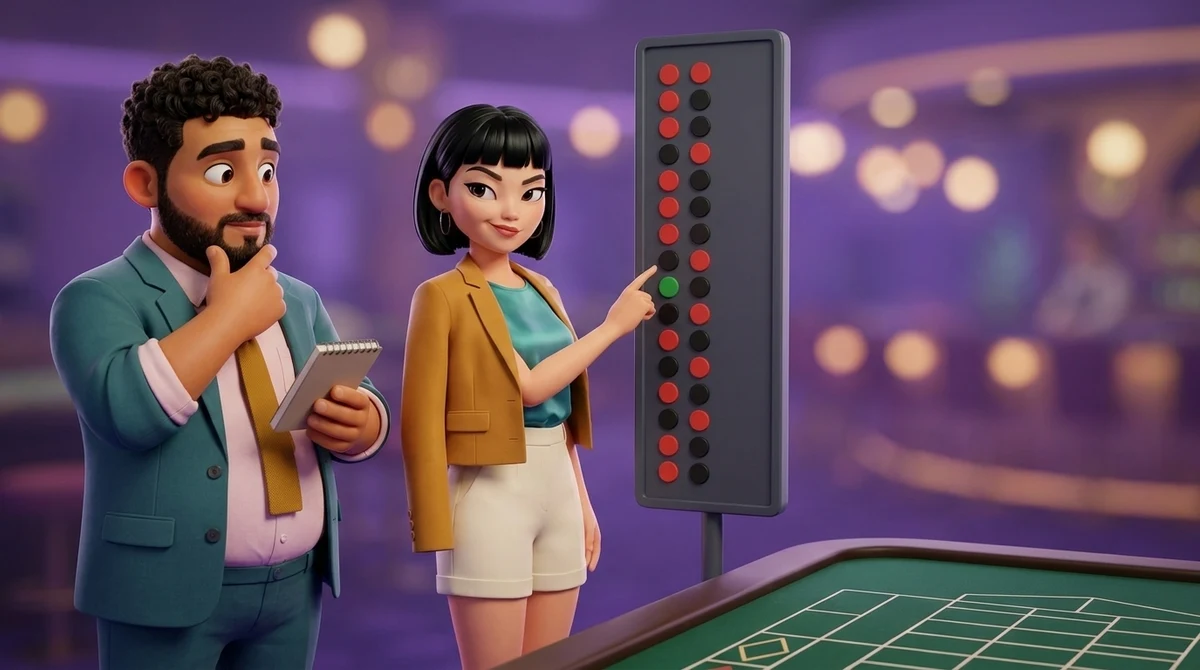
The board beside the roulette wheel lists the numbers that have come up. The board is a record of the wheel, not a forecast: every number keeps the same chance on every spin.
The board beside the roulette wheel lists 23 three times in the last 15 spins. Is 23 any more likely on the next spin?
The short answer
No. On a wheel with a zero and a double zero every number comes up 1 in 38 on every spin, and 23 is one of those numbers whatever the board lists. The board is a record of spins that have already happened. Reading the board as a forecast of the next spin is the mistake the board makes easy.
Last 15 spins · newest first
- 23
- 15
- 28
- 11
- 23
- 5
- 00
- 24
- 12
- 17
- 7
- 23
- 3
- 21
- 2
Next spin: every number 1 in 38.

Mayaformer floor supervisor · manners, money and breaks
I once stood beside a table while a man copied the whole board into a notebook, spin after spin. The record he kept was careful and accurate, and he was reading that record as a map of what the wheel would do next. A map of the past is not a map of anything that comes after it.
The board is a record of spins already made
Most roulette tables now keep an electronic screen beside the wheel that lists the numbers that have come up, and that screen has a name: a tote board.
- What the board cannot showWhere the ball comes to rest on the next spin. Nothing on the wheel reads the board, so nothing on the board reaches the next spin.
- What hot and cold meanHot is a number listed more often than its share in the last few spins; cold is a number listed less often. Both words describe spins that are over.
Fifteen spins on a wheel of 38 pockets cannot list every number, so a short board is always uneven, and the board calls that unevenness hot and cold.
Every number, every spin: the same chance
A wheel with a zero and a double zero has 38 pockets, and a wheel with one zero has 37. On every spin the ball comes to rest in one of those pockets, and every pocket has the same chance of being the pocket the ball comes to rest in.
| Wheel | One number | Red, or black | Green, a zero |
|---|---|---|---|
| A zero and a double zero, 38 pockets | 1 in 382.63% of spins | 18 in 3847.37% of spins | 2 in 385.26% of spins |
| One zero, 37 pockets | 1 in 372.70% of spins | 18 in 3748.65% of spins | 1 in 372.70% of spins |
Every figure is a count of pockets. Read the row with the same number of zeros as the wheel in front of you.
The pockets are not arranged around the wheel in the order they appear on the layout, and red and black pockets alternate around it. Wheels are inspected often, for alignment and for any lean towards some pockets over others. What an earlier spin did has no way into the next spin: the ball does not carry the board with it.
The next thousand spins after the board
The board at the head of this page was drawn from a fair wheel, and the same run carries on for 1,000 more spins after the newest number on the board. Here is how often each pocket came up in those 1,000 spins.
Thirty-eight bars, one for each pocket, showing how often each pocket came up in the thousand spins after the board. The bars are uneven, and the bar for 23 stands among the other bars rather than above them.
Each bar is one pocket, in the order of the layout and not the order on the wheel: the zero and the double zero first, then 1 to 36. The dashed line is what 1 in 38 a spin comes to over 1,000 spins, about 26.3. 23, the number the board called hot, came up 25 times, and every pocket came up somewhere between 14 and 42 times.
Uneven bars are what a fair wheel produces, uneven in a different place every thousand spins. A board of fifteen spins is a small slice of that unevenness, and hot is the name the board gives to the tallest bar in the slice.
Runs of one colour are common over an evening
A board that lists colours makes a run easy to see: eight blacks in a row, standing at the newest end of the board. Runs of that kind are not rare. An evening of 3 hours at a table with a zero and a double zero comes to about 114 spins, and over that many spins a run of one colour of each length below turns up this often:
Each bar is the share of such evenings with at least one run of that length, of red or of black.
Colour of the last 15 spins · newest first
- B
- B
- B
- B
- B
- B
- B
- B
- R
- R
- R
- B
- B
- B
- B
R red · B black · G green, one of the zeros
Next spin: every number 1 in 38.Red 18 in 38 · black 18 in 38 · green 2 in 38
A run of that kind changes nothing about the spin that follows the run. After eight blacks the next spin is red 18 in 38, exactly as after any other spin, and black the same. A long run is common, and a long run is not a reason for the other colour to arrive.
Money and time at roulette
The board grows by one line on every spin, and the money that goes down over an evening grows with the number of spins. Money and time are the two parts of an evening that are decided before the first spin, and the board changes neither of them.

Mayaformer floor supervisor · manners, money and breaks
Decide at home how much money the evening gets and when the evening ends, and leave the board out of both decisions. A run the other way is not money the table owes you, and putting more down to get back what went down only makes the evening dearer.
If the board starts to feel like a message meant for you, step away from the table, or call one of the lines below.
If it stops being fun
If gambling stops being entertainment, help is available. 19+ in most of Canada; 18+ in Alberta, Manitoba and Quebec. More on responsible gaming.
Practice: read the board
Every board in the practice run is drawn from a fair wheel. You read the board, you say what chance the named number or colour has on the next spin, and you say how sure you are of that answer. Then the next 1,000 spins after that board are shown, from the same run of the same wheel.
Nothing here is scored. Both levels are for reading through: level 1 is a number the board calls hot or cold, and level 2 is a run of one colour. The plate under every board stays the same from board to board, because the chance on the next spin does not change from board to board.
Lesson done
Review my mistakes (0)
Progress stays in this browser; nothing is sent anywhere.
The practice table needs JavaScript. Here is one board from it, with the answer.
Level 1 · A hot or cold number
A wheel with a zero and a double zero · 38 pockets
Last 15 spins · newest first
- 23
- 15
- 28
- 11
- 23
- 5
- 00
- 24
- 12
- 17
- 7
- 23
- 3
- 21
- 2
Next spin: every number 1 in 38.
23 is listed three times in the last 15 spins. What is the chance that 23 comes up on the next spin, and how sure are you of that?
- Better than 1 in 38, and I am sure of that Three times in fifteen spins is what the board calls hot. The wheel keeps no record of earlier spins, so the board cannot lift 23 above 1 in 38. Feeling sure of a better chance is the part worth noticing: a record of what happened, read quickly, looks like a pattern.
- Better than 1 in 38, but only as a hunch Three times in fifteen spins is what the board calls hot. The wheel keeps no record of earlier spins, so the board cannot lift 23 above 1 in 38. A hunch in that direction points away from the count of pockets, and the count of pockets is all the wheel has.
- 1 in 38, the same as every number, and I am sure of that Every pocket keeps the same chance on every spin, so 23 is 1 in 38 on the next spin whatever the board shows. Being sure is right here: the certainty comes from counting pockets, and the count of pockets is the same on every spin.
- 1 in 38, the same as every number, but only as a hunch Every pocket keeps the same chance on every spin, so 23 is 1 in 38 on the next spin whatever the board shows. The answer needs no hunch at all: the chance comes from counting pockets, and the count of pockets is the same on every spin.
- Worse than 1 in 38, and I am sure of that A number listed three times can look as if that number has had its turn. The wheel keeps no record of earlier spins, so the board cannot push 23 below 1 in 38. Feeling sure of a worse chance is the part worth noticing: a record of what happened, read quickly, looks like a pattern.
- Worse than 1 in 38, but only as a hunch A number listed three times can look as if that number has had its turn. The wheel keeps no record of earlier spins, so the board cannot push 23 below 1 in 38. A hunch in that direction points away from the count of pockets, and the count of pockets is all the wheel has.
The next 1,000 spins after this board, from the same run of the same fair wheel: 23 came up 25 times. At 1 in 38 a spin, 1,000 spins give about 26.3. The board was a record of spins already made, and none of the 1,000 spins after the board read the board.
Level 2 · A run of one colour
A wheel with a zero and a double zero · 38 pockets
Colour of the last 15 spins · newest first
- B
- B
- B
- B
- B
- B
- B
- B
- R
- R
- R
- B
- B
- B
- B
R red · B black · G green, one of the zeros
Next spin: every number 1 in 38.Red 18 in 38 · black 18 in 38 · green 2 in 38
The last eight spins on the board all came up black. What is the chance that the next spin is red, and how sure are you of that?
- Better than 18 in 38, and I am sure of that After eight blacks, red feels due. The wheel keeps no record of earlier spins, so the board cannot lift red above 18 in 38. Feeling sure of a better chance is the part worth noticing: a record of what happened, read quickly, looks like a pattern.
- Better than 18 in 38, but only as a hunch After eight blacks, red feels due. The wheel keeps no record of earlier spins, so the board cannot lift red above 18 in 38. A hunch in that direction points away from the count of pockets, and the count of pockets is all the wheel has.
- 18 in 38, the same as on every spin, and I am sure of that Every pocket keeps the same chance on every spin, so red is 18 in 38 on the next spin whatever the board shows. Being sure is right here: the certainty comes from counting pockets, and the count of pockets is the same on every spin.
- 18 in 38, the same as on every spin, but only as a hunch Every pocket keeps the same chance on every spin, so red is 18 in 38 on the next spin whatever the board shows. The answer needs no hunch at all: the chance comes from counting pockets, and the count of pockets is the same on every spin.
- Worse than 18 in 38, and I am sure of that After eight blacks, black feels as if black is running. The wheel keeps no record of earlier spins, so the board cannot push red below 18 in 38. Feeling sure of a worse chance is the part worth noticing: a record of what happened, read quickly, looks like a pattern.
- Worse than 18 in 38, but only as a hunch After eight blacks, black feels as if black is running. The wheel keeps no record of earlier spins, so the board cannot push red below 18 in 38. A hunch in that direction points away from the count of pockets, and the count of pockets is all the wheel has.
The next 1,000 spins after this board, from the same run of the same fair wheel: red came up 469 times. At 18 in 38 a spin, 1,000 spins give about 473.7. The board was a record of spins already made, and none of the 1,000 spins after the board read the board.
Every board in the practice run is fifteen spins of a fair wheel, and the spins shown under each board are the same run carried on. The plate under the board is the same on every board, because the chance on the next spin is the same after every board.
How the practice run works
Where the boards come from. Every board is fifteen spins of a fair wheel, drawn from a fixed starting point, and each board was chosen because the board shows what its level is about: a number listed three times, a number missing for a hundred spins, a run of one colour. The next 1,000 spins shown under each board are the same run carried on, and none of those spins was picked to make a point.
Why there are no squares to fill. A reference level has nothing to count, so there is no strip here: you read every board through, and the plate under the board gives the chance before you answer. What the practice asks for is your prediction and how sure you are of the prediction, so that the two can be set beside what the wheel did next.
Your progress stays in this browser, and nothing is sent anywhere.
Check yourself
Mayaformer floor supervisor · manners, money and breaks
Five quick ones. Pick an answer, then check it. No timer, no points: just whether it stuck.
Back to the question we opened with. 23 is no more likely on the next spin than any other number: 1 in 38, as on every spin. The board listed 23 three times because the board is a record, and a short record of a fair wheel is always uneven somewhere.
Where to go from here
19+ (18+ in AB, MB, QC) · Play responsibly · the helplines are further up this page
Further reading
- Game Rules — Roulette · Société des casinos du Québec (Loto-Québec)The rules this track follows: what the wheel holds, how inside and outside bets work, and the whole payout table.
- Casino Regulations, sections 113 to 123 · Province of Nova ScotiaThe regulator on the wheel itself: 37 pockets with one zero, 38 with two, the zeros green and the rest alternating.
- Roulette Odds and the House Edge · OLG PlaySmartWhere the difference between true odds and the payout comes from, in the operator’s own words.
- How to Play Roulette · Fallsview Casino ResortA room that posts three different wheels, and its own note that pay tables differ from table to table.
How it’s worked out
Boards, numbers, sources and hosts
Where this happens. Every board on this page is the kind that stands beside a live wheel in a room you can walk into. A screen at home that lists past numbers is asked for different things by a different book of rules, and it belongs to a track of its own.
Numbers. Every chance on this page is a count of pockets on the wheel, worked out when the page is built. The boards and the thousand spins after each board are drawn by the same wheel code the rest of this track uses, from a fixed starting point, so the same boards appear every time the page is built and every count can be checked from the starting point alone. The chance of a run over an evening is worked out exactly, spin by spin, by the same code as the Streaks tool, and the evening is 3 hours at the pace the Price of an hour tool uses for a table with two zeros, taken from the table a Las Vegas casino uses to rate roulette players.
Colours. No colour is given to any particular number anywhere on this page. The colour boards show the colour of each spin, drawn as a count of pockets: eighteen red, eighteen black and the zeros, which are green.
What is deliberately absent. There is no system on this page, no bet put forward, and no way of reading the board that changes what the next spin holds; systems of betting are lesson 10.2. The order of the pockets around the wheel is not drawn, because the documents this page quotes do not print that order. The payouts of the layout are lesson 4.2, why every bet on one wheel costs the same is lesson 4.3, the wheel chips and the marker are lesson 4.4, and the wheel with three zeros and the price of an hour are lesson 4.5. A study of how the players at one table in Reno bet after a run of one colour is often retold beside this subject; the wording of that study is not among the documents this page may quote, so the second question asks what the next spin does instead of how those players bet.
Sources. Every claim on this page carries a button with the sentence the claim rests on, the publisher of that sentence and the date the sentence was read.
Hosts. Maya and Leo are illustrated characters. Their backstories, a former floor supervisor and a former dealer, are written for the course: neither is a real person, and neither speaks for any casino. The rules and numbers on this page come from the sources it cites, not from their experience.
No promise. Roulette is played against the house. Reading the board as a record keeps a feeling from passing for a pattern; nothing on this page makes an evening at the wheel cheaper, and nothing here says how an evening would end.
The chance of one number on one spin
a 1 in 37 chance, compared to 1 in 38 for the American version.
What an earlier spin does to the next spin
But in reality, a past spin won’t influence the outcome of a future spin.
GameSense Tip: Knowing the previous number does not help you predict future winning bets.
What an earlier spin does to the next spin
But in reality, a past spin won’t influence the outcome of a future spin.
GameSense Tip: Knowing the previous number does not help you predict future winning bets.
What the board is called
It is now common to see an electronic screen called a tote board that highlights past winning numbers.
How a wheel is checked
Wheels are inspected frequently to ensure perfect alignment and no bias
How many pockets a wheel with one zero has
117 Each single zero roulette wheel shall have 37 equally spaced pockets around the wheel where the roulette ball may come to rest.
Section ss. 55(2), 113–123
Province of Nova Scotia · Casino Regulations (Gaming Control Act) · read
Roulette as a game of chance
The truth is, there are no strategies to help you play roulette and win all the time. Roulette is a game of pure chance.
What the board is called
It is now common to see an electronic screen called a tote board that highlights past winning numbers.
How many pockets a wheel with two zeros has
120 Each double zero roulette wheel shall have 38 equally spaced pockets around the wheel where the roulette ball shall come to rest.
Section ss. 55(2), 113–123
Province of Nova Scotia · Casino Regulations (Gaming Control Act) · read
The wheel has 38 numbered slots (1-36), plus two green slots with “0” and “00”.
How many pockets a wheel with one zero has
117 Each single zero roulette wheel shall have 37 equally spaced pockets around the wheel where the roulette ball may come to rest.
Section ss. 55(2), 113–123
Province of Nova Scotia · Casino Regulations (Gaming Control Act) · read
The chance of one number on one spin
a 1 in 37 chance, compared to 1 in 38 for the American version.
How the pockets are arranged
While the numbers are not in numerical order, the red and black pockets alternate to ensure a random result.
Loto-Québec · Casinos et Salons de jeux — Electronic Roulette · read
How a wheel is checked
Wheels are inspected frequently to ensure perfect alignment and no bias
What an earlier spin does to the next spin
But in reality, a past spin won’t influence the outcome of a future spin.
GameSense Tip: Knowing the previous number does not help you predict future winning bets.
Roulette as a game of chance
The truth is, there are no strategies to help you play roulette and win all the time. Roulette is a game of pure chance.
Spotted a mistake on this page? Tell us
Been here before? Review us on Trustpilot