Atlassino Academy · Blackjack · Lesson 2 of 21
How a round goes, province by province
Bet, deal, your turn, the dealer’s turn, settlement — and the three lines where the published rules of three Canadian operators do not say the same thing.
The second lesson of the blackjack track. A round of blackjack makes sense once you know what the cards count, what a blackjack is and what a soft 17 is, and all three of those are lesson 3.1. Here we sit through one round from the first chip to the last, and stop at the three things that change when you cross a province.
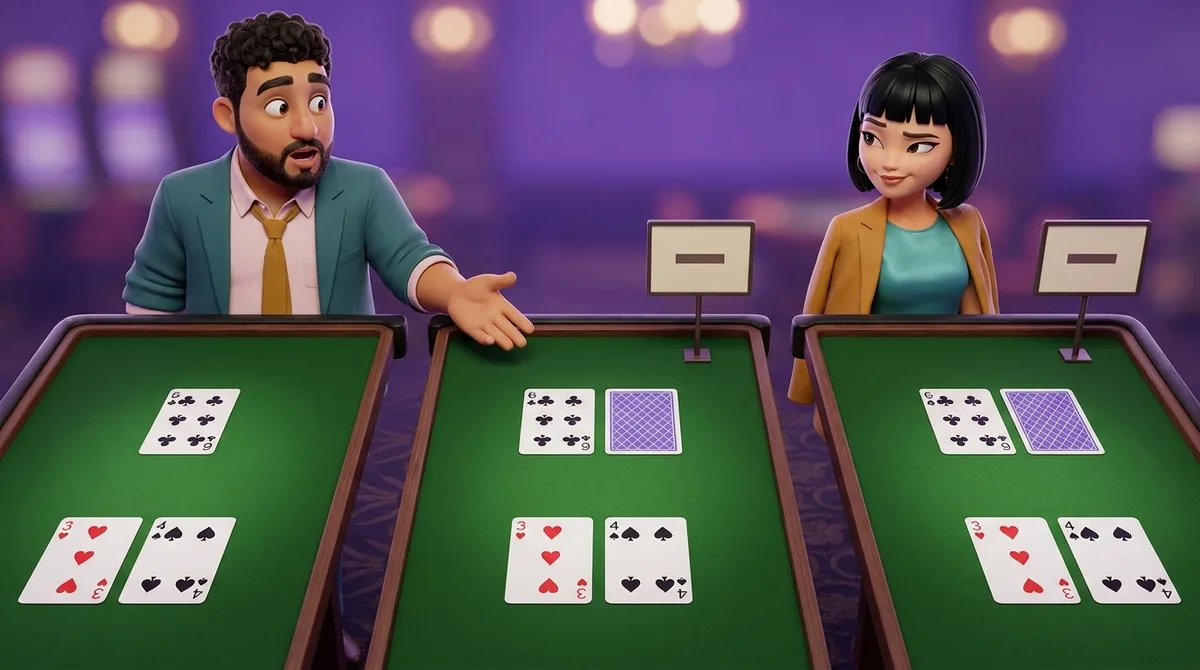
You doubled, so there is a second bet on your spot behind the first one. Then the dealer’s second card comes — an ace and a king, a blackjack. How much of your money goes?
The dealer
You, after doubling
The short answer
Five steps, always in the same order: you bet, the cards come out, you play your hand, the dealer plays a hand with nothing to decide in it, and the bets are paid or taken. Three things change from table to table: how many decks are in the shoe, whether the dealer takes a second card at the deal, and what the dealer does on a soft 17. The decks and the soft 17 change what an hour costs; the second card changes nothing.
- How many decks are in the shoeWritten as a number in British Columbia. In Quebec the rules give a range, and at the Fallsview Casino Resort tables the booklet gives nothing: count the shoe or ask the dealer.Changes what an hour costs
- Whether the dealer takes a second card at the dealPublished by all three books — and you can see the answer across the table before anybody plays.Changes nothing about the cost
- What the dealer does on a soft 17Settled for the whole province in British Columbia. In Quebec and at the Fallsview Casino Resort tables the dealer’s rule on a soft 17 is on the sign above the felt, one table at a time.Changes what an hour costs

Leoformer dealer · rules and maths
I dealt this game before I taught it, and what still surprises me is how little changes when you cross a province: the order of the five steps never changes at all.
So we go the way a hand goes: the bet, the deal, your turn, my turn, the money. And I put a price on each difference by the hour, because you read a sign once and then pay for it all evening.
The five steps
One hand from the first chip to the last, at a British Columbia table — the only one of the three sets of published rules where the dealer takes a single card at the deal and does not come back for a second card until every player at the table has finished.
Bet
Chips into your betting spot, before the first card comes out. A moment later and you are betting on the next hand.
The deal
A card to you, one face up to the dealer, then your second card. At this table the dealer’s second card comes later, after every player has finished.
Your turn
You go before the dealer, and you answer with your hand rather than your voice: hit, stand, split and double are all signalled.
The dealer’s turn
The dealer draws or stops on one fixed line, and nothing is decided here. That line is written into the provincial rules in British Columbia, and printed on the sign in front of you in Quebec and at the Fallsview Casino Resort tables.
Settlement
A hand over 21 is taken at once, before the dealer plays. Every other hand waits for the dealer’s hand to be finished.
In the hand drawn above the player stands, the dealer draws twice and goes over 21, and the bet is paid. That one hand was chosen because it passes through all five steps in order; it is not a hand that shows how an evening usually goes.
Between the deal and your turn you may be offered insurance: a side bet on the dealer’s hand rather than a move on your own hand. Insurance has a lesson of its own, 3.12.

Leoformer dealer · rules and maths
Notice where you stand in that order of five steps: your money goes down at step one, you act at step three, and I act last with nothing left to choose. That is where the price of the game comes from. Lesson 3.5 shows why going before the dealer costs you, and lesson 3.6 shows which of two moves is the cheaper one on each hand you can be dealt.
The deal: one card or two
The deal is over in a few seconds, and then you look at the dealer’s side of the table and count the cards lying there. One, or two.
The dealer
You
One card, and it stays one card until every player at the table has finished.
The dealer
You
Two cards, and the dealer’s second card is the one lying face down.
In Quebec the dealer looks at that face-down card before anybody plays: if it makes a blackjack, the round is over, your bet is gone, and you never had a turn at all. The Fallsview Casino Resort booklet says its dealer takes a second card face down and nothing we could read in it says when that card is looked at. In British Columbia, where the dealer holds a single card until the players have finished, there is nothing face down to look at, so every player at the table gets a turn whatever the dealer is holding.
Where no booklet gives the number of decks, the shoe standing in front of the dealer still has one: ask the dealer, because the number is not a secret. The minimum bet, the maximum bet and the largest payout the table will make are on the sign at the table.
| What you want to know | B.C. | Quebec | Fallsview Casino Resort |
|---|---|---|---|
| Decks in the shoe | 6 | 1 to 8 | not given — count the shoe |
| The dealer’s second card | after the players, face up | at the deal, face down, and looked at before anybody plays | at the deal, face down |
| The dealer on a soft 17 | draws, at every table in the province | whatever the sign says | whatever the sign says |
The dealer’s turn: one line decides it
The dealer chooses nothing during the dealer’s own turn: one line of text settles the whole turn. All three books put the stopping point at a total of 17, and the only argument between the three books is whether a soft 17 counts as having reached that 17.
Under the sign that has the dealer draw on a soft 17
The dealer takes another card, so your own 17 is up against a hand that is still being built.
Under the sign that has the dealer stand on every 17
The dealer stops there, so your own 17 is up against a finished hand of two cards.
In B.C. the argument is settled before you arrive: the provincial rules say the dealer draws on a soft 17 and stands on a hard 17, and they say it for every table in the province. In Quebec and at the Fallsview Casino Resort tables the rule book does not choose: it prints both answers and leaves the choice to the individual table, so the dealer follows the house strategy that table indicates above the felt. Here are the two the rule books print.
The dealer draws on a soft 17, so your own 17 is up against a hand that gets another card.
$4.31
an hour
The dealer stops on every 17. At the Fallsview Casino Resort tables the same instruction is printed as “Dealer Must Stand on 17”.
$2.83
an hour
Both prices assume $10 a hand at 70 hands an hour; only the soft-17 line changed.

Leoformer dealer · rules and maths
People read that sign for the minimum bet and stop there. The minimum bet tells you whether you can afford to sit down at all; the line about a soft 17 tells you what sitting down is going to cost you per hour. Both lines are on the same sign, and reading the line about a soft 17 takes the same two seconds as reading the minimum bet.
And if you cannot make the sign out from where you are standing, ask me. I know what it says and I am allowed to tell you: that line is printed above the table, not kept behind the desk.
The money at the end
Most of the money moves the way anybody would expect. Five lines of the published rules cover the endings that are not obvious.
- A hand over 21 is gone at once — the bet and the cards both, before the dealer plays a single card. That is why a hand over 21 loses even when the dealer goes over 21 as well.
- Unless you split or doubled and the dealer shows an ace, a face card or a 10. Then that bet is left standing on the spot until the dealer’s hand is known, because a dealer blackjack would change how much of that bet goes.
- A dealer blackjack takes your first bet only. The second bet, the one you added by doubling or splitting, comes back to you.
- A blackjack each is a standoff. Your bet comes back to you and nothing is added to it.
- With nothing left to settle, the dealer stops. If every bet at the table has already gone, the dealer’s own hand is never played out at all.
| How the hand ends | Your first bet | A second bet you put up by doubling or splitting |
|---|---|---|
| Your hand goes over 21, and the dealer shows a 2 through a 9 | Taken at once, before the dealer plays a card | Taken at once as well |
| You split or doubled, that hand goes over 21, and the dealer shows an ace, a face card or a 10 | Left standing on the spot until the dealer’s hand is known | Left standing on the spot as well |
| The dealer has a blackjack and your two cards are not one | Taken | Comes back to you |
What a hand pays is the next line of the table to read, and lesson 3.11 works out what each payout is worth. One line to read before you sit down in Quebec: the payout printed on the sign replaces the payout in the rule book, and the rules allow the posted one to go as low as 1 to 1. Read that line before the first bet, not after a blackjack. A Quebec table may also take a rake, and the rules allow one only where the table says so.
What each difference costs
Now the money. Every figure below is $10 a hand — an example bet, not a suggested one — at 70 hands an hour, with every hand played by the chart, and every figure is an average over the long run rather than a forecast of one evening.
| Where you are sitting | Of every bet, the house keeps | An hour at $10 a hand |
|---|---|---|
| B.C. | 0.53% | $3.68 |
| Quebec | 0.62% | $4.31 |
| The Fallsview Casino Resort tables | 0.62% | $4.31 |
Where the soft-17 rule is left to the sign, the row assumes the dearer sign, the one that draws on a soft 17. Where a rule book does not fix the number of decks, the row assumes six.
The dealer’s second card costs nothing
Move the dealer’s second card from the start of the hand to the end, change nothing else about the table, and the share the house keeps of every bet stays where it was.
The dealer’s second card comes at the deal, face down
0.53%
of every bet, kept by the house
The dealer’s second card comes after the players have finished
0.53%
of every bet, kept by the house
The difference between the two orders of the deal, in percentage points: 0.000
What the two orders of the deal change is what happens at the table, not what the hour costs. Where the dealer has no card face down, you can put a second bet up on a hand that turns out to have been over before you started — and the rules hand that second bet back to you. Where the dealer looks at a face-down card first, that situation never arises, because the round ends before you are asked to decide anything.
How many decks are in the shoe
The Quebec rules publish a range rather than a number: the game is played with one deck, or with eight, or with anything in between, and how many decks the shoe in front of you actually holds is decided by that one table rather than by the rule book. The two ends of that published range are two different evenings.
An hour with one deck in the shoe costs a small fraction of an hour with eight decks in the shoe, on the same published rules and the same example bet.
One deck is not a bargain, and the short bar is not an invitation. Only the number of decks changed between those two bars; a real single-deck table has other lines on its sign, and those lines move the figure back the other way. What the two bars are there to show is that the number of decks in the shoe is not a detail.
Almost all of the small gap between the British Columbia and Quebec rules is one rule: the British Columbia rules let you surrender a hand before you play it and take half the bet back. Lesson 3.3 teaches what surrender is.

Mayaformer floor supervisor · manners, money and breaks
Every figure in this section is a price, not a promise. Reading the sign before you sit down makes an evening cheaper than it would have been; it does not make the evening pay you. Decide how much money the evening gets and how long it lasts while you are still at home, and then read the sign before the first bet rather than after a hand that went badly.
What is not written down
Three rule books do not cover a country, and missing from a book is not the same thing as missing from the tables.
- Alberta. The site of Alberta Gaming, Liquor and Cannabis (AGLC) answered every request we made with a server error, two days running, so the tables of Alberta are a blank on this page. That blank is a large one: 21 of the register’s blackjack casinos stand in Alberta, and not one of the three books reaches any of them.
- When the dealer looks at a face-down card. A round can end before your turn ever arrives — and which face-up card sends the dealer looking at the face-down one is not settled by any of the three books.
At a casino none of the three books reaches, the sign on the table is the whole rule book you are given: read it before the first bet, and ask the dealer what it does not say.
Practice: one round, start to finish
Four levels, one for each step of the round where something is actually decided, and a switch for choosing which of the three rule books you are sitting under. Work through the moments in order: nothing here is scored, and nothing being scored is on purpose. Every moment is built on one published sentence, and there are only as many moments as there are sentences, so a score would be measuring how well you remember a short list rather than whether you can read a table.
Each set is a document of its own: B.C., Quebec, and one operator’s booklet for its own tables.
Lesson done
Review my mistakes (0)
Progress stays in this browser; nothing is sent anywhere.
The practice table needs JavaScript. Here is one moment from it, with the answer.
Level 2 · The deal
B.C. · table rules published by BCLC
Dealer
You
The deal is over. You have two cards face up and the dealer has one. Where is the dealer’s second card?
The answer: There is not one yet: it comes after every player has finished.
There is not one yet. The published order is three lines long: a card to each player, one card face up to the dealer, a second card to each player — and that is the end of the deal.
In our words: The dealer gives every player one face-up card, set in front of the bet;
In our words: then deals the dealer’s own card face up, in front of the chip rack;
In our words: then gives every player a second card, also face up;
BCLC · Rules of Play for Table Games — Blackjack · section 1.0 Basic Blackjack, 8.2.1 to 8.2.3 · readIn our words: Going over 21 is a bust: the bet is lost on the spot, apart from the special cases for doubled and split hands.
BCLC · Rules of Play for Table Games — Blackjack · section 1.0 Basic Blackjack, 7.1 to 7.3 · readIn our words: A busted hand is cleared at once, unless it is a split or doubled hand and the dealer’s face-up card is an ace or a ten-value card.
In our words: When every player has finished, the dealer plays by fixed rules:
In our words: draw on 16 or less, and on soft 17;
In our words: and stop drawing at hard 17.
BCLC · Rules of Play for Table Games — Blackjack · section 1.0 Basic Blackjack, 8.5 to 8.9 · readLevel 4 · Settlement
Written down in B.C. · the only one of the three books that writes this rule down
Dealer
You
You take a card on 16 and it is a 9. Twenty-five. When is that bet taken?
The answer: At once, before the dealer plays a card.
At once. The bet and the cards are collected immediately — which is the whole reason the order of play matters: you act first, and a hand over 21 is gone before the dealer’s turn exists.
In our words: Going over 21 is a bust: the bet is lost on the spot, apart from the special cases for doubled and split hands.
BCLC · Rules of Play for Table Games — Blackjack · section 1.0 Basic Blackjack, 7.1 to 7.3 · readIn our words: A busted hand is cleared at once, unless it is a split or doubled hand and the dealer’s face-up card is an ace or a ten-value card.
BCLC · Rules of Play for Table Games — Blackjack · section 1.0 Basic Blackjack, 8.5 to 8.9 · read| Shown for | The moment | What happens | The words it rests on |
|---|---|---|---|
| all three sets | The chips are in your betting spot and the dealer has not dealt yet. You decide to make the bet bigger. Until when may you? | Until the first card comes out Until the first card comes out. This is the one line of the round that two of the three publishers state in almost the same words, and it is the line everything else hangs on: the money is committed before anybody has seen anything. | In our words: A bet counts only if it sits in the betting spot before the first card is dealt. BCLC · Rules of Play for Table Games — Blackjack · section 1.0 Basic Blackjack, 5.1 to 5.3 · readBets must be placed on the designated spot before the first card is dealt.Loto-Québec · Game rules: Blackjack · section The bets · read |
| all three sets | You walk up as the cards are coming out and drop chips into an empty spot. Are you in this round? | No: that bet is not valid, and you are in from the next round You are in from the next round. Both books make the bet valid only if it was down before the deal began — which is also why nobody at the table can join a hand halfway through it. | In our words: A bet counts only if it sits in the betting spot before the first card is dealt. BCLC · Rules of Play for Table Games — Blackjack · section 1.0 Basic Blackjack, 5.1 to 5.3 · readBets must be placed on the designated spot before the first card is dealt.Loto-Québec · Game rules: Blackjack · section The bets · read |
| all three sets | Every chair is taken. Somebody standing behind one of the chairs puts chips into an empty betting spot. Is that a player? | Yes: a spot with a bet in it is a player, chair or no chair It is a player. The rules count the table by betting spots rather than by seats, which is why a full table can still have a round waiting on somebody you cannot see. | The maximum number of players at a blackjack table, whether seated or standing, is the number of betting spots at the table.Loto-Québec · Game rules: Blackjack · section The bets · read |
| BCLC | The deal is over. You have two cards face up and the dealer has one. Where is the dealer’s second card? | There is not one yet: it comes after every player has finished There is not one yet. The published order is three lines long: a card to each player, one card face up to the dealer, a second card to each player — and that is the end of the deal. | In our words: The dealer gives every player one face-up card, set in front of the bet; In our words: then deals the dealer’s own card face up, in front of the chip rack; In our words: then gives every player a second card, also face up; BCLC · Rules of Play for Table Games — Blackjack · section 1.0 Basic Blackjack, 8.2.1 to 8.2.3 · readIn our words: Going over 21 is a bust: the bet is lost on the spot, apart from the special cases for doubled and split hands. BCLC · Rules of Play for Table Games — Blackjack · section 1.0 Basic Blackjack, 7.1 to 7.3 · readIn our words: A busted hand is cleared at once, unless it is a split or doubled hand and the dealer’s face-up card is an ace or a ten-value card. In our words: When every player has finished, the dealer plays by fixed rules: In our words: draw on 16 or less, and on soft 17; In our words: and stop drawing at hard 17. BCLC · Rules of Play for Table Games — Blackjack · section 1.0 Basic Blackjack, 8.5 to 8.9 · read |
| BCLC | How many decks are in the shoe at this table? | Six — the provincial rules say so Six, from a shoe, in the opening line of the provincial rules. These provincial rules are the only one of the three books that fixes the number of decks rather than leaving it to the individual table. | In our words: The dealer deals from a shoe holding six ordinary decks. BCLC · Rules of Play for Table Games — Blackjack · section 1.0 Basic Blackjack, 1.1 to 1.3.1 · read |
| Loto-Québec | The deal is over. You have two cards, and the dealer has two cards as well with the second one lying face down. When does the dealer’s face-down card matter? | Before your turn: if it makes a blackjack, the round is over for you Before your turn. The sentence that lists what you may do begins by ruling out a house blackjack — so a round can be over before you have made a single decision. | The dealer deals one card to each player and one card face up to the house. The dealer then deals a second card to each player, and a second card face down to the house.Loto-Québec · Game rules: Blackjack · section The deal · read In the event that the house does not get a blackjack and the house's second card has not yet been revealed, players may:Loto-Québec · Game rules: Blackjack · section The player options · read |
| Loto-Québec | How many decks are in the shoe at this table? | Somewhere between one and eight: the rules give a range, not a number Between one and eight. The rules publish a range, so the answer for your table is on the table, not in the rule book — and the two ends of that range are two rather different prices for an hour. | Blackjack is played with 1 to 8 decks of 52 cards.Loto-Québec · Game rules: Blackjack · section The cards · read |
| Fallsview Casino Resort | How many cards does the dealer have when the deal is finished? | Two: one face up and one face down Two cards, and the second card is face down. This is one of the two orders a blackjack round is dealt in, and the booklet for these tables is quite clear about which one it uses. | The Dealer also receives two cards; one face up and the other face down.Fallsview Casino Resort · Playing Blackjack · section Blackjack · read |
| Fallsview Casino Resort | You want to know the lowest bet this table takes and the largest it will pay. Where does the booklet send you? | To the table: minimums, maximums and maximum payouts are posted there To the sign. The booklet publishes the order of the deal and the dealer’s two possible rules, and hands the numbers — minimum, maximum, maximum payout — to the table itself. | Minimums and maximums, and maximum payouts are posted at the table.Fallsview Casino Resort · Playing Blackjack · section Blackjack · read |
| all three sets | You are standing on 20. The dealer turns a 10 and a 6: sixteen. Does the dealer draw? | Yes: 16 draws under all three sets of published rules The dealer draws. Sixteen is under the line in all three books, and the dealer has no say in it: the whole turn is a rule being carried out. | In our words: draw on 16 or less, and on soft 17; In our words: and stop drawing at hard 17. BCLC · Rules of Play for Table Games — Blackjack · section 1.0 Basic Blackjack, 8.5 to 8.9 · readAfter revealing the house's face-down card, the dealer completes the house's hand, if necessary, according to the house strategy indicated at the table which may either be: HIT on a count of soft 17 or less and STAND on a count of hard 17 or more, or HIT on a count of 16 or less and STAND on a count of (soft or hard) 17 or more.Loto-Québec · Game rules: Blackjack · section The house strategy · read The Dealer must draw cards according to the rules posted on the table; This means that the dealer will hit their hand up to and including an ace or aces that can be totaled as either 7 or 17. "Dealer Must Stand on 17" - This means that the dealer will hit their hand on anything less than a total of 17.Fallsview Casino Resort · Playing Blackjack · section Blackjack · read |
| BCLC | You stand on hard 17. The dealer’s hand is a 6 and an ace: soft 17. Does the dealer take a card? | Yes: the provincial rules say hit soft 17 The dealer draws. This is the only one of the three books that settles the soft-17 question itself instead of handing it to the table — and your hard 17 is now against a hand that gets another card. | In our words: draw on 16 or less, and on soft 17; In our words: and stop drawing at hard 17. BCLC · Rules of Play for Table Games — Blackjack · section 1.0 Basic Blackjack, 8.5 to 8.9 · read |
| Loto-Québec | The dealer turns over the face-down card: an ace, for a soft 17. This table indicates the second of the two house strategies the rules print. Does the dealer take a card? | No: this house strategy stands on 17, soft or hard The dealer stands. These rules print two house strategies and say the table indicates which one it uses — so which of the two this table indicates is the whole answer, and the same table indicating the other one is a different game. | After revealing the house's face-down card, the dealer completes the house's hand, if necessary, according to the house strategy indicated at the table which may either be: HIT on a count of soft 17 or less and STAND on a count of hard 17 or more, or HIT on a count of 16 or less and STAND on a count of (soft or hard) 17 or more.Loto-Québec · Game rules: Blackjack · section The house strategy · read The Dealer must draw cards according to the rules posted on the table; This means that the dealer will hit their hand up to and including an ace or aces that can be totaled as either 7 or 17. "Dealer Must Stand on 17" - This means that the dealer will hit their hand on anything less than a total of 17.Fallsview Casino Resort · Playing Blackjack · section Blackjack · read |
| Fallsview Casino Resort | The dealer turns over an ace, for a soft 17. The sign says “Dealer Must Stand on 17”. Does the dealer take a card? | No: soft 17 is 17, and this sign stands on 17 The dealer stands. The booklet prints both signs an operator may post and explains each of the two signs, which is the clearest statement any of the three documents makes that this line belongs to the table rather than to the rule book. | After revealing the house's face-down card, the dealer completes the house's hand, if necessary, according to the house strategy indicated at the table which may either be: HIT on a count of soft 17 or less and STAND on a count of hard 17 or more, or HIT on a count of 16 or less and STAND on a count of (soft or hard) 17 or more.Loto-Québec · Game rules: Blackjack · section The house strategy · read The Dealer must draw cards according to the rules posted on the table; This means that the dealer will hit their hand up to and including an ace or aces that can be totaled as either 7 or 17. "Dealer Must Stand on 17" - This means that the dealer will hit their hand on anything less than a total of 17.Fallsview Casino Resort · Playing Blackjack · section Blackjack · read |
| BCLC | You were the only player, and you went over 21. Your chips have gone. Does the dealer still play the hand out? | No: with every bet settled there is nothing left to play for The dealer does not. The rules say so in one line — and it is worth knowing before you find yourself reading meaning into a hand that was never played. | In our words: If every player bet is already settled, the dealer does not draw to finish the hand. BCLC · Rules of Play for Table Games — Blackjack · section 1.0 Basic Blackjack, 8.5 to 8.9 · read |
| all three sets | You take a card on 16 and it is a 9. Twenty-five. When is that bet taken? | At once, before the dealer plays a card At once. The bet and the cards are collected immediately — which is the whole reason the order of play matters: you act first, and a hand over 21 is gone before the dealer’s turn exists. | In our words: Going over 21 is a bust: the bet is lost on the spot, apart from the special cases for doubled and split hands. BCLC · Rules of Play for Table Games — Blackjack · section 1.0 Basic Blackjack, 7.1 to 7.3 · readIn our words: A busted hand is cleared at once, unless it is a split or doubled hand and the dealer’s face-up card is an ace or a ten-value card. BCLC · Rules of Play for Table Games — Blackjack · section 1.0 Basic Blackjack, 8.5 to 8.9 · read |
| all three sets | You split your eights, and the first of the two hands goes over 21. The dealer is showing an ace. Is that bet collected straight away? | No: after a split or a double, with the dealer showing an ace, a face card or a 10, the bet stays on the spot The bet waits on the spot. The exception exists because of what comes next: the dealer may yet have a blackjack, and if so the house takes only the first bet — so there is something still to work out on that spot. | In our words: A busted hand is cleared at once, unless it is a split or doubled hand and the dealer’s face-up card is an ace or a ten-value card. BCLC · Rules of Play for Table Games — Blackjack · section 1.0 Basic Blackjack, 8.5 to 8.9 · readIn our words: If the dealer has a blackjack, a doubled hand loses only its first bet; the extra chips come back. BCLC · Rules of Play for Table Games — Blackjack · section 1.0 Basic Blackjack, 4.3 to 4.3.4.a · readIn our words: If the dealer has a blackjack, a split hand loses only its first bet; the extra bet for the split comes back. BCLC · Rules of Play for Table Games — Blackjack · section 1.0 Basic Blackjack, 4.4 to 4.4.9 · read |
| all three sets | You split a pair and put a second bet up. The dealer’s second card comes: an ace and a king, blackjack. What happens to the second bet? | The second bet comes back: only the first bet is lost The second bet comes back. This is the compensation built into a deal with no face-down card: you can commit a second bet to a hand that turns out to have been over before you started, and the rules give that bet back. | In our words: If the dealer has a blackjack, a doubled hand loses only its first bet; the extra chips come back. BCLC · Rules of Play for Table Games — Blackjack · section 1.0 Basic Blackjack, 4.3 to 4.3.4.a · readIn our words: If the dealer has a blackjack, a split hand loses only its first bet; the extra bet for the split comes back. BCLC · Rules of Play for Table Games — Blackjack · section 1.0 Basic Blackjack, 4.4 to 4.4.9 · readIn our words: A blackjack against a dealer blackjack is a push. BCLC · Rules of Play for Table Games — Blackjack · section 1.0 Basic Blackjack, 3.1 to 3.3 · readIf the Dealer also has Blackjack, it is a standoff (push) and no one wins and the player's bet is returned.Fallsview Casino Resort · Playing Blackjack · section Blackjack · read |
| all three sets | You have an ace and a king. The dealer turns over an ace and a jack. What happens? | A standoff: the bet comes back and nothing is added A standoff. The bet is returned and nothing is added to it — the one ending where a dealer blackjack costs you nothing at all, and the two books that write this ending down say the same thing about it. | In our words: A blackjack against a dealer blackjack is a push. BCLC · Rules of Play for Table Games — Blackjack · section 1.0 Basic Blackjack, 3.1 to 3.3 · readIf the Dealer also has Blackjack, it is a standoff (push) and no one wins and the player's bet is returned.Fallsview Casino Resort · Playing Blackjack · section Blackjack · read |
| Loto-Québec | You have a blackjack. The sign at this table gives a payout that is not the one in the general rules. Which one applies? | The one at the table: the rules say it replaces the general provision The sign. The rules allow the payout to vary between 1 to 1 and 10 to 1 and say that the posted figure replaces the general one — so this is a line to read before the first bet, not after a blackjack. What each payout is worth is lesson 3.11. | Where appropriate, the payout may vary between 1 to 1, and 10 to 1, in which case this payout will replace any provision to the contrary indicated in the general rules.Loto-Québec · Game rules: Blackjack · section Variations · read |
| Loto-Québec | The sign at this table says nothing about a rake. May the dealer take one anyway? | No: the rules allow a rake only where it is indicated at the table Only where the table indicates it. The rules permit a rake provided it is indicated at the table — and where a table does charge one, it is added to every price this lesson works out, because not one of those prices has a rake in it. | Provided it is indicated at the table, the house may require that the player pay a rake:Loto-Québec · Game rules: Blackjack · section Rakes · read |
How the practice table works
The switch. The three tables you can switch between are three different rule books, and a moment written from one of those books appears only while that book is the one chosen. A moment that rests on a sentence only one of the three books prints appears whatever the switch is set to, and the chip above the cards says whose words it rests on.
The sign. Where the dealer’s rule on a soft 17 is left to the individual table rather than settled by a rule book, the moment puts above the cards the house strategy that table indicates, in the words the document prints it in.
No score, no doors. Every level button is live from the start, and each level runs through its moments in order, once. Where you got to stays in this browser and nothing is sent anywhere.
Check yourself
Mayaformer floor supervisor · manners, money and breaks
Five quick ones. Pick an answer, then check it. No timer, no points: just whether it stuck.
The question at the start of this lesson. Only the first bet goes. The rules published for British Columbia say the same thing twice — once for a double down and once for a split hand, and the answer is the same both times: when the dealer has a blackjack, only the first bet is lost and the extra chips come back. If your own two cards were a blackjack as well, the round is a standoff and nothing is taken at all. Handing that second bet back is the other half of a deal with no face-down card: without a card face down you can put a second bet up on a hand that was already over, and the rules give that second bet back to you when it turns out that it was.
Where to play, and further reading
19+ (18+ in AB, MB, QC) · Play responsibly · the helplines for every province are at the end of this page
Further reading
- Rules of Play for Table Games: Blackjack · British Columbia Lottery Corporation (BCLC)The rules this track follows section by section: six decks, the dealer on soft 17, doubling, splitting and surrender.
- Game rules: Blackjack · Loto-Québec (Société des casinos du Québec)Québec’s rules: one to eight decks, a face-down dealer card, and the soft-17 rule left to the sign at the table.
- Playing Blackjack · Fallsview Casino Resort and Casino NiagaraOne Ontario operator’s own booklet, including both blackjack payouts and both dealer rules it may post.
- Blackjack: how to play · OLG PlaySmartOntario’s beginner page: the moves, the hand signals it describes, and what insurance is.
- Know the game: Blackjack · Casinos Regina & Moose Jaw (SaskGaming)A Saskatchewan operator on what the chart does and does not do, and where to pick one up in the building.
- Blackjack basics · Wizard of OddsWhat three common ways of playing blackjack without the chart cost, on that author’s own table.

Mayaformer floor supervisor · manners, money and breaks
One habit matters more than every rule and every figure we have just been through: decide the money and the time before you sit down, and stop when the time is up rather than when the evening feels finished. A table that has gone badly is not a debt owed to you, and a larger bet only makes the hour dearer.
If the money on the table starts to feel like money you need, or you are playing to get away from something, stop there and call one of the lines below. That is what they are for.
If it stops being fun
If gambling stops being entertainment, help is available. 19+ in most of Canada; 18+ in Alberta, Manitoba and Quebec. More on responsible gaming.
How it is worked out
Sources, numbers and hosts
Sources. Every rule on this page is a sentence one of three publishers printed about its own tables, stored with its address, its section and the date we read it: the rules of play of one province, the game rules of another, and one operator’s booklet for its own two casinos. Where a page says something is not published, that is the result of a search we made and it says where we searched — not a statement about tables we have not read.
Numbers. Every figure is worked out when the page is built, by the same engine as our Blackjack strategy tool, from the rules each publisher states. A cost of an hour is the example bet times hands an hour times the house edge of that set of rules, with the full chart played; hands an hour comes from the Las Vegas Strip rating table except where the page says otherwise. When this page prices a single rule, it changes that rule and nothing else — a real table changes several at once. None of the figures includes a rake, because the engine has none. Nothing here is a forecast of an evening: an evening lands far from the average in both directions.
What this lesson does not cover. What the cards count, what a blackjack is and what a soft 17 is are lesson 3.1. What each move is and when a table allows it is lesson 3.3. The hand signal that makes each move is lesson 3.4. Why acting before the dealer is where the price of the game comes from is lesson 3.5. Which of two moves is the cheaper one on a given hand is lesson 3.6. What the other lines on the sign are worth belongs to lesson 3.11, and insurance to lesson 3.12. Where one of those lessons owns a subject, this page names the lesson and stops.
Hosts. Leo and Maya are illustrated characters. Their backstories, a former dealer and a former floor supervisor, are written for the course: neither is a real person, and neither speaks for any casino. The rules and numbers on this page come from the sources it cites, not from their experience.
No promise. Blackjack is played against the house. Reading the sign lowers the price of an evening. It does not remove it, and nothing on this page tells you how an evening will end.
A hand over 21, and the exception
In our words: A busted hand is cleared at once, unless it is a split or doubled hand and the dealer’s face-up card is an ace or a ten-value card.
Section 1.0 Basic Blackjack, 8.5 to 8.9
BCLC · Rules of Play for Table Games — Blackjack · read
In our words: If the dealer has a blackjack, a doubled hand loses only its first bet; the extra chips come back.
Section 1.0 Basic Blackjack, 4.3 to 4.3.4.a
BCLC · Rules of Play for Table Games — Blackjack · read
In our words: If the dealer has a blackjack, a split hand loses only its first bet; the extra bet for the split comes back.
Section 1.0 Basic Blackjack, 4.4 to 4.4.9
BCLC · Rules of Play for Table Games — Blackjack · read
When your options exist
In the event that the house does not get a blackjack and the house's second card has not yet been revealed, players may:
Section The player options
The two signs, and what each means
After revealing the house's face-down card, the dealer completes the house's hand, if necessary, according to the house strategy indicated at the table which may either be:
HIT on a count of soft 17 or less and STAND on a count of hard 17 or more, or
HIT on a count of 16 or less and STAND on a count of (soft or hard) 17 or more.
Section The house strategy
The Dealer must draw cards according to the rules posted on the table;
This means that the dealer will hit their hand up to and including an ace or aces that can be totaled as either 7 or 17.
"Dealer Must Stand on 17" - This means that the dealer will hit their hand on anything less than a total of 17.
Section Blackjack
Hands an hour, by the number of players
This table was given to me anonymously by an executive with a major Strip casino and is used for rating players.
Table “Hands per Hour and Average House Edge”, row “Blackjack”, column “Hands/Hour”: 70
When the bet has to be down
In our words: A bet counts only if it sits in the betting spot before the first card is dealt.
Section 1.0 Basic Blackjack, 5.1 to 5.3
BCLC · Rules of Play for Table Games — Blackjack · read
Bets must be placed on the designated spot before the first card is dealt.
Section The bets
The order of the deal
In our words: The dealer gives every player one face-up card, set in front of the bet;
In our words: then deals the dealer’s own card face up, in front of the chip rack;
In our words: then gives every player a second card, also face up;
Section 1.0 Basic Blackjack, 8.2.1 to 8.2.3
BCLC · Rules of Play for Table Games — Blackjack · read
The moves, and how they are made
In our words: You choose to hit, stand, split or double with a hand signal or by putting out the right chips.
Section 1.0 Basic Blackjack, 8.5 to 8.9
BCLC · Rules of Play for Table Games — Blackjack · read
The dealer’s rule
In our words: draw on 16 or less, and on soft 17;
In our words: and stop drawing at hard 17.
Section 1.0 Basic Blackjack, 8.5 to 8.9
BCLC · Rules of Play for Table Games — Blackjack · read
How a hand ends
In our words: Going over 21 is a bust: the bet is lost on the spot, apart from the special cases for doubled and split hands.
Section 1.0 Basic Blackjack, 7.1 to 7.3
BCLC · Rules of Play for Table Games — Blackjack · read
In our words: A busted hand is cleared at once, unless it is a split or doubled hand and the dealer’s face-up card is an ace or a ten-value card.
In our words: When every player has finished, the dealer plays by fixed rules:
In our words: draw on 16 or less, and on soft 17;
In our words: and stop drawing at hard 17.
Section 1.0 Basic Blackjack, 8.5 to 8.9
BCLC · Rules of Play for Table Games — Blackjack · read
In our words: If every player bet is already settled, the dealer does not draw to finish the hand.
Section 1.0 Basic Blackjack, 8.5 to 8.9
BCLC · Rules of Play for Table Games — Blackjack · read
The order of the deal in British Columbia
In our words: The dealer gives every player one face-up card, set in front of the bet;
In our words: then deals the dealer’s own card face up, in front of the chip rack;
In our words: then gives every player a second card, also face up;
Section 1.0 Basic Blackjack, 8.2.1 to 8.2.3
BCLC · Rules of Play for Table Games — Blackjack · read
The order of the deal in Quebec
The dealer deals one card to each player and one card face up to the house. The dealer then deals a second card to each player, and a second card face down to the house.
Section The deal
The order of the deal at the Fallsview Casino Resort tables
The Dealer also receives two cards; one face up and the other face down.
Section Blackjack
When you get your turn at all
In the event that the house does not get a blackjack and the house's second card has not yet been revealed, players may:
Section The player options
What the table posts
Minimums and maximums, and maximum payouts are posted at the table.
Section Blackjack
Decks in the shoe
In our words: The dealer deals from a shoe holding six ordinary decks.
Section 1.0 Basic Blackjack, 1.1 to 1.3.1
BCLC · Rules of Play for Table Games — Blackjack · read
Decks in the shoe
Blackjack is played with 1 to 8 decks of 52 cards.
Section The cards
The dealer’s rule in British Columbia
In our words: draw on 16 or less, and on soft 17;
In our words: and stop drawing at hard 17.
Section 1.0 Basic Blackjack, 8.5 to 8.9
BCLC · Rules of Play for Table Games — Blackjack · read
The two house strategies, and what each of them means
After revealing the house's face-down card, the dealer completes the house's hand, if necessary, according to the house strategy indicated at the table which may either be:
HIT on a count of soft 17 or less and STAND on a count of hard 17 or more, or
HIT on a count of 16 or less and STAND on a count of (soft or hard) 17 or more.
Section The house strategy
The Dealer must draw cards according to the rules posted on the table;
This means that the dealer will hit their hand up to and including an ace or aces that can be totaled as either 7 or 17.
"Dealer Must Stand on 17" - This means that the dealer will hit their hand on anything less than a total of 17.
Section Blackjack
A hand over 21
In our words: Going over 21 is a bust: the bet is lost on the spot, apart from the special cases for doubled and split hands.
Section 1.0 Basic Blackjack, 7.1 to 7.3
BCLC · Rules of Play for Table Games — Blackjack · read
In our words: A busted hand is cleared at once, unless it is a split or doubled hand and the dealer’s face-up card is an ace or a ten-value card.
Section 1.0 Basic Blackjack, 8.5 to 8.9
BCLC · Rules of Play for Table Games — Blackjack · read
The one exception to that
In our words: A busted hand is cleared at once, unless it is a split or doubled hand and the dealer’s face-up card is an ace or a ten-value card.
Section 1.0 Basic Blackjack, 8.5 to 8.9
BCLC · Rules of Play for Table Games — Blackjack · read
A dealer blackjack against a second bet
In our words: If the dealer has a blackjack, a doubled hand loses only its first bet; the extra chips come back.
Section 1.0 Basic Blackjack, 4.3 to 4.3.4.a
BCLC · Rules of Play for Table Games — Blackjack · read
In our words: If the dealer has a blackjack, a split hand loses only its first bet; the extra bet for the split comes back.
Section 1.0 Basic Blackjack, 4.4 to 4.4.9
BCLC · Rules of Play for Table Games — Blackjack · read
Both hands a blackjack
In our words: A blackjack against a dealer blackjack is a push.
Section 1.0 Basic Blackjack, 3.1 to 3.3
BCLC · Rules of Play for Table Games — Blackjack · read
If the Dealer also has Blackjack, it is a standoff (push) and no one wins and the player's bet is returned.
Section Blackjack
When the dealer does not play out the hand
In our words: If every player bet is already settled, the dealer does not draw to finish the hand.
Section 1.0 Basic Blackjack, 8.5 to 8.9
BCLC · Rules of Play for Table Games — Blackjack · read
A hand over 21
In our words: Going over 21 is a bust: the bet is lost on the spot, apart from the special cases for doubled and split hands.
Section 1.0 Basic Blackjack, 7.1 to 7.3
BCLC · Rules of Play for Table Games — Blackjack · read
In our words: A busted hand is cleared at once, unless it is a split or doubled hand and the dealer’s face-up card is an ace or a ten-value card.
Section 1.0 Basic Blackjack, 8.5 to 8.9
BCLC · Rules of Play for Table Games — Blackjack · read
The one exception to that
In our words: A busted hand is cleared at once, unless it is a split or doubled hand and the dealer’s face-up card is an ace or a ten-value card.
Section 1.0 Basic Blackjack, 8.5 to 8.9
BCLC · Rules of Play for Table Games — Blackjack · read
A dealer blackjack against a second bet
In our words: If the dealer has a blackjack, a doubled hand loses only its first bet; the extra chips come back.
Section 1.0 Basic Blackjack, 4.3 to 4.3.4.a
BCLC · Rules of Play for Table Games — Blackjack · read
In our words: If the dealer has a blackjack, a split hand loses only its first bet; the extra bet for the split comes back.
Section 1.0 Basic Blackjack, 4.4 to 4.4.9
BCLC · Rules of Play for Table Games — Blackjack · read
When the sign replaces the rule book
Where appropriate, the payout may vary between 1 to 1, and 10 to 1, in which case this payout will replace any provision to the contrary indicated in the general rules.
Section Variations
A rake, where it is posted
Provided it is indicated at the table, the house may require that the player pay a rake:
Section Rakes
One to eight decks
Blackjack is played with 1 to 8 decks of 52 cards.
Section The cards
Surrender, and half the bet back
In our words: after your first two cards and before you act, you may surrender.
In our words: When you surrender, the house keeps half your bet and returns the rest.
Section 1.0 Basic Blackjack, 4.5 to 4.5.2
BCLC · Rules of Play for Table Games — Blackjack · read
A dealer blackjack against a second bet
In our words: If the dealer has a blackjack, a doubled hand loses only its first bet; the extra chips come back.
Section 1.0 Basic Blackjack, 4.3 to 4.3.4.a
BCLC · Rules of Play for Table Games — Blackjack · read
In our words: If the dealer has a blackjack, a split hand loses only its first bet; the extra bet for the split comes back.
Section 1.0 Basic Blackjack, 4.4 to 4.4.9
BCLC · Rules of Play for Table Games — Blackjack · read
In our words: A blackjack against a dealer blackjack is a push.
Section 1.0 Basic Blackjack, 3.1 to 3.3
BCLC · Rules of Play for Table Games — Blackjack · read
If the Dealer also has Blackjack, it is a standoff (push) and no one wins and the player's bet is returned.
Section Blackjack
Spotted a mistake on this page? Tell us
Been here before? Review us on Trustpilot