Atlassino Academy · Blackjack · Lesson 4 of 21
Hand signals, chips and table manners
Every move at a blackjack table is said with a hand or with a chip, and where the chip lands is the whole of the message.
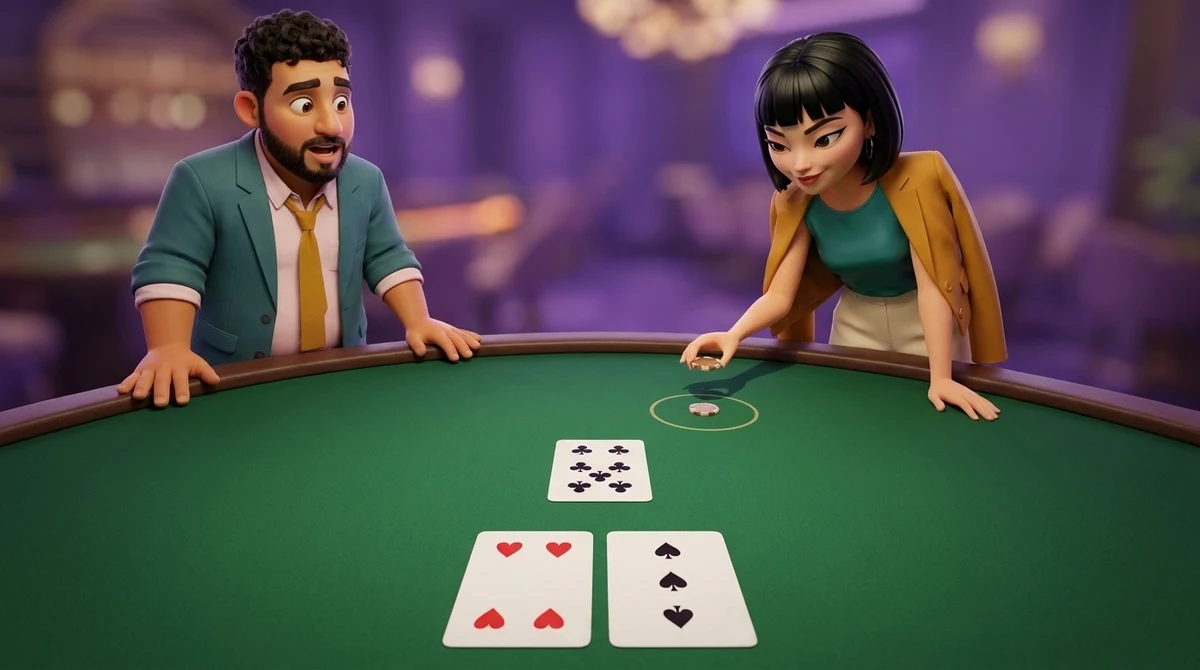
You put an extra chip down beside your bet, meaning to double. The dealer deals you a second hand. What went wrong?
The short answer
Tap the cloth for a card. Wave a flat hand over your cards for no more cards. A double and a split are said with a chip and not with your hands: you put a second chip down on the cloth, and the place where that chip lands is the whole of the message. At the table in the question a chip behind your bet asks for a double and a chip beside your bet asks for a split, so the chip beside your bet asked for a split, and the dealer dealt the two hands that chip asked for. Some other rooms put the double chip beside the bet instead, which is why the two places have to be checked at every new table. And on a pair a double and a split are both legal moves, so a chip in the wrong place is not refused: the dealer plays the move the place asks for, and nobody says a word.
What the dealer saw: your two fives, the dealer’s six, and the extra chip beside the bet.

Mayaformer floor supervisor · manners, money and breaks
I supervised tables for years, and the mistake I saw most often was not a bad play. It was a good play that arrived at the dealer as a different play: a player meant to double, the chip went down a hand’s width to the left of where the double chip belongs, and the dealer, quite correctly, dealt that player two hands.
Your hands ask for cards, and a chip makes a second bet
You have four moves to make on your own hand: a card, no more cards, a double and a split. At the table the dealers call a card a hit and no more cards a stand. Each of the four moves reaches the dealer in one way and one way only. A card and no more cards you say with your hands. A double and a split you say with a chip.
| What you want | How you say it | What happens to your bet |
|---|---|---|
| A card | Tap the cloth beside your cards | Nothing: your bet stays as it is |
| No more cards | Wave a flat hand over your cards, palm down | Nothing: your bet stays as it is |
| Double | Put one chip behind your bet | A second bet goes down behind your bet, and buys you exactly one more card |
| Split | Put one chip beside your bet, equal to your bet | A second bet goes down beside your bet, and your two cards become two hands |
The split chip has to equal your original bet, and the double chip buys exactly one more card. A bet is made by putting the chip down, so the dealer reads the move from where the chip lies.
What your hands say
Two movements, and neither movement is a courtesy: the dealer waits for the tap or for the wave, and will not go on to the next hand without one of the two.
At a table dealt from a shoe (the box the dealer deals from, holding several decks shuffled together) your hands do three things — the tap, the wave, and the putting down of a chip — and nothing else. Three things in particular your hands stay away from, and the rules name each of the three. Joining a table has the rest of what a table expects of you.
- The cards. The cards are not yours to move: only the dealer touches the cards. Pushing your cards toward the dealer is not a signal for anything.
- Your bet, once the deal has started. Your bet stays exactly as it is until the hand is settled. The only chips that move after the deal has started are the double chip and the split chip, and each of those is a second bet, not an addition to the stack.
- Your voice, in place of your hand. The rules name a hand signal for a card and a hand signal for no more cards, and name each signal as a must. A word on its own is not a signal, and the dealer is watching your hands and the cloth rather than listening.
Some rooms give a split a hand signal as well as a chip: the index finger and the ring finger held apart over your cards. In other rooms that finger gesture means nothing, while a chip put down is read as a bet at every table. So ask the dealer before you use your fingers for a split.
Where the chip goes
Behind your bet: double
One more card lands on your hand, and the hand is over.
Beside your bet: split
Your two cards become two hands, and the new chip is the bet on the second hand.
Not every room reads the two places the same way. In some rooms the double chip goes beside the bet, which is exactly where the split chip goes at the table above: the same chip in the same place, and a different move. One question to the dealer settles which way round the table in front of you reads the two places, and the question is asked before the chip goes down, not after.
The one hand where a wrong place goes through in silence
A split needs two cards of the same value. On a pair both moves are legal, so the dealer plays whatever the place says, and nothing looks wrong to anybody, including you.
Seven and four: the dealer asks
A seven and a four cannot be split, so a chip beside the bet is a question rather than a move, and the dealer asks what you meant.
Five and five: nobody asks
A pair can be split, so a chip beside the bet is a split bet, and the dealer deals two hands of five without a word.
That silence has a price per hand, which the practice table and the questions below work out on an example bet of $10 — an example bet, not a suggested one. Amounts are in Canadian dollars.
| Your hand | What you meant | What the place said | Difference a hand |
|---|---|---|---|
| Five and five against a six | Double, +$5.88 | Split, +$1.69 | $4.19 |
| Five and five against a nine | Double, +$1.49 | Split, −$5.28 | $6.77 |
| Eight and eight against a six | Split, +$3.76 | Double, −$8.75 | $12.51 |
| Eight and eight against a ten | Split, −$4.75 | Double, −$10.71 | $5.96 |
A plus sign means a hand comes out in your favour on average; it can still lose, and across all hands the house keeps its edge.
When you double, the double chip may be smaller than your original bet, down to the table minimum. Whatever size the double chip is, the double chip is real money on the cloth, and so is the split chip. Chips and cash covers where those chips came from.
Your bet, then what is on the cloth after a double, then what is on the cloth after a split.

Mayaformer floor supervisor · manners, money and breaks
If you forget everything else I have said, keep this much: a double and a split are decisions about money, taken in a second, with the cards already out. Decide your limit for the evening before you sit down (Game plan walks you through it), and count the second bet inside that limit.
Being understood costs nothing and changes nothing about the price of a hand: play every hand off the chart and the house still keeps 0.53% of every bet on average. The signals decide one thing only: whether the hand you get is the hand you asked for.
When the cards come to your hand
So far the cards have come out of a shoe and stayed on the cloth. At a two-deck table the cards may come out of the dealer’s hand instead, and the same two-deck game is dealt both ways: the room chooses, table by table. So watch one hand being dealt before you sit down, or ask the dealer whether the cards will be coming to your hand.
Dealt from a shoe
The cards land face up on the cloth and stay there. Only the dealer touches the cards.
Dealt from the dealer’s hand
You pick your two cards up with one hand and keep both cards over the table, where the dealer can see them.
Keep both cards in the dealer’s sight the whole time. Every signal changes once the cards are in your hand:
| What you want | Cards on the cloth | Cards in your hand |
|---|---|---|
| A card | Tap the cloth beside your cards | Sweep the two cards along the cloth behind your betting area |
| No more cards | Wave a flat hand over your cards, palm down | Tuck the two cards under your bet, without touching the chips |
| Double | Put one chip behind your bet | Turn both cards face up, say “double down”, and put the chip behind your bet |
The double is the one move in either game with a word in it, and the word is one of three steps made as one move:
- Turn both cards face upso the dealer sees the hand you are doubling
- Say “double down”the one word in either game that is part of a move
- Put the double chip behind your betthe double chip’s own place under these rules
Once your two cards are tucked under the bet, your turn with those cards is over. The cards are not yours to touch again, not even to push back in a card that is sticking out.
Surrender is not offered at a two-deck table, so that table has no signal for it.
A bet for the dealer travels with your hand
Before the deal you can put a chip down for the dealer, beside your own bet: a dealer bet (a tip put down as a bet played for the dealer, which is settled like any other bet). The dealer bet is placed separately from your own bet, and before the cards come out. When you double or split your own hand, you may double or split the dealer bet along with your hand — may, not must. The dealer bet is your money either way, so decide what happens to the dealer bet before the double chip leaves your fingers. Whether to put a dealer bet down at all is Joining a table.
- You may double or split the dealer bet along with your own hand. The rules name that as an option you have.
- You need not. The dealer bet can stay as it was while you double or split your own bet: an option is not a requirement.
- Either way the dealer bet is a bet, settled like any other bet, and a doubled dealer bet is money out of the same evening as the rest.
Practice: show the dealer
In every moment here the move is decided for you; the only question is how to show that move to the dealer. Level 1 is a table dealt from a shoe. Level 2 is the same table with the cards dealt from the dealer’s hand. Level 3 is not scored at all: one chip in one place, read two ways by two rule books. Where a chip in the wrong place would still be a legal move, the practice table prices that wrong place, per hand, on an example bet of $10. No money, no balance, nothing to chase: only your first answer on each moment counts.
Lesson done
Review my mistakes (0)
Progress stays in this browser; nothing is sent anywhere.
The practice table needs JavaScript. Here is one moment from it, with the answer.
At a table whose rules BCLC publishes
Five and five against a six, and you have decided to double. Where does the second chip go?
The answer: Behind your bet, nearer to you.
These rules put the double chip behind the original bet and the split chip beside it. On a pair a double and a split are both legal, so a chip in the wrong place is not refused: the dealer plays the move the place asks for. Whether two fives are worth splitting at all belongs to the lesson on pairs; the question here is only how the dealer understood you.
Every moment in the practice table works the same way: the move is decided for you, and the only question is how to show that move to the dealer. Where a chip in the wrong place would still be a legal move, the practice table prices that wrong place per hand, from the same engine that works out the strategy chart.
How the practice table works
One strip, no rounds. Every square on the strip is one moment of this lesson, and all the squares are there from the start. A square keeps your first answer on its moment; later answers on the same moment are still explained. When the squares of one level are full, the next level begins by itself, with no button in between. Mistakes go on a list you can practise again, and practising a mistake does not change the count.
The scene is the answer. Where a moment asks about a place on the cloth, the places on the cloth are the buttons: press the place where you would put the chip, or use the numbered row below the scene, which does the same thing. Every place names itself for a screen reader.
Where the amounts come from. The amounts are averages from the same engine that works out the strategy chart, for the table rules this lesson quotes, and each average is rounded to the cent before the difference between two averages is taken. No moment tells you which move to make: the move is given in the question, and only the way of showing the move is graded.
Level 3 is a reference, not a test. Level 3 has no squares at all, because there is nothing in it to practise: the point of level 3 is that the same picture has two correct readings, and which reading applies depends on whose rules the table plays by.
Check yourself

Mayaformer floor supervisor · manners, money and breaks
Five quick ones. Pick an answer, then check it. No timer, no points: just whether it stuck.
And the question at the start
The second answer: the chip went to the place that means something else at this table. A chip behind the bet is a double and a chip beside the bet is a split, and on a pair a double and a split are both legal — so nothing looked wrong to anybody, and the dealer played the move the place asked for. The first answer, that the dealer made a mistake, is the tempting one and the expensive one: there is no mistake to correct, because the hand you were dealt is exactly the hand the chip asked for. The third answer, that you should have said the move out loud, is not quite wrong, and that is the interesting part: where the cards come to your hand, a double does want the words “double down” said aloud, along with the cards turned face up and the double chip put down behind the bet. Three things at once, in the one game that asks for a word at all.
Where to see this, and further reading
19+ (18+ in AB, MB, QC) · Play responsibly · help, day or night: Gambling Support BC 1-888-795-6111, 24 hours
Further reading
- Rules of Play for Table Games: Blackjack · British Columbia Lottery Corporation (BCLC)The rules this track follows section by section: six decks, the dealer on soft 17, doubling, splitting and surrender.
- Game rules: Blackjack · Loto-Québec (Société des casinos du Québec)Québec’s rules: one to eight decks, a face-down dealer card, and the soft-17 rule left to the sign at the table.
- Playing Blackjack · Fallsview Casino Resort and Casino NiagaraOne Ontario operator’s own booklet, including both blackjack payouts and both dealer rules it may post.
- Blackjack: how to play · OLG PlaySmartOntario’s beginner page: the moves, the hand signals it describes, and what insurance is.
- Know the game: Blackjack · Casinos Regina & Moose Jaw (SaskGaming)A Saskatchewan operator on what the chart does and does not do, and where to pick one up in the building.
- Blackjack basics · Wizard of OddsWhat three common ways of playing blackjack without the chart cost, on that author’s own table.

Mayaformer floor supervisor · manners, money and breaks
One habit, and it is the only habit I would ask for. When your hand goes to the chips, hold that hand still for one second and check the place where the chip is about to land. That one second is where a right move turns into the wrong hand, and holding still costs nothing.
And if the second bet starts going down because the last hand went badly rather than because this hand calls for a double, that is worth saying out loud to somebody. The lines below are for that conversation, and the lines are confidential.
If it stops being fun
If gambling stops being entertainment, help is available. 19+ in most of Canada; 18+ in Alberta, Manitoba and Quebec. More on responsible gaming.
How it’s worked out
Sources, numbers and hosts
Sources. Every signal and every place on this page is taken from the body that publishes it, with the date we read it and, where the document is linked, its address, one tap from the sentence that rests on it. Where two publishers disagree — and on the place for the double chip two publishers do disagree — the page says so and shows both places, rather than choosing one place and calling that place the way it is done.
Numbers. The amounts are worked out when the page is built, by the same engine as our strategy tool, for the table rules this lesson quotes. Each amount is an average over all hands of that pair against that dealer card, in the currency of this site, for an example bet; each average is rounded to the cent before the difference is taken, so a difference is always the difference of the two amounts printed beside it. At a bet twice as large, each amount is about twice as much.
What is missing, and why we say so. How often a chip goes to the wrong place, what that costs anyone over an evening, and what a dealer does when a move is ambiguous: none of the three figures is published by anybody we read, and none of the three is on this page. One rule book prints a finger gesture for a split; we quote that gesture and do not draw it, because two other rule books print no gesture. Only one of the rule books we read describes a hand-dealt game at all, so whether the table in front of you is dealt that way is a question for its sign and for its dealer, not for this page.
Hosts. Maya is an illustrated character. Her backstory, a former floor supervisor, is written for the course: she is not a real person and does not speak for any casino. The rules and numbers on this page come from the sources it cites, not from her experience.
No promise. Blackjack is played against the house. Being understood costs nothing and changes nothing about the price of a hand; nothing on this page makes the game cheaper, and nothing tells you how an evening will end.
The rules this table plays by
In our words: You choose to hit, stand, split or double with a hand signal or by putting out the right chips.
Section 1.0 Basic Blackjack, 8.5 to 8.9
BCLC · Rules of Play for Table Games — Blackjack · read
Which moves are signalled and which are shown with a bet
In our words: You choose to hit, stand, split or double with a hand signal or by putting out the right chips.
Section 1.0 Basic Blackjack, 8.5 to 8.9
BCLC · Rules of Play for Table Games — Blackjack · read
A split needs a second bet of its own
In our words: Each new hand from a split needs its own bet, the same size as the first.
Section 1.0 Basic Blackjack, 4.4 to 4.4.9
BCLC · Rules of Play for Table Games — Blackjack · read
Each time players split a hand, they must place an additional bet equal to their initial bet.
Section The player options
The rules this table plays by
In our words: The extra chips for a double go behind your first bet.
Section 1.0 Basic Blackjack, 4.3 to 4.3.4.a
BCLC · Rules of Play for Table Games — Blackjack · read
Place a chip next to the original chip bet on the hand.
you may place a wager up to the amount of your original beside your bet.
This indicates to the Dealer that you are doubling down and you only get one more card.
Section Blackjack terms
What a split is
In our words: if your first two cards have the same value, you can split them into separate hands.
Section 1.0 Basic Blackjack, 4.4 to 4.4.9
BCLC · Rules of Play for Table Games — Blackjack · read
SPLIT, i.e. separate two cards of the same value (e.g. king and 10, pair of 9s) to play more than one hand, for a maximum of four hands.
Section The player options
The rules this table plays by
In our words: Once play starts, your bet stays as it is, apart from adding chips to split or double.
In our words: Once the dealer starts dealing, keep your hands off your chips.
Section 1.0 Basic Blackjack, 5.1 to 5.3
BCLC · Rules of Play for Table Games — Blackjack · read
Once the dealer calls “no more bets”, that’s your cue to not touch your chips until the play on the hand is completed.
Bets go down before the deal
In our words: A bet counts only if it sits in the betting spot before the first card is dealt.
Section 1.0 Basic Blackjack, 5.1 to 5.3
BCLC · Rules of Play for Table Games — Blackjack · read
Bets must be placed on the designated spot before the first card is dealt.
Section The bets
Hands off the bet once the deal has started
In our words: Once play starts, your bet stays as it is, apart from adding chips to split or double.
In our words: Once the dealer starts dealing, keep your hands off your chips.
Section 1.0 Basic Blackjack, 5.1 to 5.3
BCLC · Rules of Play for Table Games — Blackjack · read
Once the dealer calls “no more bets”, that’s your cue to not touch your chips until the play on the hand is completed.
The rules this table plays by
In our words: You can tip by putting out a separate bet that is played on the dealer’s behalf.
In our words: A bet played for the dealer sits apart from your own bet.
In our words: A bet you placed for the dealer can also be doubled or split.
Section 1.0 Basic Blackjack, 6.1 to 6.4
BCLC · Rules of Play for Table Games — Blackjack · read
A bet placed for the dealer
In our words: You can tip by putting out a separate bet that is played on the dealer’s behalf.
In our words: A bet played for the dealer sits apart from your own bet.
In our words: A bet you placed for the dealer can also be doubled or split.
Section 1.0 Basic Blackjack, 6.1 to 6.4
BCLC · Rules of Play for Table Games — Blackjack · read
The rules this table plays by
In our words: Double Deck uses two ordinary decks; the casino decides whether the dealer pitches them by hand or deals from a shoe.
In our words: You may lift your first two cards, using one hand.
In our words: Use just one hand whenever you handle the cards.
Section 5.0 Double Deck Blackjack, 1.1 to 5.5
BCLC · Rules of Play for Table Games — Blackjack · read
The hand-dealt game
In our words: Double Deck uses two ordinary decks; the casino decides whether the dealer pitches them by hand or deals from a shoe.
In our words: You may lift your first two cards, using one hand.
In our words: Use just one hand whenever you handle the cards.
Section 5.0 Double Deck Blackjack, 1.1 to 5.5
BCLC · Rules of Play for Table Games — Blackjack · read
The cards stay over the table
In our words: Cards stay above the felt, never past its edge, where the dealer can always see them.
In our words: After you finish and slide your cards under your chips, you may not touch them again.
Section 5.0 Double Deck Blackjack, 1.1 to 5.5
BCLC · Rules of Play for Table Games — Blackjack · read
The rules this table plays by
In our words: Cards stay above the felt, never past its edge, where the dealer can always see them.
In our words: After you finish and slide your cards under your chips, you may not touch them again.
Section 5.0 Double Deck Blackjack, 1.1 to 5.5
BCLC · Rules of Play for Table Games — Blackjack · read
The cards stay over the table
In our words: Cards stay above the felt, never past its edge, where the dealer can always see them.
In our words: After you finish and slide your cards under your chips, you may not touch them again.
Section 5.0 Double Deck Blackjack, 1.1 to 5.5
BCLC · Rules of Play for Table Games — Blackjack · read
The rules this table plays by
In our words: Double Deck games do not offer surrender.
Section 5.0 Double Deck Blackjack, 1.1 to 5.5
BCLC · Rules of Play for Table Games — Blackjack · read
No surrender on the hand-dealt game
In our words: Double Deck games do not offer surrender.
Section 5.0 Double Deck Blackjack, 1.1 to 5.5
BCLC · Rules of Play for Table Games — Blackjack · read
The rules this table plays by
In our words: Double Deck uses two ordinary decks; the casino decides whether the dealer pitches them by hand or deals from a shoe.
In our words: You may lift your first two cards, using one hand.
In our words: Use just one hand whenever you handle the cards.
Section 5.0 Double Deck Blackjack, 1.1 to 5.5
BCLC · Rules of Play for Table Games — Blackjack · read
The hand-dealt game
In our words: Double Deck uses two ordinary decks; the casino decides whether the dealer pitches them by hand or deals from a shoe.
In our words: You may lift your first two cards, using one hand.
In our words: Use just one hand whenever you handle the cards.
Section 5.0 Double Deck Blackjack, 1.1 to 5.5
BCLC · Rules of Play for Table Games — Blackjack · read
The rules this table plays by
In our words: To take a card, tap the felt.
Section 1.0 Basic Blackjack, 4.1 to 4.2.1
BCLC · Rules of Play for Table Games — Blackjack · read
Tap your finger on the table behind your cards.
The hit signal
In our words: To take a card, tap the felt.
Section 1.0 Basic Blackjack, 4.1 to 4.2.1
BCLC · Rules of Play for Table Games — Blackjack · read
Tap your finger on the table behind your cards.
Which moves are signalled and which are shown with a bet
In our words: You choose to hit, stand, split or double with a hand signal or by putting out the right chips.
Section 1.0 Basic Blackjack, 8.5 to 8.9
BCLC · Rules of Play for Table Games — Blackjack · read
The rules this table plays by
In our words: To take a card, tap the felt.
Section 1.0 Basic Blackjack, 4.1 to 4.2.1
BCLC · Rules of Play for Table Games — Blackjack · read
Tap your finger on the table behind your cards.
The hit signal
In our words: To take a card, tap the felt.
Section 1.0 Basic Blackjack, 4.1 to 4.2.1
BCLC · Rules of Play for Table Games — Blackjack · read
Tap your finger on the table behind your cards.
Which moves are signalled and which are shown with a bet
In our words: You choose to hit, stand, split or double with a hand signal or by putting out the right chips.
Section 1.0 Basic Blackjack, 8.5 to 8.9
BCLC · Rules of Play for Table Games — Blackjack · read
The rules this table plays by
In our words: To stand, wave your hand flat over your cards.
Section 1.0 Basic Blackjack, 4.1 to 4.2.1
BCLC · Rules of Play for Table Games — Blackjack · read
Wave your hand over the cards, palm down.
Once the Player is satisfied with their hand total, the Player signals to "stand" and awaits the outcome of the Dealer's hand.
Section Blackjack
The stand signal
In our words: To stand, wave your hand flat over your cards.
Section 1.0 Basic Blackjack, 4.1 to 4.2.1
BCLC · Rules of Play for Table Games — Blackjack · read
Wave your hand over the cards, palm down.
Once the Player is satisfied with their hand total, the Player signals to "stand" and awaits the outcome of the Dealer's hand.
Section Blackjack
The rules this table plays by
In our words: To stand, wave your hand flat over your cards.
Section 1.0 Basic Blackjack, 4.1 to 4.2.1
BCLC · Rules of Play for Table Games — Blackjack · read
Wave your hand over the cards, palm down.
Once the Player is satisfied with their hand total, the Player signals to "stand" and awaits the outcome of the Dealer's hand.
Section Blackjack
The stand signal
In our words: To stand, wave your hand flat over your cards.
Section 1.0 Basic Blackjack, 4.1 to 4.2.1
BCLC · Rules of Play for Table Games — Blackjack · read
Wave your hand over the cards, palm down.
Once the Player is satisfied with their hand total, the Player signals to "stand" and awaits the outcome of the Dealer's hand.
Section Blackjack
The rules this table plays by
In our words: The extra chips for a double go behind your first bet.
Section 1.0 Basic Blackjack, 4.3 to 4.3.4.a
BCLC · Rules of Play for Table Games — Blackjack · read
Place a chip next to the original chip bet on the hand.
you may place a wager up to the amount of your original beside your bet.
This indicates to the Dealer that you are doubling down and you only get one more card.
Section Blackjack terms
Where a double bet goes, in three rule books
In our words: The extra chips for a double go behind your first bet.
Section 1.0 Basic Blackjack, 4.3 to 4.3.4.a
BCLC · Rules of Play for Table Games — Blackjack · read
Place a chip next to the original chip bet on the hand.
you may place a wager up to the amount of your original beside your bet.
This indicates to the Dealer that you are doubling down and you only get one more card.
Section Blackjack terms
Where a split bet goes at this table
In our words: The chips for a split go beside your first bet.
Section 1.0 Basic Blackjack, 4.4 to 4.4.9
BCLC · Rules of Play for Table Games — Blackjack · read
The rules this table plays by
In our words: The chips for a split go beside your first bet.
Section 1.0 Basic Blackjack, 4.4 to 4.4.9
BCLC · Rules of Play for Table Games — Blackjack · read
Where a split bet goes at this table
In our words: The chips for a split go beside your first bet.
Section 1.0 Basic Blackjack, 4.4 to 4.4.9
BCLC · Rules of Play for Table Games — Blackjack · read
A split needs a second bet of its own
In our words: Each new hand from a split needs its own bet, the same size as the first.
Section 1.0 Basic Blackjack, 4.4 to 4.4.9
BCLC · Rules of Play for Table Games — Blackjack · read
Each time players split a hand, they must place an additional bet equal to their initial bet.
Section The player options
One card after a double
In our words: A doubled hand gets exactly one more card.
Section 1.0 Basic Blackjack, 4.3 to 4.3.4.a
BCLC · Rules of Play for Table Games — Blackjack · read
In any event, once the player doubles down, they are dealt one last card.
Section The player options
The rules this table plays by
In our words: To ask for a card, brush the felt behind your bet with your first two cards.
In our words: To stand, slide your first two cards under your chips.
In our words: To double, turn both cards face up and say that you are doubling.
Section 5.0 Double Deck Blackjack, 1.1 to 5.5
BCLC · Rules of Play for Table Games — Blackjack · read
The signals of the hand-dealt game
In our words: To ask for a card, brush the felt behind your bet with your first two cards.
In our words: To stand, slide your first two cards under your chips.
In our words: To double, turn both cards face up and say that you are doubling.
Section 5.0 Double Deck Blackjack, 1.1 to 5.5
BCLC · Rules of Play for Table Games — Blackjack · read
The rules this table plays by
In our words: To ask for a card, brush the felt behind your bet with your first two cards.
In our words: To stand, slide your first two cards under your chips.
In our words: To double, turn both cards face up and say that you are doubling.
Section 5.0 Double Deck Blackjack, 1.1 to 5.5
BCLC · Rules of Play for Table Games — Blackjack · read
The signals of the hand-dealt game
In our words: To ask for a card, brush the felt behind your bet with your first two cards.
In our words: To stand, slide your first two cards under your chips.
In our words: To double, turn both cards face up and say that you are doubling.
Section 5.0 Double Deck Blackjack, 1.1 to 5.5
BCLC · Rules of Play for Table Games — Blackjack · read
The rules this table plays by
In our words: To ask for a card, brush the felt behind your bet with your first two cards.
In our words: To stand, slide your first two cards under your chips.
In our words: To double, turn both cards face up and say that you are doubling.
Section 5.0 Double Deck Blackjack, 1.1 to 5.5
BCLC · Rules of Play for Table Games — Blackjack · read
The signals of the hand-dealt game
In our words: To ask for a card, brush the felt behind your bet with your first two cards.
In our words: To stand, slide your first two cards under your chips.
In our words: To double, turn both cards face up and say that you are doubling.
Section 5.0 Double Deck Blackjack, 1.1 to 5.5
BCLC · Rules of Play for Table Games — Blackjack · read
The bet is not handled with the cards
In our words: When you slide cards under your chips, leave the chips themselves alone.
Section 5.0 Double Deck Blackjack, 1.1 to 5.5
BCLC · Rules of Play for Table Games — Blackjack · read
The rules this table plays by
In our words: To ask for a card, brush the felt behind your bet with your first two cards.
In our words: To stand, slide your first two cards under your chips.
In our words: To double, turn both cards face up and say that you are doubling.
Section 5.0 Double Deck Blackjack, 1.1 to 5.5
BCLC · Rules of Play for Table Games — Blackjack · read
The signals of the hand-dealt game
In our words: To ask for a card, brush the felt behind your bet with your first two cards.
In our words: To stand, slide your first two cards under your chips.
In our words: To double, turn both cards face up and say that you are doubling.
Section 5.0 Double Deck Blackjack, 1.1 to 5.5
BCLC · Rules of Play for Table Games — Blackjack · read
The bet is not handled with the cards
In our words: When you slide cards under your chips, leave the chips themselves alone.
Section 5.0 Double Deck Blackjack, 1.1 to 5.5
BCLC · Rules of Play for Table Games — Blackjack · read
The rules this table plays by
In our words: To ask for a card, brush the felt behind your bet with your first two cards.
In our words: To stand, slide your first two cards under your chips.
In our words: To double, turn both cards face up and say that you are doubling.
Section 5.0 Double Deck Blackjack, 1.1 to 5.5
BCLC · Rules of Play for Table Games — Blackjack · read
The signals of the hand-dealt game
In our words: To ask for a card, brush the felt behind your bet with your first two cards.
In our words: To stand, slide your first two cards under your chips.
In our words: To double, turn both cards face up and say that you are doubling.
Section 5.0 Double Deck Blackjack, 1.1 to 5.5
BCLC · Rules of Play for Table Games — Blackjack · read
Where a double bet goes, in three rule books
In our words: The extra chips for a double go behind your first bet.
Section 1.0 Basic Blackjack, 4.3 to 4.3.4.a
BCLC · Rules of Play for Table Games — Blackjack · read
Place a chip next to the original chip bet on the hand.
you may place a wager up to the amount of your original beside your bet.
This indicates to the Dealer that you are doubling down and you only get one more card.
Section Blackjack terms
The rules this table plays by
In our words: To ask for a card, brush the felt behind your bet with your first two cards.
In our words: To stand, slide your first two cards under your chips.
In our words: To double, turn both cards face up and say that you are doubling.
Section 5.0 Double Deck Blackjack, 1.1 to 5.5
BCLC · Rules of Play for Table Games — Blackjack · read
The signals of the hand-dealt game
In our words: To ask for a card, brush the felt behind your bet with your first two cards.
In our words: To stand, slide your first two cards under your chips.
In our words: To double, turn both cards face up and say that you are doubling.
Section 5.0 Double Deck Blackjack, 1.1 to 5.5
BCLC · Rules of Play for Table Games — Blackjack · read
Where a double bet goes, in three rule books
In our words: The extra chips for a double go behind your first bet.
Section 1.0 Basic Blackjack, 4.3 to 4.3.4.a
BCLC · Rules of Play for Table Games — Blackjack · read
Place a chip next to the original chip bet on the hand.
you may place a wager up to the amount of your original beside your bet.
This indicates to the Dealer that you are doubling down and you only get one more card.
Section Blackjack terms
The rules this table plays by
In our words: The chips for a split go beside your first bet.
Section 1.0 Basic Blackjack, 4.4 to 4.4.9
BCLC · Rules of Play for Table Games — Blackjack · read
Where a split bet goes at this table
In our words: The chips for a split go beside your first bet.
Section 1.0 Basic Blackjack, 4.4 to 4.4.9
BCLC · Rules of Play for Table Games — Blackjack · read
The rules this table plays by
Ask your Dealer for the proper signals.
Section Blackjack terms
Where a double bet goes, in three rule books
In our words: The extra chips for a double go behind your first bet.
Section 1.0 Basic Blackjack, 4.3 to 4.3.4.a
BCLC · Rules of Play for Table Games — Blackjack · read
Place a chip next to the original chip bet on the hand.
you may place a wager up to the amount of your original beside your bet.
This indicates to the Dealer that you are doubling down and you only get one more card.
Section Blackjack terms
Ask the dealer for the signals
Ask your Dealer for the proper signals.
Section Blackjack terms
Only the dealer touches the cards
In our words: Handling the cards is the dealer’s job alone.
Section 1.0 Basic Blackjack, 1.1 to 1.3.1
BCLC · Rules of Play for Table Games — Blackjack · read
There's no reason to handle the cards you’re dealt, so be sure not to touch them.
Hands off the bet once the deal has started
In our words: Once play starts, your bet stays as it is, apart from adding chips to split or double.
In our words: Once the dealer starts dealing, keep your hands off your chips.
Section 1.0 Basic Blackjack, 5.1 to 5.3
BCLC · Rules of Play for Table Games — Blackjack · read
Once the dealer calls “no more bets”, that’s your cue to not touch your chips until the play on the hand is completed.
The hit signal
In our words: To take a card, tap the felt.
Section 1.0 Basic Blackjack, 4.1 to 4.2.1
BCLC · Rules of Play for Table Games — Blackjack · read
Tap your finger on the table behind your cards.
The hit signal
In our words: To take a card, tap the felt.
Section 1.0 Basic Blackjack, 4.1 to 4.2.1
BCLC · Rules of Play for Table Games — Blackjack · read
Tap your finger on the table behind your cards.
The stand signal
In our words: To stand, wave your hand flat over your cards.
Section 1.0 Basic Blackjack, 4.1 to 4.2.1
BCLC · Rules of Play for Table Games — Blackjack · read
Wave your hand over the cards, palm down.
Once the Player is satisfied with their hand total, the Player signals to "stand" and awaits the outcome of the Dealer's hand.
Section Blackjack
Only the dealer touches the cards
In our words: Handling the cards is the dealer’s job alone.
Section 1.0 Basic Blackjack, 1.1 to 1.3.1
BCLC · Rules of Play for Table Games — Blackjack · read
There's no reason to handle the cards you’re dealt, so be sure not to touch them.
Where a double bet goes, in three rule books
In our words: The extra chips for a double go behind your first bet.
Section 1.0 Basic Blackjack, 4.3 to 4.3.4.a
BCLC · Rules of Play for Table Games — Blackjack · read
Place a chip next to the original chip bet on the hand.
you may place a wager up to the amount of your original beside your bet.
This indicates to the Dealer that you are doubling down and you only get one more card.
Section Blackjack terms
Where a split bet goes at this table
In our words: The chips for a split go beside your first bet.
Section 1.0 Basic Blackjack, 4.4 to 4.4.9
BCLC · Rules of Play for Table Games — Blackjack · read
One card after a double
In our words: A doubled hand gets exactly one more card.
Section 1.0 Basic Blackjack, 4.3 to 4.3.4.a
BCLC · Rules of Play for Table Games — Blackjack · read
In any event, once the player doubles down, they are dealt one last card.
Section The player options
A split needs a second bet of its own
In our words: Each new hand from a split needs its own bet, the same size as the first.
Section 1.0 Basic Blackjack, 4.4 to 4.4.9
BCLC · Rules of Play for Table Games — Blackjack · read
Each time players split a hand, they must place an additional bet equal to their initial bet.
Section The player options
The signals of the hand-dealt game
In our words: To ask for a card, brush the felt behind your bet with your first two cards.
In our words: To stand, slide your first two cards under your chips.
In our words: To double, turn both cards face up and say that you are doubling.
Section 5.0 Double Deck Blackjack, 1.1 to 5.5
BCLC · Rules of Play for Table Games — Blackjack · read
The bet is not handled with the cards
In our words: When you slide cards under your chips, leave the chips themselves alone.
Section 5.0 Double Deck Blackjack, 1.1 to 5.5
BCLC · Rules of Play for Table Games — Blackjack · read
Ask the dealer for the signals
Ask your Dealer for the proper signals.
Section Blackjack terms
Which moves are signalled and which are shown with a bet
In our words: You choose to hit, stand, split or double with a hand signal or by putting out the right chips.
Section 1.0 Basic Blackjack, 8.5 to 8.9
BCLC · Rules of Play for Table Games — Blackjack · read
A split needs a second bet of its own
In our words: Each new hand from a split needs its own bet, the same size as the first.
Section 1.0 Basic Blackjack, 4.4 to 4.4.9
BCLC · Rules of Play for Table Games — Blackjack · read
Each time players split a hand, they must place an additional bet equal to their initial bet.
Section The player options
One card after a double
In our words: A doubled hand gets exactly one more card.
Section 1.0 Basic Blackjack, 4.3 to 4.3.4.a
BCLC · Rules of Play for Table Games — Blackjack · read
In any event, once the player doubles down, they are dealt one last card.
Section The player options
Bets go down before the deal
In our words: A bet counts only if it sits in the betting spot before the first card is dealt.
Section 1.0 Basic Blackjack, 5.1 to 5.3
BCLC · Rules of Play for Table Games — Blackjack · read
Bets must be placed on the designated spot before the first card is dealt.
Section The bets
The hit signal
In our words: To take a card, tap the felt.
Section 1.0 Basic Blackjack, 4.1 to 4.2.1
BCLC · Rules of Play for Table Games — Blackjack · read
Tap your finger on the table behind your cards.
The stand signal
In our words: To stand, wave your hand flat over your cards.
Section 1.0 Basic Blackjack, 4.1 to 4.2.1
BCLC · Rules of Play for Table Games — Blackjack · read
Wave your hand over the cards, palm down.
Once the Player is satisfied with their hand total, the Player signals to "stand" and awaits the outcome of the Dealer's hand.
Section Blackjack
Glossary: shoe
In our words: The dealer deals from a shoe holding six ordinary decks.
Section 1.0, 1.1
BCLC · BCLC Rules of Play for Table Games - Blackjack · read
A split gesture, as one publisher describes it
Show the dealer a splitting gesture of your index and ring finger.
Ask the dealer for the signals
Ask your Dealer for the proper signals.
Section Blackjack terms
One card after a double
In our words: A doubled hand gets exactly one more card.
Section 1.0 Basic Blackjack, 4.3 to 4.3.4.a
BCLC · Rules of Play for Table Games — Blackjack · read
In any event, once the player doubles down, they are dealt one last card.
Section The player options
Where a split bet goes at this table
In our words: The chips for a split go beside your first bet.
Section 1.0 Basic Blackjack, 4.4 to 4.4.9
BCLC · Rules of Play for Table Games — Blackjack · read
Where a double bet goes, in three rule books
In our words: The extra chips for a double go behind your first bet.
Section 1.0 Basic Blackjack, 4.3 to 4.3.4.a
BCLC · Rules of Play for Table Games — Blackjack · read
Place a chip next to the original chip bet on the hand.
you may place a wager up to the amount of your original beside your bet.
This indicates to the Dealer that you are doubling down and you only get one more card.
Section Blackjack terms
Ask the dealer for the signals
Ask your Dealer for the proper signals.
Section Blackjack terms
What a split is
In our words: if your first two cards have the same value, you can split them into separate hands.
Section 1.0 Basic Blackjack, 4.4 to 4.4.9
BCLC · Rules of Play for Table Games — Blackjack · read
SPLIT, i.e. separate two cards of the same value (e.g. king and 10, pair of 9s) to play more than one hand, for a maximum of four hands.
Section The player options
You may double for less
In our words: The extra bet for a double can be up to the size of your first bet, and no less than the table minimum.
Section 1.0 Basic Blackjack, 4.3 to 4.3.4.a
BCLC · Rules of Play for Table Games — Blackjack · read
What the chart does to the cost of play
By following basic strategy you can reduce the house advantage and your cost of play.
What the correct play does and does not do
Blackjack has an element of skill, but making the statistically correct play does not ensure a winning outcome.
The hand-dealt game
In our words: Double Deck uses two ordinary decks; the casino decides whether the dealer pitches them by hand or deals from a shoe.
In our words: You may lift your first two cards, using one hand.
In our words: Use just one hand whenever you handle the cards.
Section 5.0 Double Deck Blackjack, 1.1 to 5.5
BCLC · Rules of Play for Table Games — Blackjack · read
The cards stay over the table
In our words: Cards stay above the felt, never past its edge, where the dealer can always see them.
In our words: After you finish and slide your cards under your chips, you may not touch them again.
Section 5.0 Double Deck Blackjack, 1.1 to 5.5
BCLC · Rules of Play for Table Games — Blackjack · read
The signals of the hand-dealt game
In our words: To ask for a card, brush the felt behind your bet with your first two cards.
In our words: To stand, slide your first two cards under your chips.
In our words: To double, turn both cards face up and say that you are doubling.
Section 5.0 Double Deck Blackjack, 1.1 to 5.5
BCLC · Rules of Play for Table Games — Blackjack · read
The bet is not handled with the cards
In our words: When you slide cards under your chips, leave the chips themselves alone.
Section 5.0 Double Deck Blackjack, 1.1 to 5.5
BCLC · Rules of Play for Table Games — Blackjack · read
The signals of the hand-dealt game
In our words: To ask for a card, brush the felt behind your bet with your first two cards.
In our words: To stand, slide your first two cards under your chips.
In our words: To double, turn both cards face up and say that you are doubling.
Section 5.0 Double Deck Blackjack, 1.1 to 5.5
BCLC · Rules of Play for Table Games — Blackjack · read
The cards stay over the table
In our words: Cards stay above the felt, never past its edge, where the dealer can always see them.
In our words: After you finish and slide your cards under your chips, you may not touch them again.
Section 5.0 Double Deck Blackjack, 1.1 to 5.5
BCLC · Rules of Play for Table Games — Blackjack · read
No surrender on the hand-dealt game
In our words: Double Deck games do not offer surrender.
Section 5.0 Double Deck Blackjack, 1.1 to 5.5
BCLC · Rules of Play for Table Games — Blackjack · read
Glossary: dealer bet
In our words: You can tip by putting out a separate bet that is played on the dealer’s behalf.
Section 1.0, 6.1
BCLC · BCLC Rules of Play for Table Games - Blackjack · read
A bet placed for the dealer
In our words: You can tip by putting out a separate bet that is played on the dealer’s behalf.
In our words: A bet played for the dealer sits apart from your own bet.
In our words: A bet you placed for the dealer can also be doubled or split.
Section 1.0 Basic Blackjack, 6.1 to 6.4
BCLC · Rules of Play for Table Games — Blackjack · read
Spotted a mistake on this page? Tell us
Been here before? Review us on Trustpilot