Atlassino Academy · Craps · Lesson 10 of 12
Shooting the dice and table manners
Taking the dice is a turn at the table, and the turn comes with a short set of rules: one hand, the far wall, the dice always in view. Here they are, and what the crew does when a throw goes wrong.
The stickman pushes 5 dice across the felt to you, and the turn to shoot is yours. What do your hands do next?
The short answer
Choose 2 of the dice, pick the two up with one hand, and throw with that same hand so the dice bounce off the wall at the far end of the table. The dice stay where the crew can see the dice the whole time. When somebody else is shooting, your bets go down before the shooter has the dice, and your hands come off the table once the stickman calls “dice are out”.
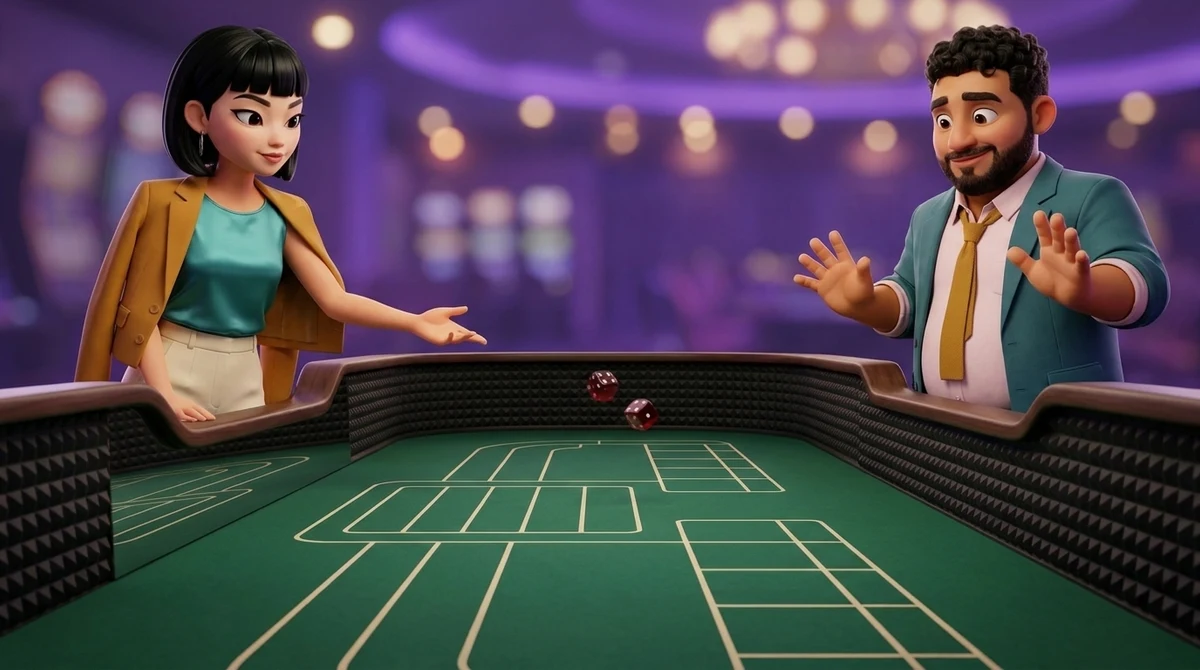
The dice have hit the wall at the far end and bounced back onto the felt.
A throw the table expects: from the shooter’s place on the rail, off the far wall and back.

Mayaformer floor supervisor · manners, money and breaks
The first time the dice came my way, I picked them up with both hands, the way you pick up anything you do not want to drop. The stickman took the dice straight back, nobody was unkind about it, and the table stopped for a moment while the boxman looked the dice over.
Every rule about the throw comes back to one idea: the crew has to see the dice, and the dice have to land in a way nobody arranged. Hold on to that idea and the rules stop being a list to remember.
Five dice, two in one hand
Every craps table plays with a set of five dice, and the shooter selects two of the five. The stickman is the one who moves the dice around the table: a curved stick collects the dice after every roll and pushes the dice to whoever is shooting next.
The hand matters more than the choice of dice. You pick the dice up and shoot the dice with the same hand; move the dice from one hand to the other, and the stickman takes the dice back and the boxman inspects the dice before the game goes on.
Two dice are in your right hand, and the other three dice are back with the stickman.
Two dice in one hand, three dice back with the stickman. If the hand that picked the dice up is not the hand you throw with, put the dice back and pick the dice up again before the stickman calls the dice out, rather than switching hands at the rail.
The throw goes to the far wall
The throw has one requirement: the dice are meant to bounce off the wall at the opposite end of the table, and a throw that hits the far wall and bounces off gives an outcome nobody arranged.
A throw that falls short is not cancelled for falling short: when the dice do not reach the end of the table but the obvious intention was made, the roll is valid. If the same shooter fails to roll the dice correctly on a later roll, the boxman determines whether that roll counts, and a shooter who keeps throwing the dice in a way the table will not accept can see the boxman pass the dice to the next player.
The dice stay where the crew can see the dice
From the moment the dice reach your hand until the dice come to rest, the dice must remain in view of the stickman and the boxman, and dice taken out of view go straight back to the boxman to be inspected. Holding the dice low behind the rail, or cupped tight against your chest, takes the dice out of that view.

Leoformer dealer · rules and maths
When I stood at the stick, I was not watching the shooter’s face or the bets. I was watching two dice and one hand. A shooter who kept one hand on the dice and sent the dice to the far wall was a shooter I never had to think about, and that is the kindest thing a shooter can be to a crew.
Bets first, then hands off
Bets go down before the shooter has the dice. Then the stickman announces to the table that the dice are out, and for every player who is not shooting that call is the cue to get hands out of the way. Until the dice come to rest, keep your hands to yourself and do not let your hands dangle over the table.
Sometimes there is not enough time to put a bet down. The rules of play BCLC publishes for casinos in British Columbia cover that moment with a call bet: you announce the bet to the dealer or the stickman, who repeats the bet aloud so the boxman and the floorman know of the bet, puts the bet down after the roll and settles the bet by that roll; a call that is not clear is answered “No Bet This Roll”, and the bet is not taken.
A call bet is a rule of those rules of play. No rule book we could read for another province prints a call bet, so at a table elsewhere ask the dealer how a late bet is handled before the dice are out, not while the dice are in the air.
A turn, not an obligation
Every player gets a turn to be the shooter as long as that player has a bet on the pass or don’t pass line, and the turn moves clockwise around the table. The turn can be declined: a player who does not wish to shoot the dice says so, and the dice are offered to the next player.
A turn with the dice lasts until a seven ends the turn after a point has been set, and on average a turn runs to about 8.5 rolls. How the come-out roll and the point work is lesson 5.2, and none of the rules on this page changes with the stage of the roll.
The shooter has no say over which numbers come up, and neither has anybody talking at the rail. Some players will not say the word “seven” at the table, as if the word could bring one; a superstition like that holds no weight in how a roll comes out.
A grid of every way two dice can land, the first die by row and the second die by column, with the ways that make seven marked along one diagonal.
Every one of the 36 ways two dice can land, with the 6 ways that make a seven marked: whoever holds the dice, a seven comes on 1/6 of all rolls.
- “Yo”is what you will hear for an 11.
- Leaving the tablewait until the shooter has made the point before you cash out.
- A bet for the dealerThe rules of play BCLC publishes for casinos in British Columbia let a player place a separate bet played for the dealer.
Two things you will meet at the rail that are not about the throw. On the bet for the dealer, no document we could read says how large such a bet should be, or that such a bet is expected.

Mayaformer floor supervisor · manners, money and breaks
Taking the dice means a bet on the line first, so a turn to shoot is never free of cost. Decide what the evening gets before you walk up to the rail, and stop when that amount is gone. A long turn with the dice is exciting and changes nothing about the next roll, and taking the dice to get back what is already lost only puts another bet on the line.
If the money on the table starts to feel like money you need, the lines below are there for exactly that.
If it stops being fun
If gambling stops being entertainment, help is available. 19+ in most of Canada; 18+ in Alberta, Manitoba and Quebec. More on responsible gaming.
Practice: your turn to shoot
The stickman pushes the dice to you, and every moment after that is one decision at the rail: which dice and which hand, where the throw goes, what happens when the throw falls short, and what your hands do while somebody else is shooting.
Nothing is thrown here, and nothing is bet. Each moment is a picture of the table and one decision, and the answer is the rule the table plays by.
Lesson done
Review my mistakes (0)
Progress stays in this browser; nothing is sent anywhere.
The practice table needs JavaScript. Here is one moment from it, with the answer.
Taking the dice
The stickman has pushed five dice across the felt to your place on the rail.
The stickman pushes five dice to your place on the rail, and the turn to shoot is yours. How do you take the dice?
- Pick two dice up with both hands, so neither die drops One hand is the rule. Two dice in one hand stay where the stickman and the boxman can see the dice the whole time.
- Choose two of the five and pick the two up with one hand The shooter chooses two of the five dice the stickman offers, and the same hand picks the dice up and shoots the dice.
- Wait for the stickman to choose two dice for you The choice belongs to the shooter. The stickman offers five dice, and which two of the five go into your hand is yours to decide.
Five dice come across the felt, two go into one hand, and the other three go back to the stickman. The section on the five dice, further up this page, quotes the wording behind each step.
A bet after the dice are out
The dice are in the air, and your chips are on the rail in front of you.
The dice are in the air, your chips are on the rail in front of you, and you want a bet you have not made yet. At a table that takes call bets, what do you do?
- Toss the chips to the dealer and say what the chips are for Chips thrown onto the layout while the dice are in the air are a hand on the table by another route. The bet is said aloud, and the chips stay on the rail.
- Lean over and put the chips on the spot yourself Hands stay off the table for the roll. The rule that lets a bet be made late lets the bet be made by voice, not by reaching.
- Say the bet aloud to the dealer or the stickman, and keep your hands off the felt A call bet is said aloud, repeated back by the crew, and placed and settled after the roll; a call that is not clear is answered “No Bet This Roll”, and the bet is not taken.
Bets go down before the shooter has the dice. When there is no time left, a call bet covers the moment at a table whose rules print a call bet; no rule book we could read for another province prints a call bet, so elsewhere ask the dealer before the dice are out.
Every moment in the practice run is a picture of the table and one decision at the rail, and the answer is the rule the table plays by. Nothing is thrown here and nothing is bet.
How the practice run works
Where the moments come from. Each moment is one rule from this page, set at the table: the five dice, the one hand, the far wall, the short throw, the dice in view, the call of “dice are out”, the late bet and the turn you can decline. Every wrong answer is one named mistake, and the explanation under each answer says which rule that mistake runs into.
One strip, and no rounds. Every square on the strip is one moment of this lesson, and all of the squares are there from the start. Your first answer fills the square it belongs to; the run begins by itself at the first moment, with no button to press. Practising a moment you got wrong turns its cross into “fixed in practice” and does not change the count, because only first answers count.
Your progress stays in this browser, and nothing is sent anywhere.
Check yourself

Mayaformer floor supervisor · manners, money and breaks
Five quick ones. Pick an answer, then check it. No timer, no points: just whether it stuck.
Back to the question we opened with. Two of the five dice, one hand from pick-up to throw, and a throw that is meant for the far wall; everything else the crew handles.
Where the tables are, and further reading
19+ (18+ in AB, MB, QC) · Play responsibly · the helplines are further up this page
Further reading
- Rules of Play for Table Games — Craps · BCLCThe full B.C. rules: the line, odds and lay limits, place and buy, the centre of the table and the Fire Bet, with every pay table.
- How to play craps · OLG PlaySmartThe crew, the puck, the come-out roll and the turn to shoot, in plain words.
- Craps · GameSense by AGLCHow the game runs in Alberta, the Full Double odds and the terms you hear at the table.
How it’s worked out
Rules, numbers, sources and hosts
Where this happens. Every table on this page is a live craps table in a room you can walk into, with dice, a stickman and a boxman. An electronic craps machine has no dice to hold and no wall to throw at, and nothing on this page applies to one.
The pictures. The table seen from above is our schematic: the rule books print no drawing of a craps table, and the positions of the crew, the shooter and the far wall in the pictures are ours.
Numbers. The few figures on this page are worked out from two dice when the page is built: every pairing of faces is counted, the pairings that make a seven are counted among them, and the average length of a turn with the dice is solved exactly from the come-out roll and the six points rather than simulated.
What is deliberately absent. There is no price on this page: no house edge, no payout and no figure for an hour, because the way the dice are held and thrown changes none of them. The areas of the table and who places which bet are lesson 5.1; the come-out roll and the point are lesson 5.2; what the pass line costs is lesson 5.3; the centre bets the stickman offers, and the Fire Bet, are lesson 5.9; the price of an evening is lesson 5.11; whether a way of holding or throwing the dice changes how the dice land is lesson 5.12. How much to give the dealers is not here either, because no document we could read says.
Sources. Every rule on this page carries a button with the sentence the rule rests on, the publisher who wrote that sentence and the date we read it. The call bet and the separate bet for the dealer are rules of play BCLC publishes for casinos in British Columbia: a published set of rules for that province, not a description of any one room.
Hosts. Maya and Leo are illustrated characters. Their backstories, a former floor supervisor and a former dealer, are written for the course: neither is a real person, and neither speaks for any casino. The rules and numbers on this page come from the sources it cites, not from their experience.
No promise. Craps is played against the house. Knowing how to take and throw the dice keeps the table running and keeps you out of the crew’s way; nothing on this page makes any bet cheaper, and nothing here says how an evening at the table would end.
When to cash out
Always wait until the shooter has made his point to cash out.
A bet for the dealer
A Player may place a separate bet which is a tip being played for the Dealer.
Section 1.0 Craps; 2.0 Fire Bet
One hand
The Player must pick up the dice and shoot them with the same hand.
If the Player switches the dice from one hand to the other, the dice must be retrieved by the Stickman and inspected by the Boxman.
Section 1.0 Craps; 2.0 Fire Bet
When your turn comes to shoot, never use two hands - and keep the dice where the crew can see them.
Patrons can only touch dice with one hand.
GameSense by AGLC · Craps · read
Dice are out
The Stickman must announce that the dice are Out to the table.
Section 1.0 Craps; 2.0 Fire Bet
When the stickman calls out “Dice are out”, this is your cue to get your hands out of the way, assuming you’re not the shooter.
A call bet
A Player may announce a Call Bet to the Dealer or Stickman if there is not enough time to place the wager during the roll.
Book the bet by repeating the call bet so that the Boxman and Floorman are aware of the wager;
After the roll, place the wager and pay or lock up the wager based on the outcome of the roll.
If the Players Call Bet is not clear, the Dealer or Stickman shall announce 'No Bet This Roll' and the wager shall not be accepted.
Section 1.0 Craps; 2.0 Fire Bet
The far wall
The Player must shoot the dice so that the dice are intended to bounce off the opposite end of the table.
If the dice do not reach the end of the table, but the obvious intention was made, the roll shall be valid.
Section 1.0 Craps; 2.0 Fire Bet
Toss the dice so they hit the far wall of the table and bounce off.
This move ensures a random outcome and is considered a valid throw.
When the boxman decides
If the Player, on a subsequent roll fails to roll the dice correctly, the Boxman will determine the validity of the roll.
If a Player is inappropriately shooting the Dice, the Boxman at their discretion will empty the dice bowl and the Dice will be passed to the next Player.
Section 1.0 Craps; 2.0 Fire Bet
Passing the dice
If a Player does not wish to shoot the dice, they will be offered to the next Player;
If there are no Players wishing to shoot the dice, the game will be terminated.
Section 1.0 Craps; 2.0 Fire Bet
Superstitions
This long-held superstition holds no weight in terms of affecting the outcome of a roll
Five dice, two chosen
Craps is a dice game played with a set of five standard casino dice.
Players have the option of selecting two out of the five dice to roll for their turn.
Section 1.0 Craps; 2.0 Fire Bet
There are five dice used at any Craps table. A “shooter” selects two of the five dice offered to them by the “stickperson”.
Who touches the dice
The only people permitted to touch the dice are the stickperson, who uses a curved stick to collect them and pass them to the person whose turn it is to the throw the dice after each roll, known as the shooter.
One hand
The Player must pick up the dice and shoot them with the same hand.
If the Player switches the dice from one hand to the other, the dice must be retrieved by the Stickman and inspected by the Boxman.
Section 1.0 Craps; 2.0 Fire Bet
When your turn comes to shoot, never use two hands - and keep the dice where the crew can see them.
Patrons can only touch dice with one hand.
GameSense by AGLC · Craps · read
The far wall
The Player must shoot the dice so that the dice are intended to bounce off the opposite end of the table.
If the dice do not reach the end of the table, but the obvious intention was made, the roll shall be valid.
Section 1.0 Craps; 2.0 Fire Bet
Toss the dice so they hit the far wall of the table and bounce off.
This move ensures a random outcome and is considered a valid throw.
When the boxman decides
If the Player, on a subsequent roll fails to roll the dice correctly, the Boxman will determine the validity of the roll.
If a Player is inappropriately shooting the Dice, the Boxman at their discretion will empty the dice bowl and the Dice will be passed to the next Player.
Section 1.0 Craps; 2.0 Fire Bet
The dice stay in view
The dice must remain in view of the Stickman and Boxman at all times;
If the dice are removed from view, they must be returned to the Boxman immediately for inspection.
Section 1.0 Craps; 2.0 Fire Bet
Bets before the dice
Make sure your bets are placed before the shooter has the dice.
Dice are out
The Stickman must announce that the dice are Out to the table.
Section 1.0 Craps; 2.0 Fire Bet
When the stickman calls out “Dice are out”, this is your cue to get your hands out of the way, assuming you’re not the shooter.
Hands off the table
Keep your hands to yourself, don’t dangle them over the table.
A call bet
A Player may announce a Call Bet to the Dealer or Stickman if there is not enough time to place the wager during the roll.
Book the bet by repeating the call bet so that the Boxman and Floorman are aware of the wager;
After the roll, place the wager and pay or lock up the wager based on the outcome of the roll.
If the Players Call Bet is not clear, the Dealer or Stickman shall announce 'No Bet This Roll' and the wager shall not be accepted.
Section 1.0 Craps; 2.0 Fire Bet
Whose turn it is
In craps, every player gets a turn to be the shooter as long as he or she has an active pass or don’t pass wager.
The honour moves clockwise around the table.
They are placed before the come-out roll and in order to take a turn at being the shooter, you are obligated to place one of these bets. If you win, they pay out at even money or 1 to 1.
To play the game – and get a chance to roll the dice – you place a wager on one of these lines.
GameSense by AGLC · Craps · read
Passing the dice
If a Player does not wish to shoot the dice, they will be offered to the next Player;
If there are no Players wishing to shoot the dice, the game will be terminated.
Section 1.0 Craps; 2.0 Fire Bet
Superstitions
This long-held superstition holds no weight in terms of affecting the outcome of a roll
Spotted a mistake on this page? Tell us
Been here before? Review us on Trustpilot