Atlassino Academy · Craps · Lesson 9 of 12
Centre bets and the Fire Bet
The calls from the middle of the craps table are offers with a price. Here is what each centre bet pays, what it costs, and how fast that cost adds up.
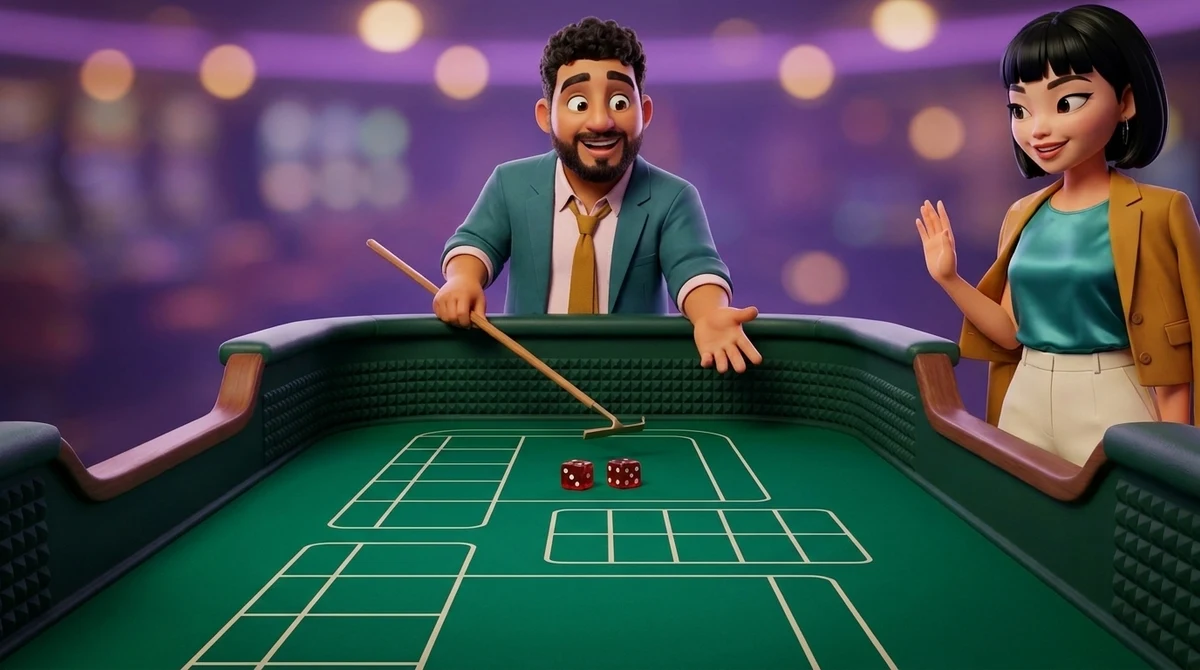
The stickman points the stick at the middle of the table and calls “Hard eight!” What does saying yes cost?
The short answer
Every bet in the centre of the table pays a big figure and charges a big price. The price of a bet is the share of the money on the bet that the house keeps, on average, each time the bet is settled, and in the centre that price runs from 9.09% to 16.67%. The pass line along the rail is priced at 1.41%. Most centre bets are settled on one roll, so their price is charged again on every roll.
Each bar is the price of one bet. The shortest is the pass line along the rail; every centre bet is several times longer.

Mayaformer floor supervisor · manners, money and breaks
The calls from the middle of a craps table are the loudest thing at the rail. Every call is an offer, and each offer has a price: learn the prices once, and you can answer any call in your head.
What sits in the centre of the table
The centre of the craps table belongs to the stickman. The stickman takes every centre bet, so a player names the bet and hands over the chips, and the stickman puts the chips in place in the box.
Our schematic of the centre; a real table may lay the boxes out differently. Each box shows what the bet pays and, under that, its price.
The stickman also calls every roll and says whether a 4, 6, 8 or 10 came the hard way, as a pair, or the easy way. The same voice offers the centre bets, so an offer can sound like news about the game.
Centre bets pay more than the bets along the rail because centre bets come in less often. Every payout in the box stops short of the fair payout, the payout that would leave the house keeping nothing over many rolls, and the gap between the fair payout and the payout in the box is the price of the bet.
One-roll bets: any 7, any craps and the numbers
A one-roll bet is settled on the very next roll: the bet is paid if the number on the bet comes, and the bet is taken if any other total comes. An 11 has a name of its own at the table, “yo”, so a call of “yo” from the stick is an offer of the one-roll bet on 11.
- Any 7Comes on 6 of 36 rollsFair payout 5 to 1The box pays 4 to 1
- Any craps: 2, 3 or 12Comes on 4 of 36 rollsFair payout 8 to 1The box pays 7 to 1
- 3, or 11Comes on 2 of 36 rolls, eachFair payout 17 to 1The box pays 15 to 1
- 2, or 12Comes on 1 of 36 rolls, eachFair payout 35 to 1The box pays 30 to 1
Any 7 comes most often of these bets, and any 7 also has the highest price.
Horn, World and C and E are bundles: one chip split across several of the one-roll bets above, each part paid at its own payout.
- HornA quarter of the chip on each of 2, 3, 11 and 12Price 12.50%
- WorldA fifth of the chip on each of 2, 3, 11, 12 and any 7Price 13.33%
- C and EHalf of the chip on any craps and half on 11Price 11.11%
A combination bet costs what its parts cost, averaged by the share of the chip on each part. Splitting the chip spreads the price across more numbers; splitting the chip does not lower the price.
The payouts for any 7, any craps, the single numbers and the hardways are printed in the same figures in other provinces as well.
Hardways and hop bets
A hardway is a bet that a 4, 6, 8 or 10 comes as a pair before the same number comes any other way and before a 7 comes. Unlike a one-roll bet, a hardway stays up until the bet is settled, and most rolls settle nothing. In the rules BCLC publishes for British Columbia casinos, a hardway bet is automatically on for the come-out roll, so the bet keeps working on every roll until a pair, an easy way or a 7 settles the bet.
- PaidA 4 and a 4: 1 way of the 36
- Taken: an easy 8A 2 and a 6, or a 3 and a 5, in either order: 4 ways
- Taken: a 7Any 7: 6 ways
- Anything elseNo decision; the hard 8 stays up for the next roll
| Hardway | Pays | Fair payout | Price |
|---|---|---|---|
| Hard 6 or hard 8 | 9 to 1 | 10 to 1 | 9.09% |
| Hard 4 or hard 10 | 7 to 1 | 8 to 1 | 11.11% |
The hard 6 and the hard 8 are the lowest prices in the centre of the table. The hard 4 and the hard 10 come as a pair just as rarely, with fewer easy ways to take them, and pay less for it.
A hop bet is a one-roll bet on one exact pair of faces, such as a 2 and a 5. A pair of different faces can come two ways and is paid at one figure; a pair of the same face comes one way and is paid at another.
- Hop on two different facesA 2 and a 5 can come 2 ways; fair payout 17 to 1The box pays 15 to 1 · price 11.11%
- Hop on a pairA 5 and a 5 can come 1 way; fair payout 35 to 1The box pays 30 to 1 · price 13.89%
The Fire Bet: two tables under one name
The Fire Bet is a side bet made before a new shooter’s first come-out roll, and the Fire Bet is paid by how many different points that shooter makes before the seven-out. A point made twice counts once, and in the rules for British Columbia casinos the bet is from $1 to $5.
| Different points made | Rules for British Columbia casinos | The payout itself | Rules for Quebec casinos |
|---|---|---|---|
| 4 | 25 For 1 | 24 to 1 | 25 to 1 |
| 5 | 250 For 1 | 249 to 1 | 250 to 1 |
| 6 | 1,000 For 1 | 999 to 1 | 1,000 to 1 |
The middle column is the “For 1” payout with your chip taken out.
“For 1” counts the chip inside the figure: 25 For 1 hands back that many chips, and one of them was already yours. “To 1” pays the whole figure and hands the chip back beside the payout. One casino’s own page prints “for 1” as well, so read the word after the figure on any Fire Bet table you meet.
- Fire Bet, rules for British Columbia casinosPayouts written “For 1”Price 20.76%
- Fire Bet, rules for Quebec casinosPayouts written “to 1”Price 19.70%
Two different tables with two different prices, not one table written two ways. Either price is far above the price of any bet along the rail.
A roll at a time: what the habit costs in an hour
No Canadian document we could read prints how many rolls a craps table makes in an hour. The rules for British Columbia casinos say only who sets the speed of the game. Every hourly figure below uses one pace, the pace casino rating systems are set to: about 60 rolls an hour, which comes to about 18 pass-line decisions.
A one-roll bet is settled on every one of those rolls, so its price is charged on every roll. A hardway is settled only when its number or a 7 comes, so the same chip on a hardway is charged far fewer times in the same hour.
| The habit | Settled | An hour, on average |
|---|---|---|
| Pass line | about 18 times an hour | $1.27 |
| Hard 6 or hard 8 | when the number or a 7 comes | $8.33 |
| Hard 4 or hard 10 | when the number or a 7 comes | $8.33 |
| 3 or 11 | on every roll | $33.33 |
| Any craps | on every roll | $33.33 |
| C and E | on every roll | $33.33 |
| Hop, two different faces | on every roll | $33.33 |
| Horn | on every roll | $37.50 |
| World | on every roll | $40 |
| 2 or 12 | on every roll | $41.67 |
| Hop, a pair | on every roll | $41.67 |
| Any 7 | on every roll | $50 |
The same example bet of $5 in every row, an example and not a suggested bet; what changes is how often the bet is settled. Amounts are in Canadian dollars.

Mayaformer floor supervisor · manners, money and breaks
When the stickman calls, the answer can simply be “no, thanks”. Nobody at the table needs a reason, and the stick will call again on the next roll whatever you answer.
Decide what the evening gets before you reach the rail, and stop when that amount is gone. A centre bet to get back what the evening already took only buys the highest prices on the table, faster. If the money on the rail starts to feel like money you need, the lines below are there for exactly that.
If it stops being fun
If gambling stops being entertainment, help is available. 19+ in most of Canada; 18+ in Alberta, Manitoba and Quebec. More on responsible gaming.
The lesson on one card
That is the lesson. Here it is on one card: print it, or keep it on your phone.
| Bet | Pays | Price |
|---|---|---|
| Hard 6 or hard 8 | 9 to 1 | 9.09% |
| Hard 4 or hard 10 | 7 to 1 | 11.11% |
| 3 or 11 | 15 to 1 | 11.11% |
| Any craps | 7 to 1 | 11.11% |
| C and E | split across its parts | 11.11% |
| Hop, two different faces | 15 to 1 | 11.11% |
| Horn | split across its parts | 12.50% |
| World | split across its parts | 13.33% |
| 2 or 12 | 30 to 1 | 13.89% |
| Hop, a pair | 30 to 1 | 13.89% |
| Any 7 | 4 to 1 | 16.67% |
| Fire Bet | 25 For 1 and more | 20.76% |
| Pass line, for comparison | even money | 1.41% |
Fire Bet: “For 1” counts your chip inside the figure.
19+ (18+ in AB, MB, QC) · Set a limit before you reach the rail · Play responsibly · the line for your province is at Helplines by province
Practice: the stickman’s call
Level 1 is an hour at the rail with the calls coming one after another: “Hard eight!”, “Any seven!”, “Fire Bet!”, and each call asks what saying yes costs every time the bet is settled. Level 2 sets the one-roll bets against the hardways and asks what the same chip costs in an hour.
Nothing is scored here, and nothing is bet. Both levels are read through once, call by call, and each answer is worked out from the payouts in the box and the pace named above.
Lesson done
Review my mistakes (0)
Progress stays in this browser; nothing is sent anywhere.
The practice table needs JavaScript. Here is one call from it, with the answer.
Level 1 · The stickman’s call
Stickman“Hard eight! Hard eight!”
What does this bet cost, as a share of the money on the bet, each time the bet is settled?
- 1.41% That is the price of the pass line, the bet along the rail in front of you. Every bet in the centre of the table is priced several times higher than the pass line.
- 9.09% The hard 8 pays 9 to 1 where the fair payout is 10 to 1, and that gap is 9.09% of the money on the bet, every time the bet is settled.
- 0% That reads the payout in the box as the fair payout. The hard 8 would have to pay 10 to 1 for the house to keep nothing, and the box pays 9 to 1.
Saying “no, thanks” to the call costs nothing. Saying yes costs 9.09% of the money on the bet, on average, each time the bet is settled.
Level 2 · One roll against the hardways
The habitAny 7, kept up all hour.
$5 on any 7, put back up every time the bet is settled, for an hour. What does the hour cost on average?
- $15 That counts the 18 pass-line decisions in an hour instead of the rolls. Any 7 is settled on every roll, so the hour holds about 60 settlements.
- $50 Any 7 is settled on every roll, so the price is charged on every one of about 60 rolls in the hour.
- $0.83 That is what one bet costs on average, settled once. The hour holds every settlement after the first one as well.
A one-roll bet charges its price on every roll, and a craps table makes a lot of rolls in an hour.
Every call in the practice run is worked out the same way: the payout in the box against the fair payout, and for the hour, how often the bet is settled.
How the practice run works
Where the calls come from. Every bet in the practice run is a bet from the rules for British Columbia casinos, and every price and every hourly figure is worked out when the page is built from the payouts in those rules, rather than written down anywhere by hand. The wrong answers are worked out from the same figures, and each wrong answer is one named mistake: the price of the pass line taken for the price of a centre bet, the payout in the box read as the fair payout, the hour counted by pass-line decisions instead of rolls, a hardway charged as though the bet were settled on every roll, or one bet taken for an hour of bets.
No strip of squares. Both levels are reference levels: there are no squares to fill and no count kept. Each answer moves to the next call, and when the calls of one level are done, the next level begins by itself.
Your progress stays in this browser, and nothing is sent anywhere.
Check yourself

Mayaformer floor supervisor · manners, money and breaks
Five quick ones. Pick an answer, then check it. No timer, no points: just whether it stuck.
Back to the question we opened with. Saying yes to the hard eight costs 9.09% of the money on the bet each time the bet is settled. Saying no costs nothing.
Where to check this, and further reading
19+ (18+ in AB, MB, QC) · Play responsibly · the helplines are further up this page
Further reading
- Rules of Play for Table Games — Craps · BCLCThe full B.C. rules: the line, odds and lay limits, place and buy, the centre of the table and the Fire Bet, with every pay table.
- Craps — leaflet · Loto-QuébecThe most popular bets and the whole payout chart on two pages, with the odds and lay limits.
- How to play craps · OLG PlaySmartThe crew, the puck, the come-out roll and the turn to shoot, in plain words.
- Craps · GameSense by AGLCHow the game runs in Alberta, the Full Double odds and the terms you hear at the table.
How it’s worked out
Payouts, numbers, pace, sources and hosts
Where this happens. Every table on this page is a craps table standing in a room you can walk into. The payouts are the rules BCLC publishes for British Columbia casinos, a set of rules rather than a fact about any one room: a table may post its own sign, and the sign at the table is what counts at that table.
Numbers. Every payout comes from the rules for British Columbia casinos as our rule files hold them, and every price is worked out from those payouts and the 36 ways two dice can fall. The prices of the one-roll bets are checked against an exact count, roll by roll, when the page is built. A hardway is counted as working on the come-out roll, because the rules for British Columbia casinos say a hardway bet is automatically on for the come-out roll. The Fire Bet in the rules for Quebec casinos is worked out from the payouts quoted beside its table.
Pace. No Canadian document we could read prints how many rolls a craps table makes in an hour. The hourly figures use the pace casino rating systems are set to, as a casino consultant describes them in Global Gaming Business: about 60 rolls an hour, or about 18 pass-line decisions. Your table may be faster or slower, and the stickman sets the speed.
What is deliberately absent. The payouts of the horn, world and C and E bets appear here only as rules for British Columbia casinos: no document we could read prints them for any other province. There is no figure here for how often a shooter makes four, five or six different points, and nothing about streaks: that is lesson 5.12, “Hot shooters and dice setting”. The table and its crew are lesson 5.1; the come-out roll and the point, lesson 5.2; the pass line, lesson 5.3; odds, lesson 5.4; come bets, lesson 5.5; the don’t side, lesson 5.6; place, buy and lay bets, lesson 5.7; the field and Big 6 and Big 8, lesson 5.8; shooting the dice, a bet called out loud and table manners, lesson 5.10; and an evening built from the cheaper bets, lesson 5.11. The calls in the practice run are our own wording for practice: no rule book prints what a stickman says.
Sources. Every payout and every claim on this page carries a button with the sentence it rests on, the publisher who wrote that sentence and the date we read it.
Hosts. Maya and Leo are illustrated characters. Their backstories, a former floor supervisor and a former dealer, are written for the course: neither is a real person, and neither speaks for any casino. The rules and numbers on this page come from the sources it cites, not from their experience.
No promise. Craps is played against the house. Knowing the price of each centre bet lets you answer the stickman before the dice are out; nothing on this page makes any bet cheaper, and nothing here says how an evening at the table would end.
Centre bets pay more and come in less
Casinos give higher payouts on centre bets to make them more attractive, but the odds of them winning are lower.
In fact, some bets in craps have no house edge at all. Of course, for other bets the house edge can go as high as 16.67%.
OLG PlaySmart · Craps — odds · read
The Fire Bet: “For 1”
A `Fire Bet' is an optional side wager used in the game of Craps.
Players can only make a wager on the side bet, before the first `Come Out' roll of a new Shooter.
A `Fire Bet' wager may be a minimum of $1, up to a maximum of $5.
If an individual point is made more than once, it will only count as one point made towards the `Fire Bet' wager.
4 25 For 1
5 250 For 1
6 1,000 For 1
Section 1.0 Craps; 2.0 Fire Bet
Who sets the pace
The Stickman controls the speed of the game, under the direction of the Boxman or Floorman.
Section 1.0 Craps; 2.0 Fire Bet
Hardways
HARDWAY WAGER
6 or 8 9 to 1
4 or 10 7 to 1
A Hardway bet is automatically On for the Come Out roll.
Section 1.0 Craps; 2.0 Fire Bet
The Fire Bet: “to 1”
A Fire Bet® side bet may not be withdrawn (or designated inactive) after the shooter establishes a point.
If the shooter establishes a point and hits it several times, said point is counted as a single point established and hit.
6 individual points 1,000 to 1
5 individual points 250 to 1
4 individual points 25 to 1
Note that only the highest payout ratio is paid on a winning bet.
Loto-Québec · Rules of the game: Fire Bet side bet in craps · read
The price of the pass line
Pass Line/Come Bet Actual or “True” Odds: 251 to 244 Odds Paid or Payout: 1 to 1 House Edge: 1.41%
OLG PlaySmart · Craps — odds · read
Who takes the centre bets
The stickperson also takes all centre bets.
All Proposition bets are placed by the Stickman in a position relative to the Players position on the table.
Section 1.0 Craps; 2.0 Fire Bet
Hard or easy
The Stickman must announce the dice combination twice, and specify if the number was rolled the Hard or Easy way, if applicable.
Section 1.0 Craps; 2.0 Fire Bet
Centre bets pay more and come in less
Casinos give higher payouts on centre bets to make them more attractive, but the odds of them winning are lower.
In fact, some bets in craps have no house edge at all. Of course, for other bets the house edge can go as high as 16.67%.
OLG PlaySmart · Craps — odds · read
One-roll bets and what they pay
A Proposition bet is a one roll bet that wins if the number the bet is on is rolled.
2 or 12 30 to 1
3 or 11 15 to 1
Any Craps (2, 3 or 12) 7 to 1
Any 7 4 to 1
Section 1.0 Craps; 2.0 Fire Bet
Horn
A Horn bet shall be paid as if there are four separate wagers on 2, 3, 11 and 12.
Section 1.0 Craps; 2.0 Fire Bet
World
A World bet shall be paid as if there are five separate wagers on 2, 3, 11, 12 and Any 7.
Section 1.0 Craps; 2.0 Fire Bet
C and E
A Craps Eleven bet shall be paid as if one half of the wagered amount had been placed on `Any Craps' and one half on `Eleven' and shall be paid as if two separate wagers were made for the one roll.
Section 1.0 Craps; 2.0 Fire Bet
The centre bets elsewhere
The wager wins when the number is rolled the Hard Way and loses when the number is rolled in any other combination or if a 7 is rolled.
hard ways 4 and 10 7 to 1 6 and 8 9 to 1
Any Craps 7 to 1
Craps 2 30 to 1
Craps 3 15 to 1
Craps 12 30 to 1
Any 7 4 to 1
11 15 to 1
Any combination of the two dice can be wagered on the “Hop”.
Hop Bet (Hopping) 15 to 1
Hopping (Hardway) 30 to 1
The Hard Ways pays odds of 9 to 1 for a Hard 8 or 6, and 7 to 1 for a Hard 10 or 4.
The wager is a winner if a 7 is rolled and pays odds of 4 to 1.
The Player wins odds of 7 to 1 if a 2, 3 or 12 are rolled.
11 is a one-roll bet that pays odds of 15 to 1 if an 11 is rolled.
Remember, Hard Six and Hard Eight pays 9-to-1; Hard Four and Hard Ten pays 7-to-1.
GameSense by AGLC · Craps · read
Hardways
HARDWAY WAGER
6 or 8 9 to 1
4 or 10 7 to 1
A Hardway bet is automatically On for the Come Out roll.
Section 1.0 Craps; 2.0 Fire Bet
Hop bets
A Hop bet is a one roll bet that wins if the exact combination of dice requested is rolled.
A Player can make a Hop bet on any combination of the two dice except 2, 3, 11 and 12 as they are considered Proposition bets.
Two Possible Winning Combinations 15 to 1
One Possible Winning Combination 30 to 1
Section 1.0 Craps; 2.0 Fire Bet
The Fire Bet: “For 1”
A `Fire Bet' is an optional side wager used in the game of Craps.
Players can only make a wager on the side bet, before the first `Come Out' roll of a new Shooter.
A `Fire Bet' wager may be a minimum of $1, up to a maximum of $5.
If an individual point is made more than once, it will only count as one point made towards the `Fire Bet' wager.
4 25 For 1
5 250 For 1
6 1,000 For 1
Section 1.0 Craps; 2.0 Fire Bet
The Fire Bet: “to 1”
A Fire Bet® side bet may not be withdrawn (or designated inactive) after the shooter establishes a point.
If the shooter establishes a point and hits it several times, said point is counted as a single point established and hit.
6 individual points 1,000 to 1
5 individual points 250 to 1
4 individual points 25 to 1
Note that only the highest payout ratio is paid on a winning bet.
Loto-Québec · Rules of the game: Fire Bet side bet in craps · read
The Fire Bet on one casino’s page
The fire bet is an optional side wager which can be placed on a come out roll of a NEW shooter.
4 Individual point 25 for 1
5 Individual points 250 for 1
6 Individual points 1000 for 1
Who sets the pace
The Stickman controls the speed of the game, under the direction of the Boxman or Floorman.
Section 1.0 Craps; 2.0 Fire Bet
Spotted a mistake on this page? Tell us
Been here before? Review us on Trustpilot