Atlassino Academy · Video poker · Lesson 4 of 8
When the deal already pays something
A deal that already pays is not always a deal to keep whole. Here is what every hold of a paying deal is worth, counted over every draw, and when the made hand is worth breaking.
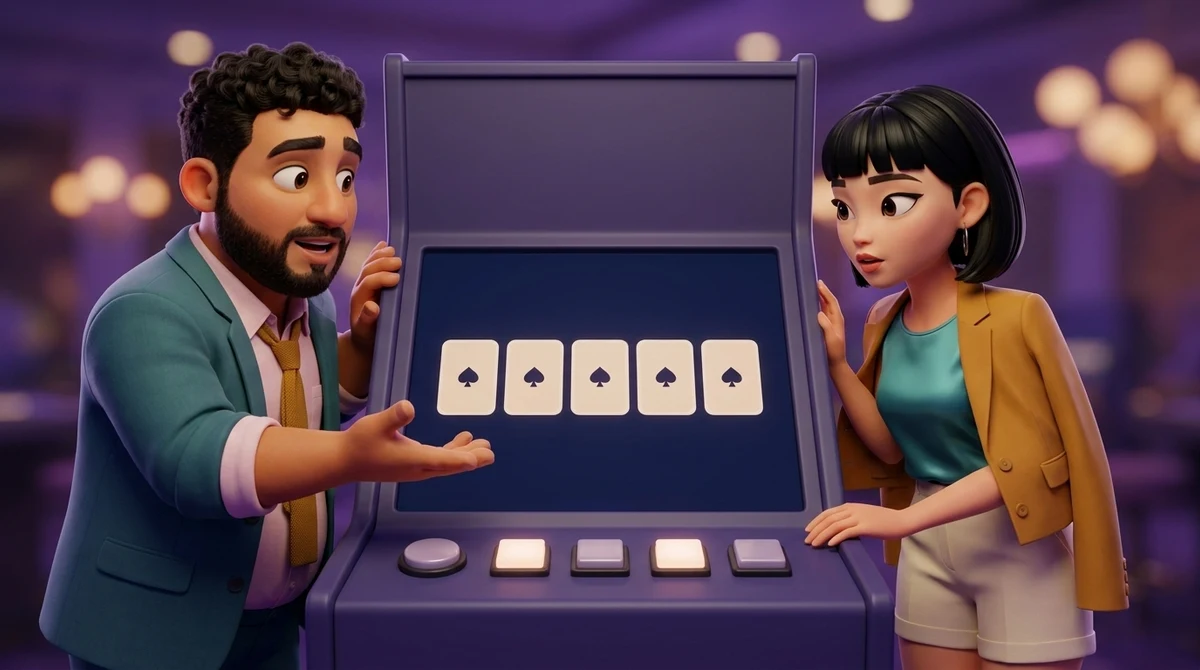
The video poker screen shows J♠ J♦ 2♠ 9♠ K♠. The deal already pays a pair of jacks, and four of the five cards are spades. Which cards do you hold?
The short answer
Hold the two jacks and nothing else. Counted over every possible draw, the pair of jacks is worth 1.537 a bet and the four spades are worth 1.255: a high pair is worth more than four to a flush. A deal that pays is usually worth keeping, but only the cards that pay: a spare card beside a pair costs money. The made hands worth breaking are few, and the plainest is a flush with four cards of a royal flush inside the flush.
Hold the pair of jacks
The deal is J♠ J♦ 2♠ 9♠ K♠. Held: J♠ J♦.
Hold the four spades
The deal is J♠ J♦ 2♠ 9♠ K♠. Held: J♠ 2♠ 9♠ K♠.
The deal is the same on both screens, and only the cards held over the deal change. The value under each screen is what that hold pays back on average, for each coin bet, over every draw that can follow.

Leoformer dealer · rules and maths
The deals worth slowing down for are the few where the made hand is worth less than a draw inside it: a flush with four cards of a royal flush in it, or a pair of jacks sitting in four cards to a straight flush. I ask people to look for those two before they press draw.
What already pays, and what a hold is worth
In Jacks or Better the lowest hand that pays anything is a pair of jacks, and a pair of jacks, queens, kings or aces is called a high pair. Any deal that holds a high pair or anything above a high pair is a made hand: the five cards pay before you draw a single new card.
| The made hand | Pays for each coin bet |
|---|---|
| Royal flush | 800 |
| Straight flush | 50 |
| Four of a kind | 25 |
| Full house | 9 |
| Flush | 6 |
| Straight | 4 |
| Three of a kind | 3 |
| Two pair | 2 |
| Jacks or better | 1 |
The pays come from the 9/6 table printed in an online version of the game’s rules; the name 9/6 is ours, after the table’s Full House and Flush lines. The royal flush pays more for each coin at a five-coin bet than at a smaller bet, and lesson 8.3 is about that difference. The machine in front of you prints its own table on its glass.
After the deal you choose which cards to hold, and every card you do not hold is replaced by a new card from the 47 cards left in the deck. What a hold is worth is the average of what every possible draw pays, for each coin bet.
- The dealJ♠ J♦ 2♠ 9♠ K♠Five cards, and the five cards already pay: a pair of jacks.
- The holdHold J♠ J♦The other three cards are thrown away, and three new cards replace them.
- Every draw1.537 betsAll 16,215 ways three new cards can come from the 47 cards left, each paid by the table, then averaged.
One deal, one hold, every draw. Each of the thirty-two ways to hold five cards gets a value the same way, and the hold with the largest value is the one worth making.
A high pair is worth more than four to a flush
Four spades look like a flush that needs one more card, but the pair of jacks is worth more, by 0.28 of a bet each time this deal comes up.
| The hand after the draw | Holding J♠ J♦of 16,215 draws | Holding J♠ 2♠ 9♠ K♠of 47 draws |
|---|---|---|
| Four of a kind | 45 | 0 |
| Full house | 165 | 0 |
| Flush | 0 | 9 |
| Three of a kind | 1,854 | 0 |
| Two pair | 2,592 | 0 |
| Jacks or better | 11,559 | 5 |
| Nothing that pays | 0 | 33 |
Every draw for the pair still pays at least a pair of jacks.
Other high pairs beside other draws come out the same way. In K♦ K♠ Q♦ J♦ 4♣ the pair of kings is worth 1.537 and the three diamonds to a royal flush are worth 1.488. In A♥ A♦ K♣ Q♠ J♥ the pair of aces is worth 1.537 and the four cards to a straight are worth 0.574.
Three cards to a royal flush look like the bigger chance, and the royal flush pays the most of any hand. The pair of kings is still worth more: the royal flush needs two exact cards, and the pair pays on every draw.
A kicker beside the paying cards costs money
A kicker is a card held beside a pair that pays nothing by itself, like the king next to A♠ A♦ in A♠ A♦ K♣ 7♥ 2♠. The pair alone is worth 1.537; the pair and the king are worth 1.416, which is 0.12 of a bet less each time this deal comes up.
Hold the pair alone
The deal is A♠ A♦ K♣ 7♥ 2♠. Held: A♠ A♦.
Hold the pair and the king
The deal is A♠ A♦ K♣ 7♥ 2♠. Held: A♠ A♦ K♣.
Hold the pair and the seven
The deal is A♠ A♦ K♣ 7♥ 2♠. Held: A♠ A♦ 7♥.
The deal is the same in all three pictures, and only the cards held over the deal change. Every card held beside the pair is one new card fewer, and three new cards make three of a kind, a full house or four of a kind more often than two new cards do.
The same holds for the other made hands in the table below: keep the cards that pay, and let the spare card go. Two pair keeps four cards and draws one; three of a kind keeps three cards and draws two.
| The made hand | Keep only the cards that pay | Keep one more card | Keep all five |
|---|---|---|---|
| A high pairA♠ A♦ K♣ 7♥ 2♠ | 1.537A♠ A♦ | 1.416A♠ A♦ K♣ | 1.000 |
| Two pair4♣ 4♦ Q♣ Q♥ 7♠ | 2.5964♣ 4♦ Q♣ Q♥ | keeping one more card is keeping all five | 2.000 |
| Three of a kind9♥ 9♦ 9♣ 5♠ K♠ | 4.3029♥ 9♦ 9♣ | 3.8519♥ 9♦ 9♣ K♠ | 3.000 |
In every row the left-hand value is the largest.
When a made hand is worth breaking
Sometimes the made hand is the thing to let go. A♠ K♠ Q♠ J♠ 3♠ is a flush, and a flush pays 6 for each coin bet. The same five cards hold four cards to a royal flush: throw away the 3♠ and the one new card can make a royal flush, a flush, a straight or a high pair.
Hold four to a royal flush
The deal is A♠ K♠ Q♠ J♠ 3♠. Held: A♠ K♠ Q♠ J♠.
Keep the flush
The deal is A♠ K♠ Q♠ J♠ 3♠. Held: A♠ K♠ Q♠ J♠ 3♠.
The flush pays the moment the five cards are kept. Four to a royal flush gives the flush up for a draw worth 18.43 a bet on average, against the 6.000 the flush pays: the draw is worth more, even though most single draws pay less than the flush.
Keeping the made flush gives up 12.4 bets each time A♠ K♠ Q♠ J♠ 3♠ comes up. On an example bet of $1.25, five coins of $0.25, that is $15.53 each time; the bet is only an example, not a suggested bet. Amounts are in Canadian dollars.
A draw to a straight flush is worth breaking a high pair for, and it is not worth breaking a made flush or a made straight for. Four cards to a straight flush pay nothing yet, so the made hand they sit beside decides.
J♣ J♠ 10♠ 9♠ 8♠ pays jacks or better
- Four to a straight flush: J♠ 10♠ 9♠ 8♠3.574
- A high pair: J♣ J♠1.537
9♠ 8♠ 7♠ 6♠ 2♠ pays flush
- Keep the flush: 9♠ 8♠ 7♠ 6♠ 2♠6.000
- Four to a straight flush: 9♠ 8♠ 7♠ 6♠3.404
5♥ 6♥ 7♥ 8♥ 9♣ pays straight
- Keep the straight: 5♥ 6♥ 7♥ 8♥ 9♣4.000
- Four to a straight flush: 5♥ 6♥ 7♥ 8♥3.447
Each block is one deal, and the longer bar is the hold worth more in that deal.
What the printed summary and the screen tell you
An online version of the game’s rules prints a short summary of holds for the 9/6 table: four cards to a royal flush first, then a full house or a flush, then a high pair, then three cards to a royal flush, then four cards to a flush. Beside each line stands how many cards to keep, and no value.
| The line of the summary | How many cards it keeps | Worth, held from one deal in this lesson |
|---|---|---|
| Four cards to a royal flush | keep four cards | 18.43held from A♠ K♠ Q♠ J♠ 3♠ |
| A full house or a flush | keep all five cards | 6.000held from A♠ K♠ Q♠ J♠ 3♠ |
| A high pair, jacks to aces | keep two cards | 1.537held from J♠ J♦ 2♠ 9♠ K♠ |
| Three cards to a royal flush | keep three cards | 1.488held from K♦ K♠ Q♦ J♦ 4♣ |
| Four cards to a flush | keep four cards | 1.255held from J♠ J♦ 2♠ 9♠ K♠ |
Wherever two of these lines meet in one deal in this lesson, the line higher in the summary is worth more.
Under the standard for machines in B.C. casinos, held cards and cards not held have to be clearly marked on the screen, and that includes holds the machine itself suggests, where suggesting a hold is allowed. The standard says how a hold has to be shown, and nothing about which hold is worth the most.

Mayaformer floor supervisor · manners, money and breaks
Knowing the right hold makes every hand a little cheaper, and every hand still costs money: even played without a single mistake, the machine keeps a share of what goes through it. Practise holds at home with the trainer on this page, not with money in the machine.
Decide before you sit down how much money and how much time the session gets, and stop when either one runs out. A hand that went wrong is not a reason to put more in.
If it stops being fun
If gambling stops being entertainment, help is available. 19+ in most of Canada; 18+ in Alberta, Manitoba and Quebec. More on responsible gaming.
Practice: which hold?
Every deal in the practice run already pays. Level 1 deals a high pair or two pair, with a draw or a spare card beside the paying cards. Level 2 deals a made hand beside a draw, and the question is whether the made hand is worth breaking.
Nothing is bet here, and nothing is drawn: each deal stops at the moment you choose the hold.
Lesson done
Review my mistakes (0)
Progress stays in this browser; nothing is sent anywhere.
The practice table needs JavaScript. Here is one deal from it, with the answer.
Level 1 · A high pair and a draw
This deal pays: Jacks or better
9/6 Jacks or Better · five coins bet
This deal already pays. Which cards do you hold before the draw?
- A high pair: J♠ J♦ Worth 1.537 a bet on average over every draw; no other hold of J♠ J♦ 2♠ 9♠ K♠ is worth more. The pair pays as it stands, and three new cards can only add to the pair.
- Four to a flush: J♠ 2♠ 9♠ K♠ Worth 1.255 a bet on average over every draw: 0.28 of a bet less than holding a high pair (J♠ J♦), each time this deal comes up. Four to a flush pays nothing until a fifth card of the suit comes.
- A high pair and a kicker: J♠ J♦ K♠ Worth 1.416 a bet on average over every draw: 0.12 of a bet less than holding a high pair (J♠ J♦), each time this deal comes up. A kicker takes the place of a new card, so the paying cards draw fewer cards toward a bigger hand.
A high pair already pays, and three new cards can still turn the pair into two pair, three of a kind, a full house or four of a kind. Four to a flush pays nothing until a fifth spade comes.
Level 2 · Break it or keep it
This deal pays: Flush
9/6 Jacks or Better · five coins bet
This deal already pays. Which cards do you hold before the draw?
- Keep the flush: A♥ K♥ Q♥ J♥ 4♥ Worth 6.000 a bet on average over every draw: 12.4 of a bet less than holding four to a royal flush (A♥ K♥ Q♥ J♥), each time this deal comes up. Keeping all five takes what the deal pays now and gives up the draw.
- Two to a royal flush: A♥ K♥ Worth 0.479 a bet on average over every draw: 17.9 of a bet less than holding four to a royal flush (A♥ K♥ Q♥ J♥), each time this deal comes up. Cards to a royal flush still need the draw to finish a royal flush, and on most draws they finish far less.
- Four to a royal flush: A♥ K♥ Q♥ J♥ Worth 18.43 a bet on average over every draw; no other hold of A♥ K♥ Q♥ J♥ 4♥ is worth more. Four to a royal flush gives up what the deal pays now for a draw worth more on average.
The flush pays 6 for each coin bet. Throw away the four of hearts and the one new card can still make a royal flush, a flush, a straight or a high pair, and on average that draw is worth more than three times what the flush pays.
Every deal in the practice run is worked out the same way: all thirty-two ways to hold the five cards are counted over every possible draw, and the hold worth the most is the answer.
How the practice run works
Where the answers come from. Every deal is a set of five cards chosen to show one thing, and the answer is worked out when the page is built: all thirty-two ways to hold the five cards are counted over every possible draw on the 9/6 table at five coins, and the hold worth the most is the answer. The wrong answers are named mistakes — a kicker kept beside the paying cards, all five kept when a draw is worth more, a draw kept when the made hand is worth more — and each one shows what it is worth and how much less than the answer.
One strip, and no rounds. Every square on the strip is one deal of this lesson, and all of the squares are there from the start. Your first answer fills the square it belongs to; when the squares of one level are full, the next level begins by itself, with no button in between. Practising a deal you got wrong turns its cross into “fixed in practice” and does not change the count, because only first answers count.
Your progress stays in this browser, and nothing is sent anywhere.
Check yourself

Mayaformer floor supervisor · manners, money and breaks
Five quick ones. Pick an answer, then check it. No timer, no points: just whether it stuck.
Back to the question we opened with. In J♠ J♦ 2♠ 9♠ K♠ hold the two jacks and nothing else: the pair of jacks is worth 1.537 a bet, and the four spades are worth less.
Further reading
19+ (18+ in AB, MB, QC) · Play responsibly · the helplines are further up this page
Further reading
- Jacks or Better: game rules (online version) · Loto-QuébecA full pay table by number of chips and a printed holding strategy, from Loto-Québec’s online casino.
How it’s worked out
Tables, numbers, sources and hosts
Where this happens. Every machine on this page is a video poker machine in a room you can walk into. The 9/6 table, the lowest hand that pays and the printed summary of holds come from an online version of the game’s rules: no Canadian document we could read prints the pay table of a video poker machine on a casino floor, or which cards to hold on one. The glass of the machine in front of you is where that machine’s own table is printed, and the values here hold only for a table with the same lines.
Numbers. Every value on this page is counted over every possible draw: for one deal and one hold, each way the new cards can come from the cards left is paid by the 9/6 table at a five-coin bet, and the average for each coin bet is the value of the hold. The counts are exact fractions, printed rounded; the counts of draws are whole numbers. Every figure carries a machine-readable key and is recomputed by the same engine on every build.
What rests on the count alone. “Never keep a kicker” is not printed as a rule by any operator or regulator we could read; the rule rests on the values in this lesson. The printed summary gives an order of holds and the number of cards each keeps, and no values; the values are ours.
What is deliberately absent. There is no return of the whole table here and no comparison of pay tables: that is lesson 8.2. Coins, denominations and the royal flush paying more at five coins are lesson 8.3. Deals that pay nothing — a low pair, single high cards, drawing five new cards — are lesson 8.5. Deuces Wild is lesson 8.6. What mistakes cost over a hundred hands is lesson 8.7, and the myths about machines being due are lesson 8.8. How a hand is dealt, held and drawn is lesson 8.1. Nothing here is counted per hour.
Sources. Every claim on this page carries a button with the sentence it rests on, the publisher who wrote that sentence and the date we read it.
Hosts. Leo and Maya are illustrated characters. Their backstories, a former dealer and a former floor supervisor, are written for the course: neither is a real person, and neither speaks for any casino. The rules and numbers on this page come from the sources it cites, not from their experience.
No promise. Video poker is played against the house. Choosing the hold worth the most makes each hand cost less than a careless hold would; nothing on this page turns the game in your favour, and nothing here says how a session at a machine would end.
The lowest hand that pays
The lowest winning hand is a pair of Jacks.
Pair of Jacks or better: pair of Jacks, Queens, Kings or Aces.
Loto-Québec (online version) · Jacks or Better — game rules · read
The 9/6 pay table, online version
Hands X1 X2 X3 X4 X5
Royal Flush 250 500 750 1000 4000
Straight Flush 50 100 150 200 250
Four of A Kind 25 50 75 100 125
Full House 9 18 27 36 45
Flush 6 12 18 24 30
Straight 4 8 12 16 20
Three of A Kind 3 6 9 12 15
Two Pair 2 4 6 8 10
Pair of Jacks or Better 1 2 3 4 5
Loto-Québec (online version) · Jacks or Better — game rules · read
The printed summary of holds, online version
Player's Hand Cards to Hold
4/5 of Royal Flush 4
Full House 5 Flush 5
High Pair (JJ-AA) 2
3/5 of Royal Flush 3
4/5 of Flush 4
Loto-Québec (online version) · Jacks or Better — game rules · read
How a machine in B.C. marks holds
Held and non-held cards, including recommended holds where allowed, shall be clearly marked on the screen.
Section 4.7.3 Poker Game Requirements, b) and c)
Spotted a mistake on this page? Tell us
Been here before? Review us on Trustpilot